Three Days In Padua: Adding The Euganean Hills Or The Brenta
Three days in Padua cover the Scrovegni Chapel, the Basilica of Saint Anthony, the Orto Botanico and the university's anatomical theatre, with a third day for the Euganean Hills or the Brenta Riviera.
Short answer
Spend day one on the Scrovegni Chapel and the Eremitani, day two on the Santo, Prato della Valle and the Orto Botanico, and day three in the Euganean Hills or on the Brenta Riviera. The Scrovegni Chapel is timed entry only, at most 25 people every 15 minutes, and closes 16 to 27 November 2026 for its annual fresco inspection.
Padua (Italian: Padova) is an inland city in the Veneto, northern Italy, about 36 km in a straight line from Venice, and three days is the point at which the city stops being a sprint and starts being a place. One day buys you the Scrovegni Chapel and a fast loop of the centre, a plan covered in Padua In One Day. Two days, as laid out in Padua In Two Days, adds the Orto Botanico and the university. Three days adds something the shorter plans cannot: a whole day outside the walls, in the Euganean Hills or on the Brenta Riviera, without giving up a single headline sight in town.
This itinerary is written by the Padua Travel Guide editorial desk from what the primary sources themselves state: the chapel's own booking site, the civic museums' price page, the FAI's Villa dei Vescovi page and the Busitalia fare table. Every price below comes from one of those. Where a figure sits with an operator, the page says so and leaves it there.
What Does Three Days In Padua Give You That One Day Cannot?
Three days in Padua let you book the Scrovegni Chapel at a civilised hour instead of taking whatever slot is left, see the two UNESCO listings properly, walk the Prato della Valle and the markets at their real hours, and still hold a full day for the Euganean Hills or the Brenta Riviera, both under 26 km in a straight line from the centre, without a single rushed morning. The one-day visitor trades all of that for a compressed loop. The difference is not more sights per hour, it is fewer sights per day done at the pace the city actually runs.
The single most consequential fact for a three-day plan is the Scrovegni Chapel's entry system. The chapel's own booking page states timed entry of at most 25 people every 15 minutes, about 15 minutes inside, arrival five minutes before the slot, and no same-day online booking. Slots run 9:00 to 19:00 with last entry 18:45, and advance slots are bookable until 10 February 2027 through the chapel's site or the call centre on +39 049 2010020. A three-day trip means you can pick a morning on day one, when the daytime ticket also covers the Musei Civici Eremitani and Palazzo Zuckermann, rather than grabbing a leftover late slot between other bookings.
| Resource | One-day trip | Three-day trip |
|---|---|---|
| Scrovegni Chapel slot | Whatever is left that day | Chosen days or weeks ahead |
| UNESCO listings seen | Scrovegni, maybe the Orto Botanico | Both, plus the Urbs Picta satellites |
| Prato della Valle | A walk-by at best | A morning with the Saturday market if timed |
| Day outside the city | Not possible | Full day: hills or Brenta |
| Museums at full hours | One or two | Eremitani, Zuckermann, Palazzo del Bo, Palazzo della Ragione |
The chapel also closes 16 to 27 November 2026 for its annual fresco inspection by the Istituto Centrale per il Restauro, so a trip in late November should move the chapel to another day entirely or lean on Padua In The Rain alternatives. The two UNESCO listings are worth naming precisely, because plenty of guides compress them into one: the Orto Botanico, inscribed in 1997, founded 1545, and Padova Urbs Picta, the fourteenth-century fresco cycles across eight complexes, inscribed in 2021. Three days is enough to see both and still reach four or five of the eight fresco complexes.
If you are coming from Venice for the whole stay rather than a day, One Day In Padua From Venice explains the morning train logic; the regional run is about 26 to 40 minutes at about EUR 5, per the published schedules, and Padua As A Base For Venice covers the reverse plan.
How Should You Structure Day One In Padua?
Day one belongs to the frescoes: book the Scrovegni Chapel for 9:00, arrive five minutes early for the climate-controlled waiting room, spend your 15 minutes inside, then use the same daytime ticket for the Musei Civici Eremitani and Palazzo Zuckermann, walk to the Basilica of Saint Anthony for the free-entry tomb visit, and end on Piazza delle Erbe and Piazza dei Frutti as the market stalls close or the evening aperitivo begins. That order runs west to east through the historic centre and keeps every stop within a walkable core.
The morning is fixed by the chapel's rules, not by preference. The ticket is EUR 15 full, EUR 11 reduced, EUR 5 for Padua residents, plus a EUR 1 booking fee, and the museums-only version without the chapel is EUR 11 or EUR 9. The daytime ticket's museum coverage is the part worth exploiting: the Eremitani complex sits about 100 m from the chapel entrance, and Palazzo Zuckermann, Tue to Sun 10:00 to 19:00, holds the applied arts and Bottacin collections. Book the earliest slot you can and the museums fill the rest of the morning naturally.
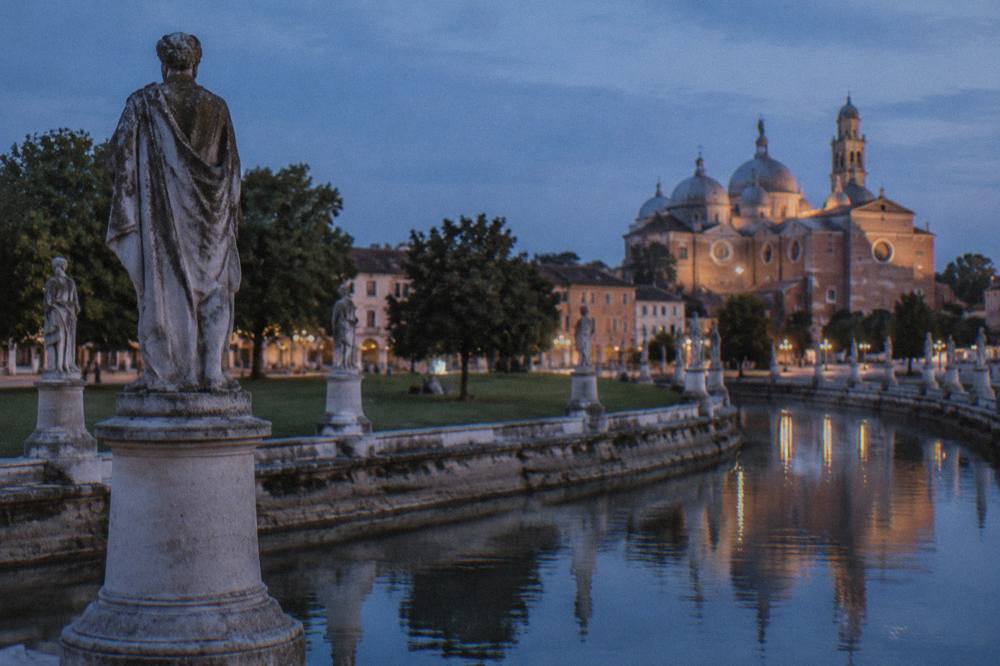
Afternoon one is the Santo. The Basilica of Saint Anthony has free entry, per the Urbs Picta visiting page, and holds the Saint's tomb and the Chapel of the Relics; the Basilica's own regulation page states a dress code suitable for a church environment, and no visits run during functions. Donatello's equestrian Gattamelata stands in the piazza outside, and the Scuola del Santo and Oratorio di San Giorgio cluster beside the basilica, part of the 2021 UNESCO inscription. The detailed sight-by-sight breakdown lives at Basilica Di Sant'Antonio and the wider square plan at Santo And Prato.
| Time | Stop | Ground truth |
|---|---|---|
| 9:00 | Scrovegni Chapel slot | EUR 15 full + EUR 1 fee, 15 min inside, 25 people per slot |
| 10:00 | Musei Civici Eremitani | Included in daytime ticket, daily 9:00 to 19:00 |
| 11:30 | Palazzo Zuckermann | Included, Tue to Sun 10:00 to 19:00 |
| 15:00 | Basilica of Saint Anthony | Free entry, no visits during functions |
| 17:00 | Piazza delle Erbe and Piazza dei Frutti | Market Mon to Fri to 13:30, Sat to 20:00 |
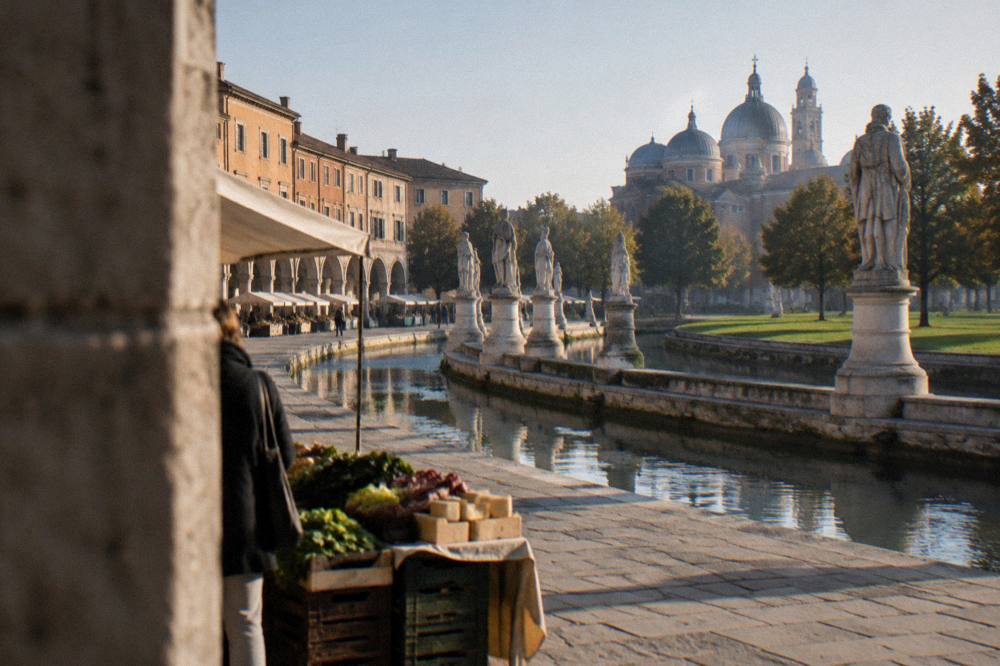
Close the day in the market squares. The Comune di Padova's market page lists Piazza delle Erbe, 52 stalls of fruit, vegetables and flowers, running Monday to Friday 7:30 to 13:30 and Saturday 7:30 to 20:00, with Piazza dei Frutti alongside it. The evening scene around these squares is the spritz heart of the city, a subject with its own page at Spritz In Padua: Aperol was created in Padua in 1919 by the Barbieri brothers, per the company histories, which is about as local a claim to the drink as exists.
A walking guide changes how much of day one lands, and there are several ways to buy one covered on Padua Walking Tour.
What Belongs On Day Two In Padua?
Day two is the university and gardens day: start at Palazzo del Bo for the guided historical circuit through the 1594 anatomical theatre and Galileo's chair, continue to the Orto Botanico, whose ticket is EUR 15 full from 1 September 2026, cross to Palazzo della Ragione and the Sotto il Salone market beneath it, then spend the late afternoon at Prato della Valle and the Caffe Pedrocchi, with flexibility for any Urbs Picta site missed on day one. It is a slower day by design, because day one runs on chapel clocks.
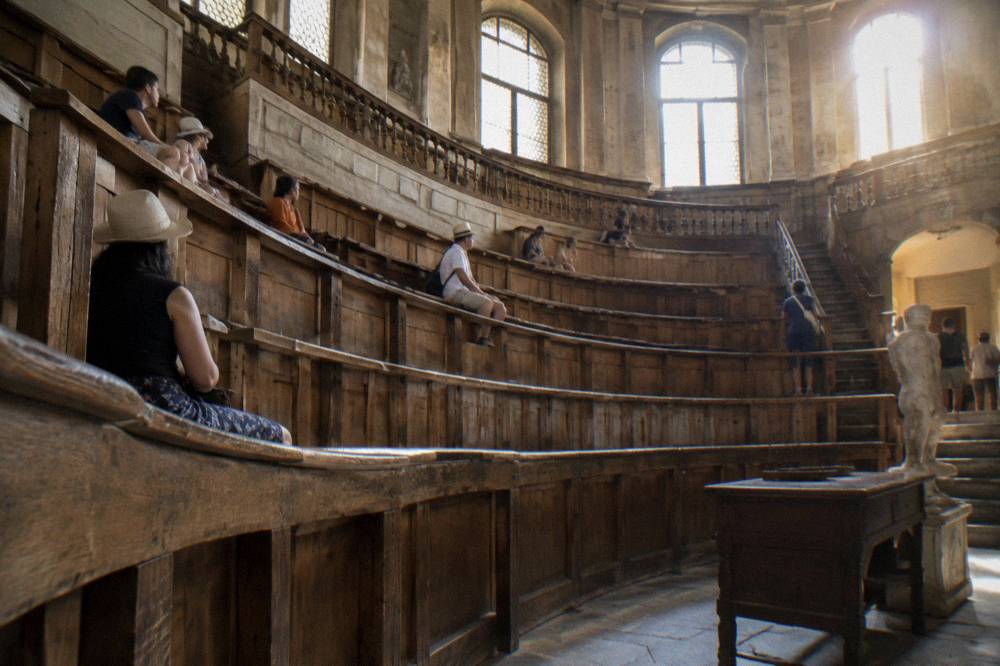
Palazzo del Bo's own page sets the terms: the "Giro storico" guided visit costs EUR 10 full, EUR 8 reduced, EUR 6 for ages 6 to 25, lasts about 45 minutes, and runs alternating Italian and English slots such as 12:30 Italian, 13:30 English, 15:30 Italian. The route covers the Aula Magna, Galileo's chair in the Sala dei Quaranta, the anatomical theatre of 1594, described by the university as the first permanent anatomical theatre, and the statue of Elena Cornaro Piscopia, who graduated in philosophy on 25 June 1678 as the first woman university graduate. Galileo held the chair of mathematics here from 1592 to 1610, years he called the best eighteen of his life, per the university's own history pages. Booking runs through the university centre on 049 827 3939.
The Orto Botanico is a short walk away, and the 2026 price change matters: from 1 September 2026 the full ticket is EUR 15 for ages 26 to 64, EUR 12 in winter, November to February, with EUR 10 reduced for 65 and over and Padua province residents, EUR 8 winter reduced. Hours shift seasonally, October from 10:00 to 18:00 and from 24 October 10:00 to 17:00, closed non-holiday Mondays, and the garden closes 25 December while opening 8 December. The audioguide is included, and fixed-time guided tours run on weekends and holidays. Founded in 1545 and inscribed by UNESCO in 1997, it is the world's first university botanical garden in the university's own wording.
| Day-two stop | Price | Key constraint |
|---|---|---|
| Palazzo del Bo Giro storico | EUR 10 full / EUR 8 / EUR 6 | Fixed language slots, about 45 min, book ahead |
| Orto Botanico | EUR 15 full from 1 Sept 2026, EUR 12 winter | Closed non-holiday Mondays |
| Palazzo della Ragione | EUR 8 full / EUR 6 reduced | Tue to Sun 9:00 to 19:00, tickets at IAT Piazza delle Erbe 52 |
| Prato della Valle | Free | Saturday market 8:00 to 19:00 winter, to 20:00 summer |
| Museums pass caveat | City-card prices unstated here | Scrovegni needs its own timed booking either way |
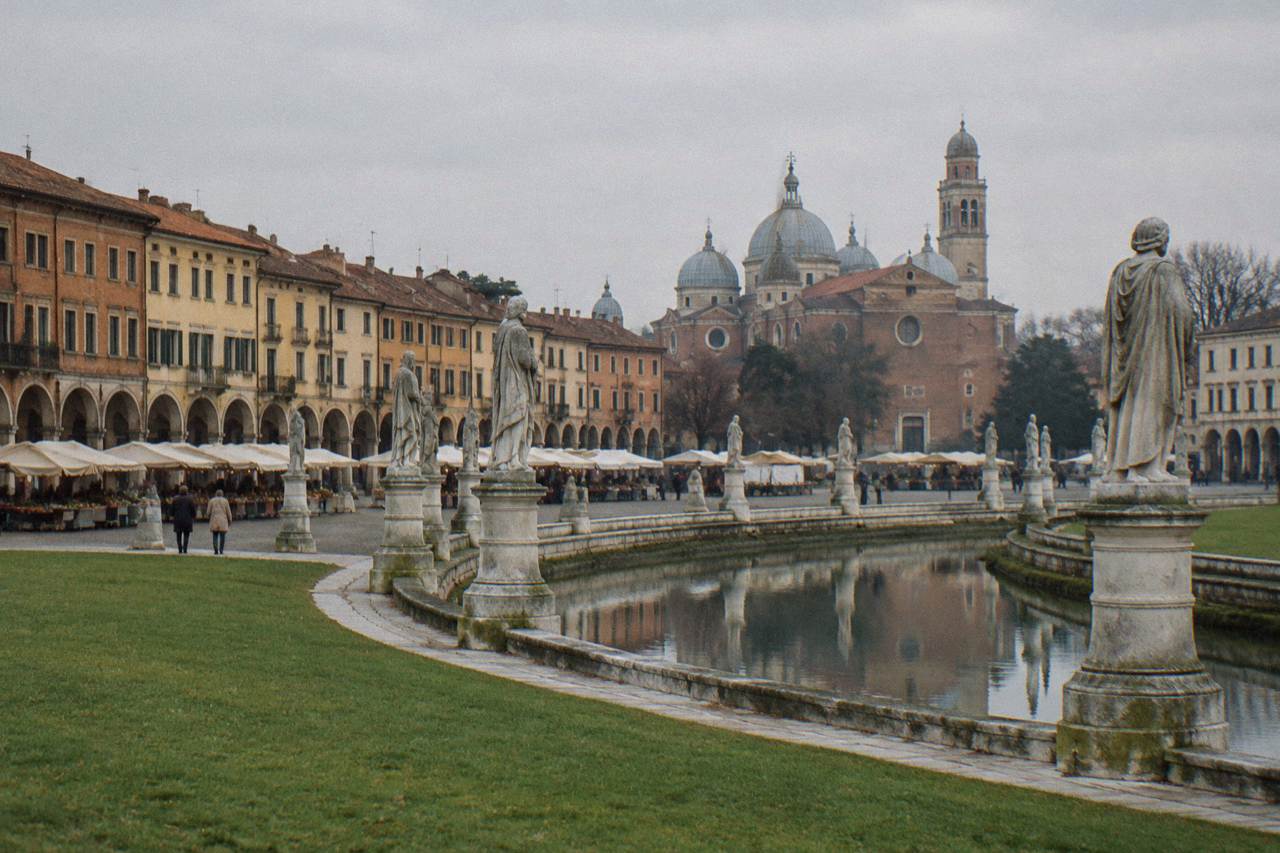
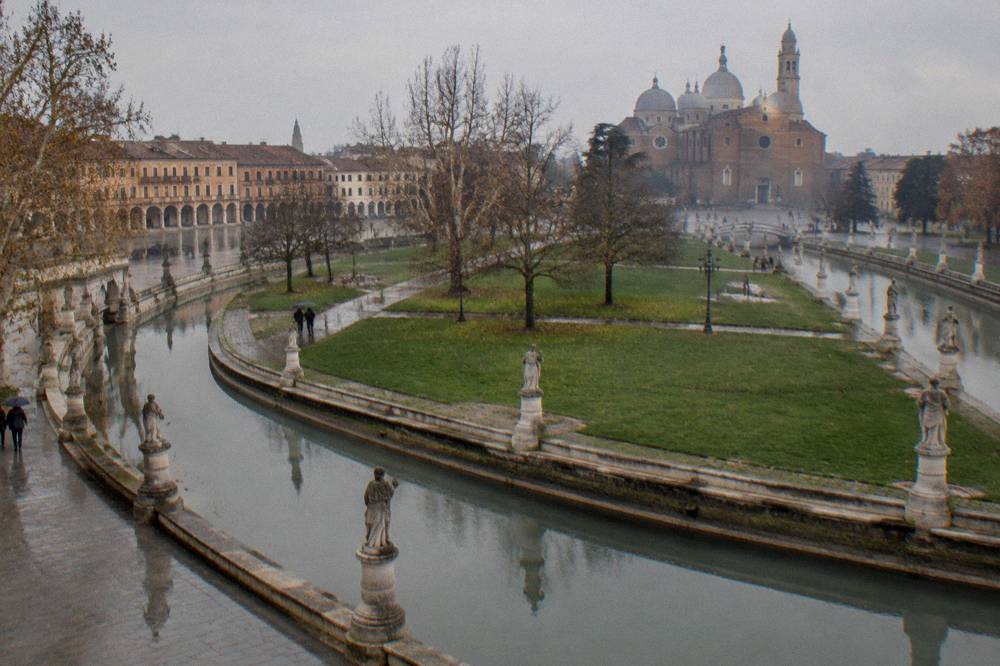
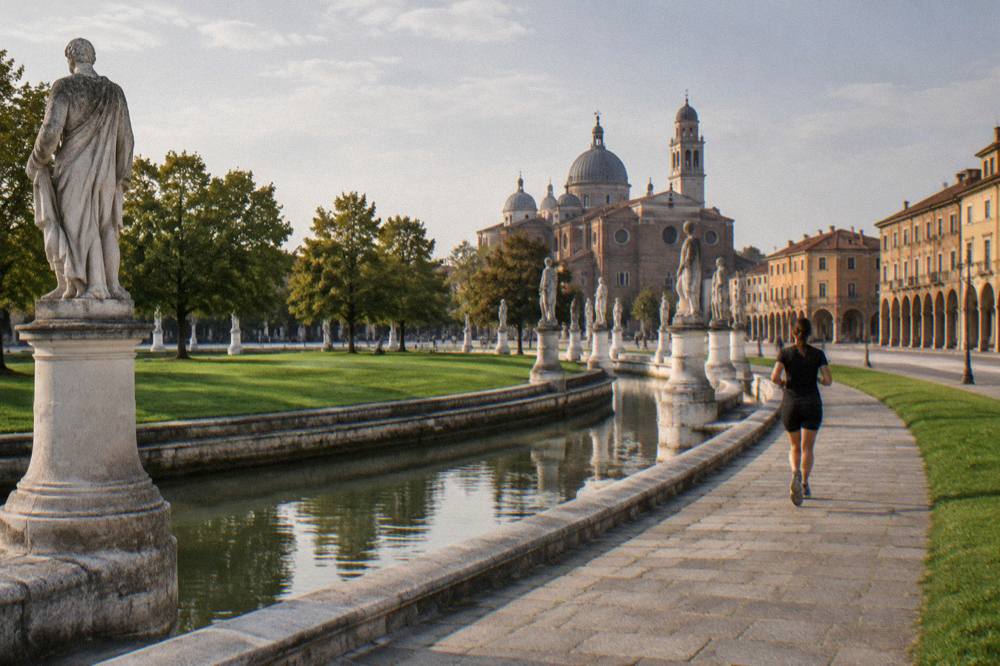
Prato della Valle deserves the late-afternoon slot. The square's own listing on the tourism board's site describes the canal, the double ring of numbered statues of famous people, and the Venetian Senate's 1767 declaration of the space as communal, reclaimed under Andrea Memmo. The Saturday market fills it from 8:00 to 19:00 in winter and 8:00 to 20:00 in summer, per the Comune's market page, and the antiques market takes the square and via Umberto I every third Sunday of the month. If your day two is a Saturday, consider swapping the order and doing Prato in the morning. The full sight guide is at Prato Della Valle.
End under Caffe Pedrocchi's neoclassical rooms, opened in 1831, with the story, reported by the tourism board, that it stayed open around the clock until 1916. For the centre's overall geography, Padua Map and Centro Storico hold the street-level detail.
A cooking class is the other strong evening move on day two, since Paduan home cooking is otherwise hard to reach as a visitor.
Should Day Three Be The Euganean Hills Or The Brenta Riviera?
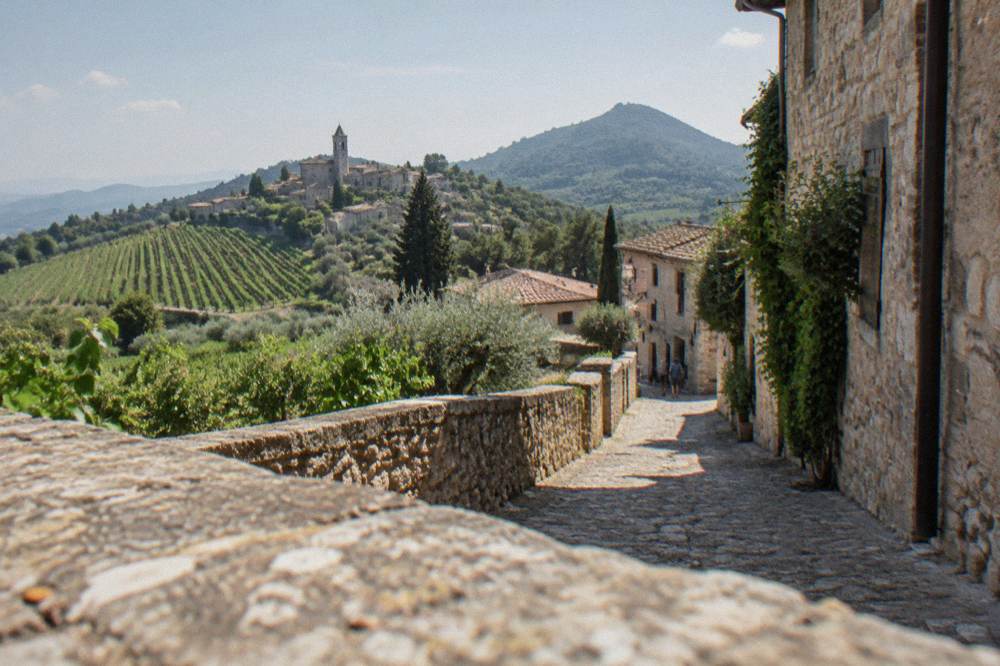
Day three should be the Euganean Hills if you want wine, olive oil and hill villages by car or guided minibus, with Villa dei Vescovi at EUR 11 and Casa del Petrarca at EUR 6 as anchor stops, and the Brenta Riviera if you want Palladian and Venetian villas along the river, with Villa Pisani's famous maze at Stra and an Il Burchiello boat option that runs between Padua and Venice from March to October. Both sit under 26 km in a straight line from the centre, and the choice is about texture, not distance.
The hills run closer: Abano Terme about 8 km, Montegrotto Terme about 11 km, Villa dei Vescovi about 15 km, Arquà Petrarca about 20 km, Monselice about 21 km, Este about 26 km, all straight-line figures. Villa dei Vescovi, the FAI property in Luvigliano di Torreglia, charges EUR 11 adults, EUR 6 for ages 6 to 18 and students to 26, free under 6, EUR 28 family, per the FAI's own page, with seasonal opening you should check before setting out. Casa del Petrarca in Arquà Petrarca is EUR 6 full, EUR 4 reduced, EUR 3 school, closed non-holiday Mondays plus 8 December, 25 and 26 December and 1 January. The full regional picture is on Euganean Hills, with village pages at Arquà Petrarca, Monselice and Este.
The Brenta runs east toward Venice: the Mira stretch of the Riviera is about 21 km in a straight line, and Villa Pisani at Stra about 11 km. The villa's own site describes its maze as among the most important in Europe, with timed or limited access announced; check the current price on the official ticket page before booking. Il Burchiello, the historic boat service, runs Padua to Venice and back along the Brenta from March to October, per the operator's site, and the river-villa landscape is laid out on Brenta Riviera and Villa Pisani. A boat-and-villa day also pairs naturally with the plan in Padua Weekend With Venice.
| Day-three choice | Anchor stops | Straight-line distance | Entry figures |
|---|---|---|---|
| Euganean Hills | Villa dei Vescovi, Arquà Petrarca, Montegrotto | 8 to 26 km | EUR 11 villa, EUR 6 Petrarca |
| Brenta Riviera | Villa Pisani at Stra, river villas, Il Burchiello | 11 to 21 km | Check prices on official pages |
| Split option | Hills morning, Brenta afternoon | Not practical in one day by design | Pick one |
Without a car, the hills are the harder of the two to stitch together by bus, and that is exactly where a guided trip earns its price. The From Padua: Olive Oil & Wine in the Euganean Hills outing covers an olive mill and winery stops in the hills with transport from the city, and it is the featured pick for this itinerary; the details and the operator's live listing carry the current price and dates, or Check availability directly. A shorter alternative that stays closer to town is the winery visit and tasting in the Padua hills, a single-vinery stop of about 75 minutes.
What Does A Three-Day Padua Trip Cost?
The core sighted entries for a three-day Padua trip are the EUR 16 Scrovegni daytime ticket with its booking fee, EUR 10 for Palazzo del Bo, EUR 15 for the Orto Botanico, EUR 8 for Palazzo della Ragione, and EUR 11 plus EUR 6 for the two hills anchors, while the Basilica of Saint Anthony, Prato della Valle and the markets cost nothing, so the paid-sight budget is simply the sum of the ticketed stops you choose, before food, lodging and any day-three tour or boat fare. The itemised table below does the arithmetic line by line.
| Item | Full price | Note |
|---|---|---|
| Scrovegni Chapel, daytime | EUR 15 + EUR 1 fee | Also covers Eremitani museums and Palazzo Zuckermann |
| Palazzo del Bo, guided | EUR 10 | Reduced EUR 8 and EUR 6 |
| Orto Botanico | EUR 15 | From 1 Sept 2026; EUR 12 winter |
| Palazzo della Ragione | EUR 8 | EUR 6 reduced; tickets at IAT Piazza delle Erbe 52 |
| Villa dei Vescovi | EUR 11 | EUR 6 ages 6 to 18 and students to 26 |
| Casa del Petrarca | EUR 6 | Closed non-holiday Mondays |
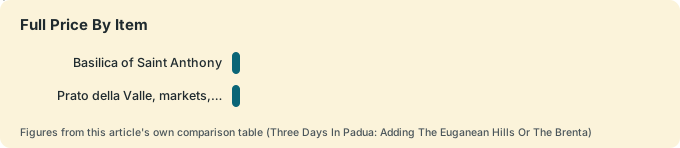
| Basilica of Saint Anthony | Free | Dress code suitable for a church |
| Prato della Valle, markets, squares | Free | Saturday market to 19:00 or 20:00 |
Two warnings from the correction log. A city card exists in Padua in several forms, and its prices and inclusions change; whatever card you consider, the Scrovegni Chapel still needs its own timed booking with its EUR 1 fee, per the chapel's own booking page. And the Orto Botanico's EUR 10 price you may remember from older guides was replaced on 1 September 2026 by the EUR 15 tariff. Food and lodging are genuinely variable and this page prints no hotel or restaurant figures; the per-person tourist tax exists, is collected by your accommodation, and is capped at five consecutive nights, per the Comune di Padova's tax page.
What Should You Eat Across Three Days In Padua?
Across three days in Padua, build meals around the city's own named dishes, the tourism board's three patented Paduan recipes, risotto ricco alla Padovana, cappone alla canevera and torta pazientina, plus bigoli, baccalà and gallina padovana, sourced from the Sotto il Salone market beneath Palazzo della Ragione, which the board describes as a covered food market of some eight centuries, and around the evening aperitivo squares rather than any single named restaurant, none of which this page endorses. The market-under-the-palace is the structural food fact of the city.
The Sotto il Salone sits beneath Palazzo della Ragione and carries local products daily; its October food event, the Salone dei Sapori, ran 11 to 18 October 2026 in the latest edition, reported by local press as eight days of regional food and wine. The daytime squares do the rest: Piazza delle Erbe and Piazza dei Frutti are working markets, not set dressing, with hours set by the Comune. For the full dish-by-dish account, see What To Eat In Padua; for the evening drink culture, Padua Nightlife covers the squares.
A guided food walk compresses the learning curve on day one, and the market-to-osteria format with a local guide and tastings is described on Padua Food Tour. The spritz itself has a Paduan stamp: Aperol was created and presented in Padua in 1919 by the Barbieri brothers, per the brand histories, and the guided spritz walks in the city take that story bar to bar. No page on this site names the best restaurant, since no such verdict can be made without eating everywhere.
What If It Rains During Your Three Days In Padua?
If it rains during your three days in Padua, the plan barely bends: the Scrovegni visit is 15 minutes between the climate-controlled waiting room and the chapel, Palazzo della Ragione, the Eremitani museums, Palazzo Zuckermann, Palazzo del Bo and the Sotto il Salone market are all under roofs, and the ERA5 reanalysis, 1991-2020, shows November as the month with the highest rain total at 114 mm, with September and October near 105 mm each, so an autumn three-day plan should expect at least one wet block. Summer rain is heavier per event but the totals drop, with July at about 62 mm.
| Month block | Mean high C | Rain mm | Three-day planning note |
|---|---|---|---|
| Jan to Feb | 7.3 to 9.4 | 53.6 to 57.9 | Cold and damp; Orto Botanico on winter hours |
| Mar to May | 13.7 to 22.1 | 67.2 to 99.7 | Chapel evening visits run from 25 March |
| Jun to Aug | 26.2 to 28.8 | 62.1 to 81.0 | Evening chapel slots 19:00 to 22:00 to 1 Nov |
| Sep to Nov | 23.6 down to 12.6 | 105.4 to 114.0 | Highest-rainfall stretch; two museum days is the safer order |
| Dec | 7.8 | 69.9 | Chapel closed 16 to 27 Nov only; garden closed 25 Dec |
All figures are ERA5 reanalysis, 1991-2020, a modelled grid cell for the centre of Padua, not a weather-station record, and sunshine data is not part of that table. The practical read for a wet day is already built into the itinerary: Palazzo del Bo's guided circuit is indoors, the Eremitani and Zuckermann collections are covered by the chapel ticket anyway, and the covered market does not care about the sky. The full wet-weather plan, with the churches that hold frescoes worth an hour of rain, is on Padua In The Rain, and family-specific rearrangements are on Padua With Kids.
How Do You Get Around Padua And The Hills In Three Days?
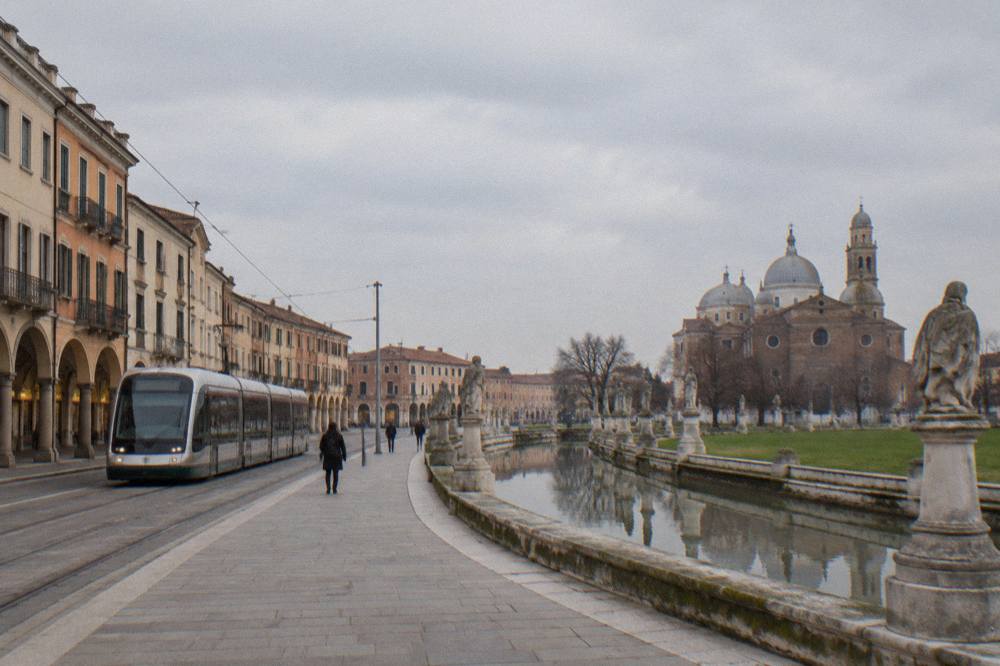
Inside Padua you walk or ride the tram and buses with a EUR 1.70, 90-minute urban ticket, or tap a contactless card on board at the same fare, per Busitalia's own fare page; the SIR1 tram already runs the north-south axis while the SIR3 line remains in testing with no opening date to promise. For day three you take a regional train, a Busitalia hill line, a guided trip with transport included, or the EUR 13 airport-bus link if your timing suits it. A car is optional for day three and unnecessary for days one and two.
Urban fares are the EUR 1.70 90-minute TU1 ticket and contactless tap-on-board at EUR 1.70, with a EUR 4.70 day ticket on the operator's site; buy in the Busitalia app before boarding or tap on board. The SIR1 line has run since 2007 on its roughly 10.5 km north-south route; SIR3, from the station toward Voltabarozzo, was in pre-service testing in late 2026 with service targeted around the end of the year in local reporting, and this page promises no date. Regional trains from Padova reach Venezia Santa Lucia in about 26 to 40 minutes at about EUR 5, and Vicenza in about 16 to 25 minutes at about EUR 6, per the published schedules; the airport bus to Venice Marco Polo is EUR 13 one-way, about 45 minutes, running every 40 minutes, 54 runs a day. The station's left-luggage office at platform 1, daily 6:00 to 20:00 at EUR 5 per 6 hours, is the figure that matters on departure day.
For the hills specifically, the Colli bus lines exist but the schedules are thin for a full village-to-village day, which is the honest argument for a guided minibus: it turns three scattered stops into one itinerary. The general transport pages, Getting Around Padua and How To Get To Padua, carry the station-by-station detail, and if your three days are really the first leg of a wider Veneto loop, Veneto Itinerary sequences Padua against Vicenza, Verona and the hills.
Is Three Days In Padua Too Long If Venice Is On The Same Trip?
Three days in Padua is not too long on a combined trip, because the standard split, two full days in Padua plus one hills or Brenta day, then a train of about 26 to 40 minutes and about EUR 5 into Venice, gives each city a distinct rhythm, and the Venice day-tripper access fee question is settled for now: the 2026 trial ended on 27 July 2026, the fee does not apply after that date, and no 2027 decision had been announced, per Venezia Unica's own access-fee page. That removes the planning headache that complicated Venice day trips earlier in 2026.
The decision that actually shapes the trip is where you sleep. Basing in Padua and day-tripping into Venice keeps costs and space on Padua's side and puts the train at the centre of the plan; basing in Venice and reversing the day trips works too, and How Far Is Padua From Venice covers the distance question directly. What three days in Padua does not need is defensiveness: the answer to Is Padua Worth Visiting is structural, with two UNESCO listings, a university founded in 1222, and a chapel you cannot simply walk into, demand for timed slots does that arguing on its own.
If a fourth day ever appears, the extensions ranked by distance are the Prosecco hills and the Brenta villas by boat, and the deeper hills towns; Prosecco Hills and Praglia Abbey hold those. The guided-hills option this itinerary keeps featuring remains the simplest day-three purchase, since it bundles the mill, the winery and the driving.
Common Questions About Three Days In Padua
Is 3 days in Padua too much?
No. Two days cover the city's core sights and the third covers the Euganean Hills or the Brenta Riviera, both within 26 km in a straight line of the centre. The Scrovegni Chapel alone takes a booked timed slot, and the Orto Botanico, Palazzo del Bo and Palazzo della Ragione fill day two without rushing.
How many days do you need in Padua?
Two days is the working minimum for the city itself and three is comfortable, with the third held for a day trip. The detailed reasoning, including the one-day and two-day plans, is on How Many Days Do You Need In Padua.
Can you visit Venice from Padua on a three-day trip?
Yes. The regional train from Padova to Venezia Santa Lucia takes about 26 to 40 minutes at about EUR 5, per the published schedules. The Venice day-tripper access fee trial ended on 27 July 2026 and the fee does not apply after that date; no 2027 decision had been announced, per Venezia Unica.
Do you need to book the Scrovegni Chapel before a three-day trip?
Yes. Entry is timed, at most 25 people every 15 minutes, there is no same-day online booking, and late arrivals must rebook and pay again. Slots are bookable until 10 February 2027 through the chapel's site or the call centre, and the chapel closes 16 to 27 November 2026 for its annual fresco inspection.
Is a car needed for the Euganean Hills on day three?
Not necessarily. A guided trip with transport included, such as the olive oil and wine day from Padua, covers the mill and winery stops; the Colli bus lines serve the hills but their schedules limit a multi-village day. Within Padua itself a car is a hindrance, and the urban tram and bus ticket is EUR 1.70 for 90 minutes.
Three days in Padua, two in the frescoed centre and one in the hills or on the Brenta, is the shape that fits the city's own constraints: timed chapel slots, Monday closures at the garden and the hills museums, and a day-three landscape that rewards a single unhurried line through it.
