Prato Della Valle: The Oval Square And Its Statues
Prato della Valle is Padua's great oval square, a island meadow ringed by a canal lined with statues of famous people, minutes from the Basilica of Saint Anthony and the Saturday market ground.
Short answer
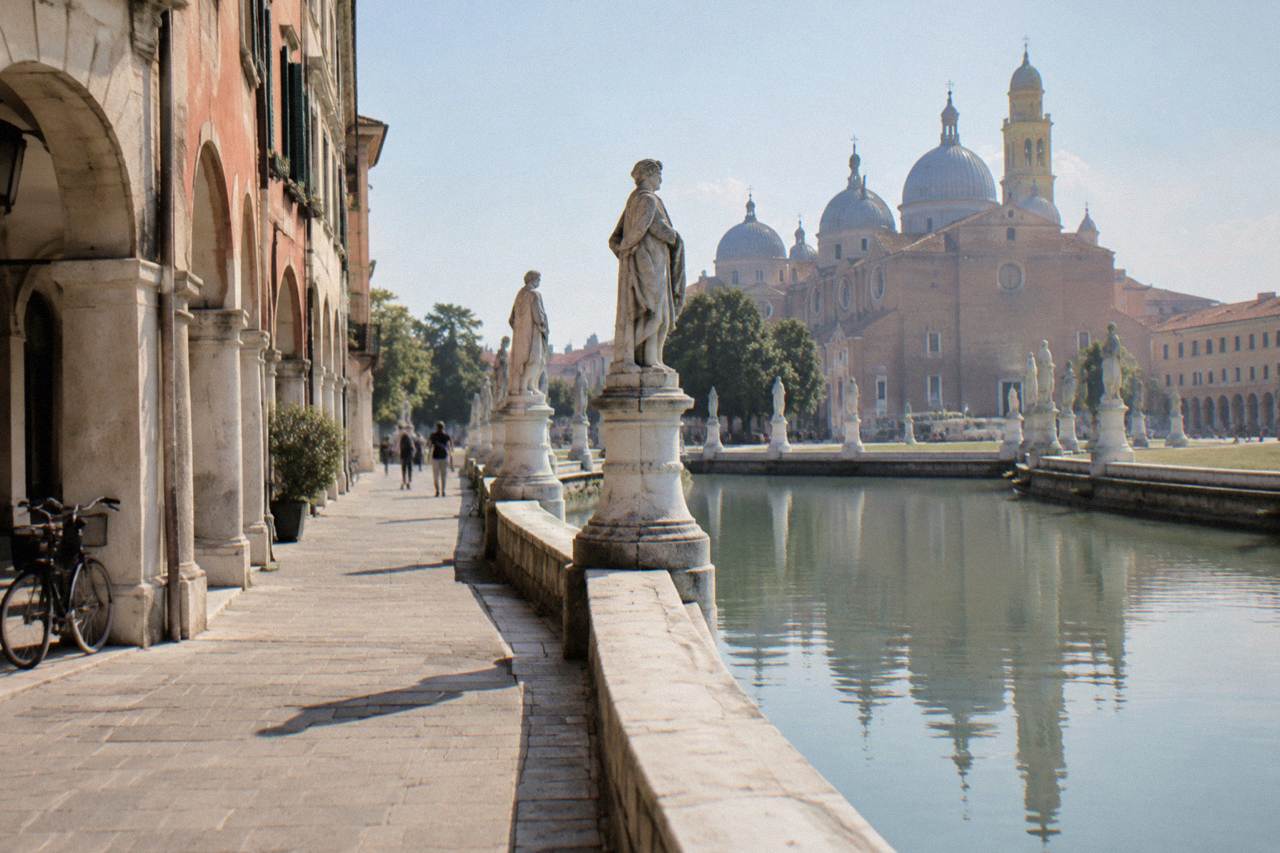
Prato della Valle is a large oval square in Padua, Italy, formed around an island called Isola Memmia and surrounded by a canal lined with a double ring of statues. The Venetian Senate declared the space communal in 1767 and Andrea Memmo reclaimed it, turning a marsh into the public square seen today.
Prato della Valle is the great oval square of Padua (Padova), a city in the Veneto in northern Italy, an inland city of arcaded streets about 36 km in a straight line from Venice. The square is not a flat open plaza in the ordinary sense: it is a grassed island, the Isola Memmia, ringed by a canal, and the canal is lined on both banks by a double row of statues of famous people, numbered one by one on their pedestals. The Venetian Senate declared the ground communal space in 1767, and the reclamation that produced the present layout was carried out under Andrea Memmo, whose name the island still carries. The square sits at the edge of the Santo and Prato quarter, minutes from the Basilica of Saint Anthony, and it doubles as the market ground for the Prato della Valle Saturday market and the finish line of the Padova Marathon.
What Is Prato Della Valle In Padua?
Prato della Valle is a monumental oval square in the south of Padua's historic centre, built around a canal-lined island, the Isola Memmia, and surrounded by a double ring of statues of famous people on numbered pedestals. The Venetian Senate declared the space communal in 1767, and the reclamation that shaped it was directed by Andrea Memmo, which is why the island bears his name.
The name itself is plain Italian: "prato" means meadow, and for centuries the ground west of the Basilica of Saint Anthony was exactly that, low reclaimed land that flooded and drained with the seasons. The word "valle" in the Venetian sense describes a low hollow, and this hollow lay outside the line of the city's early walls, too damp to build on and too close to town to ignore. The statute of 1767 settled a long dispute by making the ground common property, and Memmo's reclamation turned a marsh into a formal public space: an island, a canal around it, and promenade rings planted with the statues that give the square its second identity.
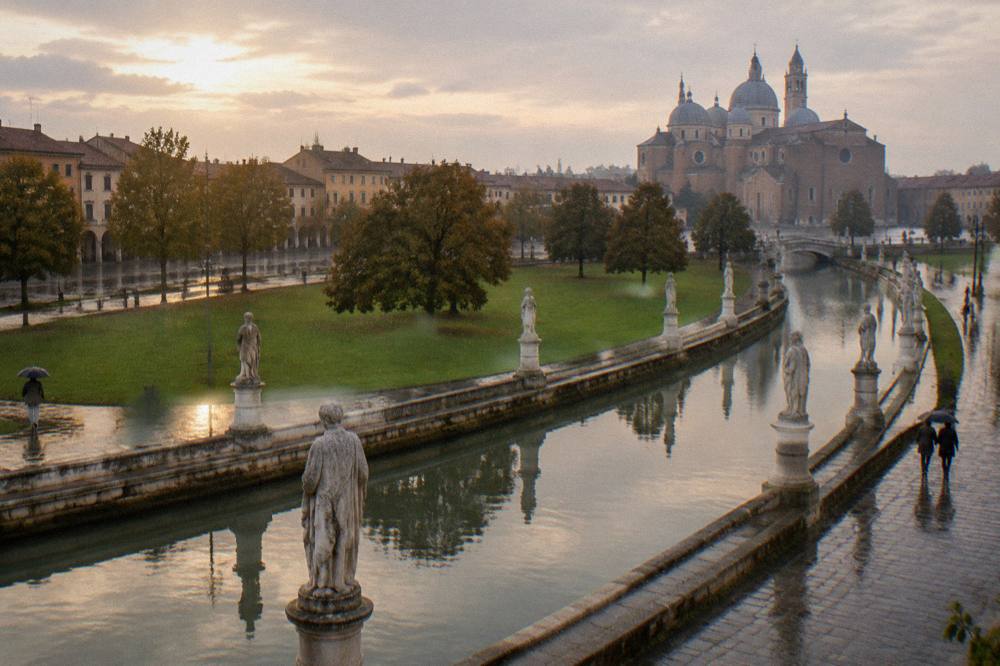
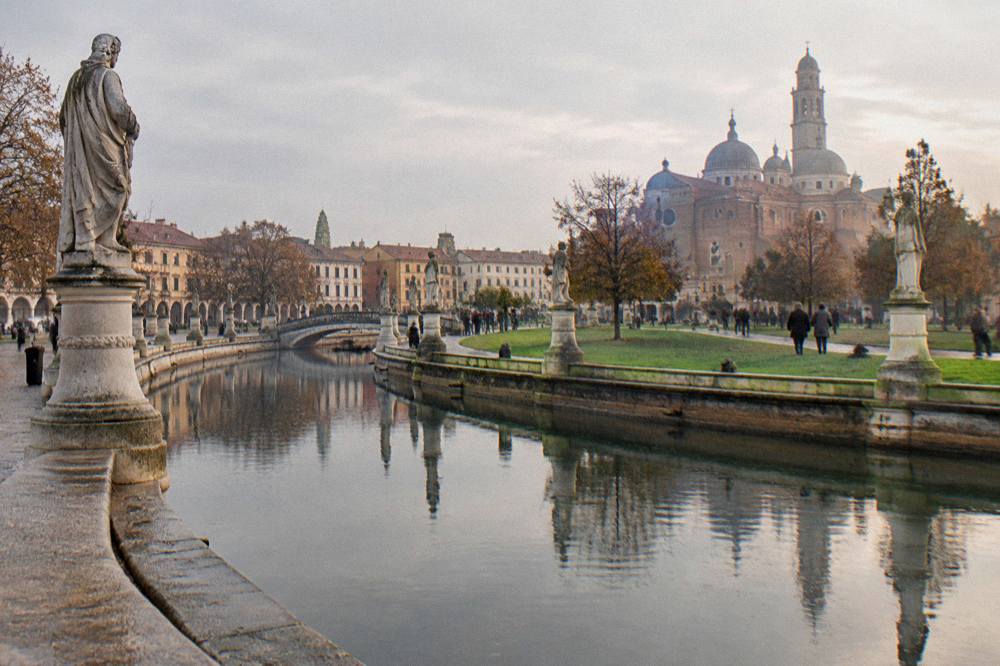
What stands there now is the layout that reclamation produced. The outer ring follows the curve of the oval, crossed by bridges onto the island, which is reserved for walkers. Statues face outward from the inner ring and inward from the outer one, a gallery of figures chosen when the scheme was laid out, each with a number and a name carved below. The Basilica of Santa Giustina closes the view to the southeast, its dome rising directly behind the oval, and the streets on the far side run up toward the Basilica of Saint Anthony.
For orientation before a first visit, the Santo and Prato area guide covers the whole quarter, and the general things to do in Padua page places the square in a city itinerary that also takes in Giotto's frescoes and the Orto Botanico.
Why Is There A Canal Around The Square?
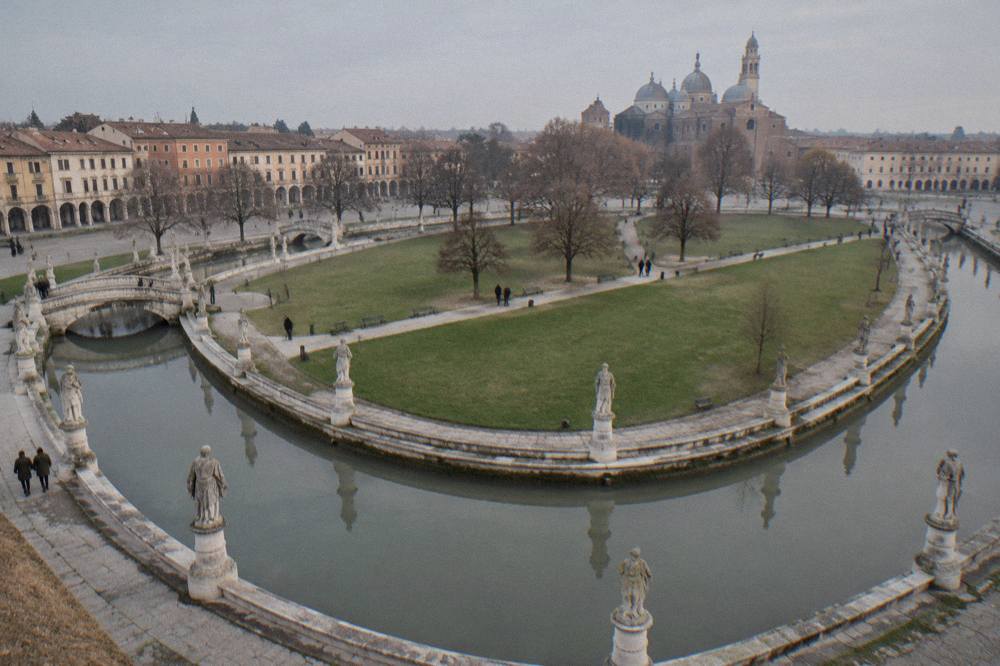
The canal exists because the ground was waterlogged before 1767, and the reclamation under Andrea Memmo drained it by shaping the hollow into a controlled oval: the island was raised, the water was channelled into a ring around it, and the banks were lined with stone and statues. The Venetian Senate's declaration of 1767 made the project a public one.
Before the Senate acted, the space was a mix of common meadow, periodic fairground and standing water. The city had grown around it for centuries, and the Basilica of Santa Giustina, whose own history runs deep into the city's past, stood beside it. The 1767 declaration, recorded on the city's tourism pages, fixed the ground as communal space, and Memmo, a Venetian patrician serving the city, took charge of the reclamation. The engineering answer to a marsh is drainage and fill, and the design gave both a monumental form: a ring canal to carry the water, an island raised above it, and bridges to connect the two.
The statues came with the stone. A double ring of figures, each on a pedestal, each numbered, turned the promenade into an open-air gallery of famous people, a scheme of the Enlightenment rather than the middle ages. The exact count of statues is a figure this page does not carry, and neither does it carry the square's surface area or any ranking of it among the squares of Italy or Europe: those numbers circulate widely, but the primary sources for them are not settled, and a guide that prints a shaky number does its reader no service. What the sources do settle is the shape, the canal, the double ring, the year 1767 and the name Memmo.
The island itself carries the name Isola Memmia in his honour, and it remains the quiet centre of the composition: lawns, paths and trees inside the ring, with the statues and the passing city outside.
What Can You See At Prato Della Valle Today?
Visitors today see an oval of about a dozen statue-lined segments, bridges onto the Isola Memmia, the domed Basilica of Santa Giustina immediately to the southeast, and the open ground used for the Saturday market, the third-Sunday antiques market and the finish of the Padova Marathon, whose 2027 edition finishes here on 18 April.
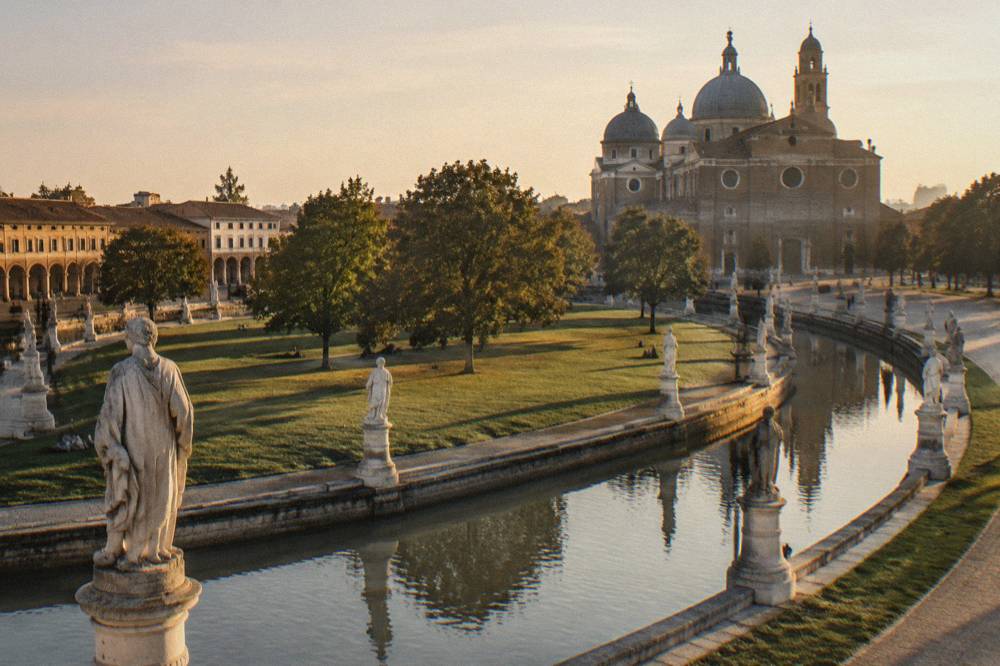
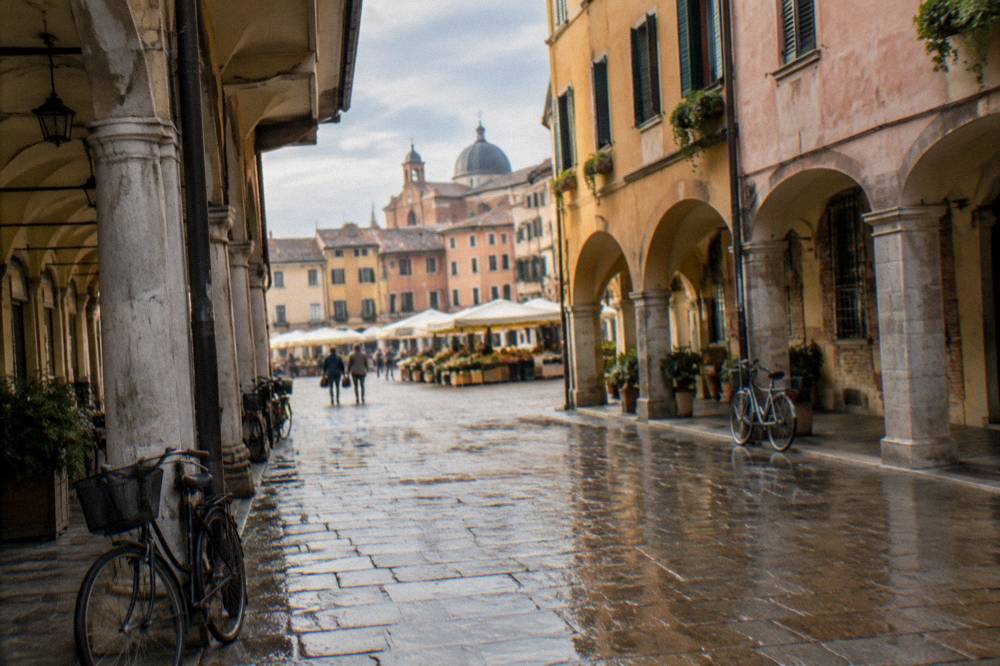
The square works as a circuit. A walk around the outer ring passes statue after statue, each pedestal numbered in sequence, and the bridges give onto the island at intervals, so the loop can be walked outside, inside or both. The statues represent famous people, chosen when the scheme was created, and reading the names from pedestal to pedestal is the square's particular pleasure: it is a portrait gallery with no roof and no queue.
Around the oval, the city closes in on three sides. The Basilica of Santa Giustina, one of Padua's great churches, stands directly at the southeast edge, its dome the square's principal landmark; the Basilica of Santa Giustina attraction page covers it in detail. A short walk north through the quarter brings you to the Basilica of Saint Anthony, the pilgrimage church known as the Santo, whose construction began in 1232, a year after the Saint's death on 13 June 1231. Entry to the Santo is free, per the Urbs Picta visiting pages, and the dress expectation is simply that clothing be suitable for a church.
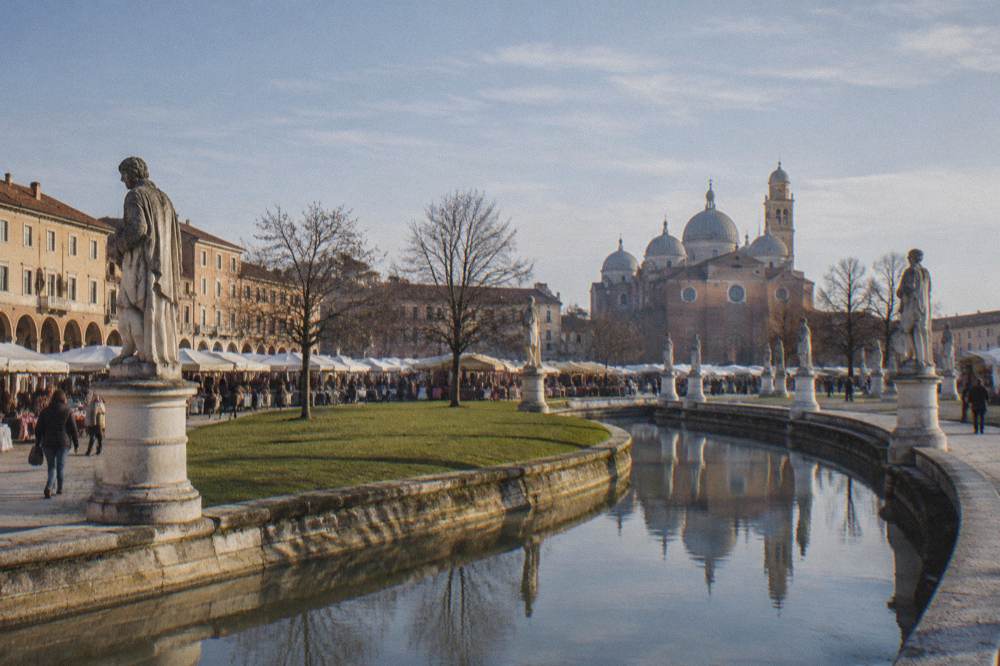
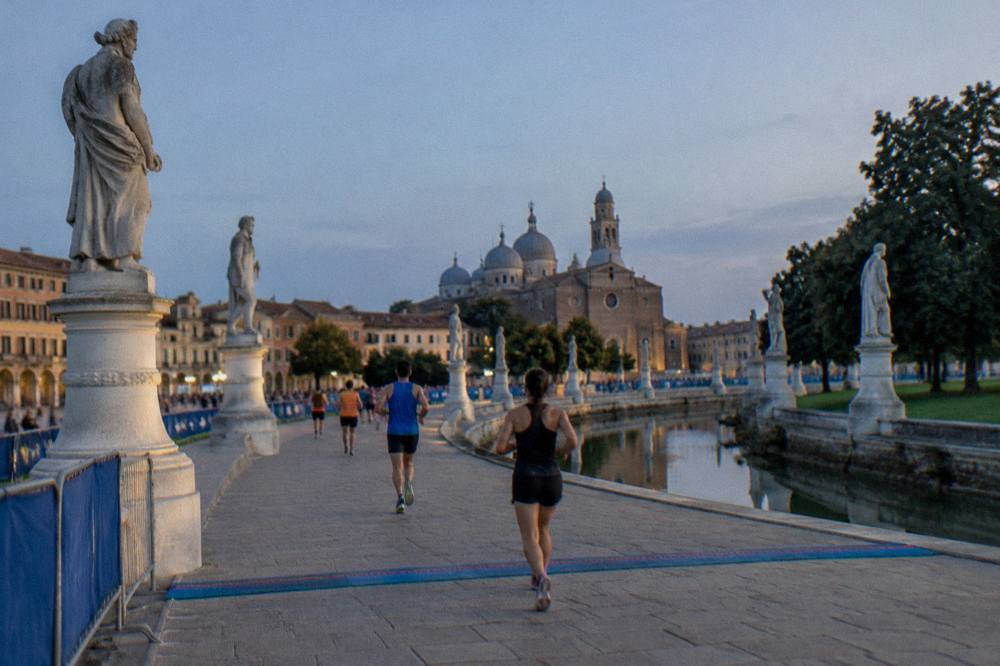
The square is also a working ground. On Saturdays it hosts the Prato della Valle market, and on the third Sunday of each month the antiques market spreads across the square and along via Umberto I. On 18 April 2027 the Padova Marathon finishes here, with the start at the Stadio Euganeo at 8:30, so on that one morning the oval belongs to runners and their crowd.
A guided walk is one way to take the quarter in with the context attached. A private city walking tour with a Scrovegni Chapel visit covers the historic centre and the chapel, and the quarter around the Santo and Prato della Valle fits naturally into such a route: Check availability on the operator's live listing if that combination suits your plans.
When Are The Markets At Prato Della Valle?
The Prato della Valle Saturday market runs from 8:00 to 19:00 in winter and 8:00 to 20:00 in summer, selling non-food goods, plants, flowers, fruit and vegetables, per the Comune di Padova's market page. The antiques market runs on the third Sunday of each month, from 8:00 to 20:00, across the square and along via Umberto I.
The Saturday market is the square's weekly transformation: stalls spread across the open ground, and the oval becomes a trading floor with the statues looking on. The Comune's own market page sets the hours and the goods, and it is the page to check for any change to the pattern. Piazza delle Erbe and Piazza dei Frutti, the twin market squares in the heart of the old centre, run their own schedules on weekdays and Saturdays, and the Piazza delle Erbe guide covers those; the Prato market is the bigger, brasher, outdoor counterpart.
| Market | Where | When | Hours |
|---|---|---|---|
| Prato della Valle market | Prato della Valle | Saturdays | Winter 8:00 to 19:00, summer 8:00 to 20:00 |
| Antiques market | Prato della Valle and via Umberto I | Third Sunday of the month | 8:00 to 20:00 |
| Piazza delle Erbe market | Piazza delle Erbe | Monday to Saturday | 7:30 to 13:30 Mon to Fri, to 20:00 Sat |
| Piazza dei Frutti food market | Piazza dei Frutti | Monday to Saturday | 8:00 to 14:00 Mon to Wed, to 19:00 Thu to Sat |
The antiques market is a different animal, smaller and slower, spread once a month under the statues. The Comune di Padova's antiques-market page is the authority for its dates, and the third-Sunday rule holds through the year with the square itself otherwise free.
How Do You Get To Prato Della Valle?
Prato della Valle sits in the southeast of Padua's historic centre, within the area covered by the urban TU1 ticket, which costs EUR 1.70 for 90 minutes and can be bought in the Busitalia Veneto app or paid by tapping a contactless card on board. Tram line SIR1 serves the city north to south, and the square is a short hop from the station by that line or on foot from the centre.
The urban fare is printed on the Busitalia pages: EUR 1.70 for 90 minutes in the Orange Zone that covers the city, with contactless tap-on-board accepted on tram and bus. The daily ticket at EUR 4.70 is reported on the same operator pages. Tram SIR1 runs north to south across the city on its roughly 10.5 km line, and a stop near the square connects it to the station end of town; a second line, SIR3, is in testing, with service targeted toward the end of 2026, but no opening date should be counted on until the operator announces it. The rest of the planning pages sit on Padua Travel Guide.
On foot, the square is a straightforward walk from the centre: the route runs south from the Piazza delle Erbe quarter past the Santo, and the whole historic centre of Padua is compact enough that the standard itinerary, the one day in Padua plan, links the station, the Scrovegni Chapel, the market squares and Prato della Valle in a single loop. Cyclists find the flat terrain and the bike culture of a student city on their side, and the square's outer ring is part of the city's everyday riding surface.
| Way In | What It Involves | Fare Or Fact |
|---|---|---|
| Urban tram SIR1 | North to south line across Padua | TU1 ticket EUR 1.70 for 90 minutes |
| Urban bus | Orange Zone city network | Same TU1 ticket, or tap a contactless card on board |
| On foot from Piazza delle Erbe | Walk south through the old centre past the Santo | No fare; flat route on arcaded streets |
| From Padova station | Tram or bus south, or a walk through the centre | TU1 daily ticket EUR 4.70 reported by the operator |
What Is Near Prato Della Valle?
The immediate neighbours are the Basilica of Santa Giustina at the southeast edge of the oval, the Basilica of Saint Anthony a short walk north through the Santo quarter, and beyond it the historic centre with Palazzo della Ragione, the Scrovegni Chapel and the Orto Botanico, Padua's university botanical garden founded in 1545 and inscribed by UNESCO in 1997.
The quarter rewards a slow loop. Start at the oval, take in Santa Giustina beside it, walk north to the Santo with Donatello's equestrian Gattamelata statue in the piazza outside, then continue into the centre toward Palazzo della Ragione, the great hall whose market sheds, the Sotto il Salone, still trade beneath it. The Scrovegni Chapel with Giotto's frescoes, painted between 1303 and 1305, lies at the north end of the centre near the Eremitani church, and it is timed entry only: 25 people every 15 minutes, booked in advance, with the daytime full ticket at EUR 15 plus a EUR 1 booking fee also covering the Musei Civici Eremitani and Palazzo Zuckermann. The chapel is closed 16 to 27 November 2026 for its annual fresco inspection.
The Orto Botanico and the historic university buildings of Palazzo del Bo, with its 1594 anatomical theatre, round out the set, and together they explain why the square's statue gallery fits its city: Padua prints its history on its walls, and the oval is the largest single page of it.
| Neighbour | Relation To The Square | Key Fact |
|---|---|---|
| Basilica of Santa Giustina | At the southeast edge of the oval | Dome closes the square's principal view |
| Basilica of Saint Anthony (the Santo) | Short walk north in the same quarter | Construction began 1232; entry free |
| Palazzo della Ragione | In the centre, north of the quarter | Full ticket EUR 8, Tue to Sun |
| Scrovegni Chapel | North end of the centre | Timed entry, EUR 15 full plus EUR 1 booking fee |
| Orto Botanico | Near the centre | Founded 1545, UNESCO 1997, EUR 15 from 1 Sept 2026 |
When Is The Best Time Of Day To Visit Prato Della Valle?
The square is open public ground with no ticket and no gate, so timing is a matter of light and activity rather than access: the market hours on Saturdays are 8:00 to 19:00 in winter and 8:00 to 20:00 in summer, the antiques market runs on third Sundays from 8:00 to 20:00, and the rest of the week the oval belongs to whoever is in it.
Morning is when the markets set up, and a Saturday morning puts the square at its busiest trade, stalls and crowds under the statues. The afternoon suits the circuit at walking pace, and the evening in summer, when the July and August mean high sits at 28.8 C per the ERA5 reanalysis for Padua, 1991-2020, is when the island's lawns fill and the canal catches the low light along the statue ring. Winter mornings are cold, with a January mean low of minus 0.2 C in the same reanalysis, and November is the month with the highest rain total in the Padua normals at 114.0 mm of rain, so the shoulder months between the two extremes are a practical choice for a long circuit.
| Month | Mean High C | Mean Low C | Rain Mm |
|---|---|---|---|
| January | 7.3 | -0.2 | 53.6 |
| April | 17.6 | 7.8 | 84.4 |
| July | 28.8 | 18.9 | 62.1 |
| October | 18.4 | 10.6 | 105.4 |
| November | 12.6 | 5.5 | 114.0 |
The figures above are ERA5 reanalysis values for the 1991-2020 period, a modelled grid cell rather than a station record, and they describe the climate, not any given week. Whatever the month, the square costs nothing to enter, and no timetable governs a walk around the ring.
What Events Happen At Prato Della Valle?
The square's calendar is anchored by the Saturday market, the third-Sunday antiques market and the Padova Marathon, which finishes at Prato della Valle: the 2027 edition runs on 18 April, starting at the Stadio Euganeo at 8:30, with entry at EUR 49 to 30 September 2026, EUR 55 to 20 December 2026 and EUR 65 after, per the marathon's own page.
The marathon is the one day the oval is transformed into a finish arena, and the course's arrival under the statues is a spectacle the city builds its spring around. The feast of Saint Anthony fills the surrounding quarter every June: the Tredicina ran 31 May to 12 June in 2026 with the feast day on 13 June, an annual event whose procession moves through the streets near the Santo, and the 2027 dates had not been announced. Summer brings the Sherwood Festival to the park near the stadium rather than to the square itself, running 10 June to 12 July in its 2026 edition.
Beyond those, the square's events are the everyday ones: the market, the antiques, the graduation celebrations of a university city with about 76,000 students, reported by the university, and the plain life of a public space that has served the city since the Senate opened it in 1767. Check the Comune di Padova's events pages before a visit timed to any specific occasion, since market and event patterns can shift by ordinance.
Is Prato Della Valle Free To Visit?
Yes, the square is free public open space at all hours, with no ticket, no gate and no timed entry, and the same applies to the surrounding streets and the exterior of the Basilica of Santa Giustina; the only costs are the optional ones, the urban ticket at EUR 1.70 to reach it and the paid sights and tours around it.
That freeness is part of the square's design. The Senate's 1767 declaration made the ground communal, and the reclamation under Memmo produced a space that has never been enclosed since. Visitors on a budget can build a full day around free ground: the oval, the Santo with its free entry, the streets of the historic centre and the exterior of the churches, with the Scrovegni Chapel the one unmissable sight that must be booked ahead at its timed price.
For those who want a guide's context, the site's Padua walking tour overview sets out the guided options, from private walks that pair the chapel with the centre to food walks that take in the market squares. Tours render their own prices and ratings from live listings, and this page does not type them.
Common Questions About Prato Della Valle
Is Prato della Valle the largest square in Italy?
The square's surface area and its ranking among Italian or European squares are figures that the primary sources for this page do not settle, so no ranking is stated here. What the sources do confirm is the form: an oval island, the Isola Memmia, ringed by a canal with a double ring of statues, declared communal space by the Venetian Senate in 1767.
How many statues are there at Prato della Valle?
The statues form a numbered double ring around the canal, but an exact count is not carried on the official pages used for this guide, so none is printed. Walking the circuit and reading the pedestals in sequence is the way to see them all.
When is the Prato della Valle market?
The Saturday market runs 8:00 to 19:00 in winter and 8:00 to 20:00 in summer, per the Comune di Padova's market page. The antiques market runs on the third Sunday of each month, 8:00 to 20:00, across the square and along via Umberto I.
How do I get to Prato della Valle from Padua station?
The square lies in the southeast of the historic centre, reached by the urban tram or bus network with the TU1 ticket at EUR 1.70 for 90 minutes, or on foot through the centre. Tram line SIR1 crosses the city north to south on its roughly 10.5 km route.
Is Prato della Valle free?
Yes. The square is open public space with no ticket or gate, a status fixed by the Venetian Senate's 1767 declaration of the ground as communal. The nearby Basilica of Saint Anthony is also free to enter.
What is near Prato della Valle?
The Basilica of Santa Giustina stands at the southeast edge of the oval, the Basilica of Saint Anthony lies a short walk north, and the historic centre beyond it holds Palazzo della Ragione, the Scrovegni Chapel and the Orto Botanico, two UNESCO-listed treasures of the city.
