Palazzo Bo: The Anatomical Theatre And Galileo's Lectern
Palazzo Bo is the historic seat of the University of Padua, and its guided tour takes in the anatomical theatre of 1594, Galileo's chair and the statue of the first woman graduate on record. Here is what the tour covers, what it costs and how to book it.
Short answer
Palazzo Bo in Padua is visited on a guided Giro storico of about 45 minutes, EUR 10 full price (EUR 8 reduced, EUR 6 for ages 6 to 25), with alternating Italian and English slots and booking through the university centre on 049 827 3939. The route includes the anatomical theatre of 1594 and Galileo's chair in the Sala dei Quaranta.
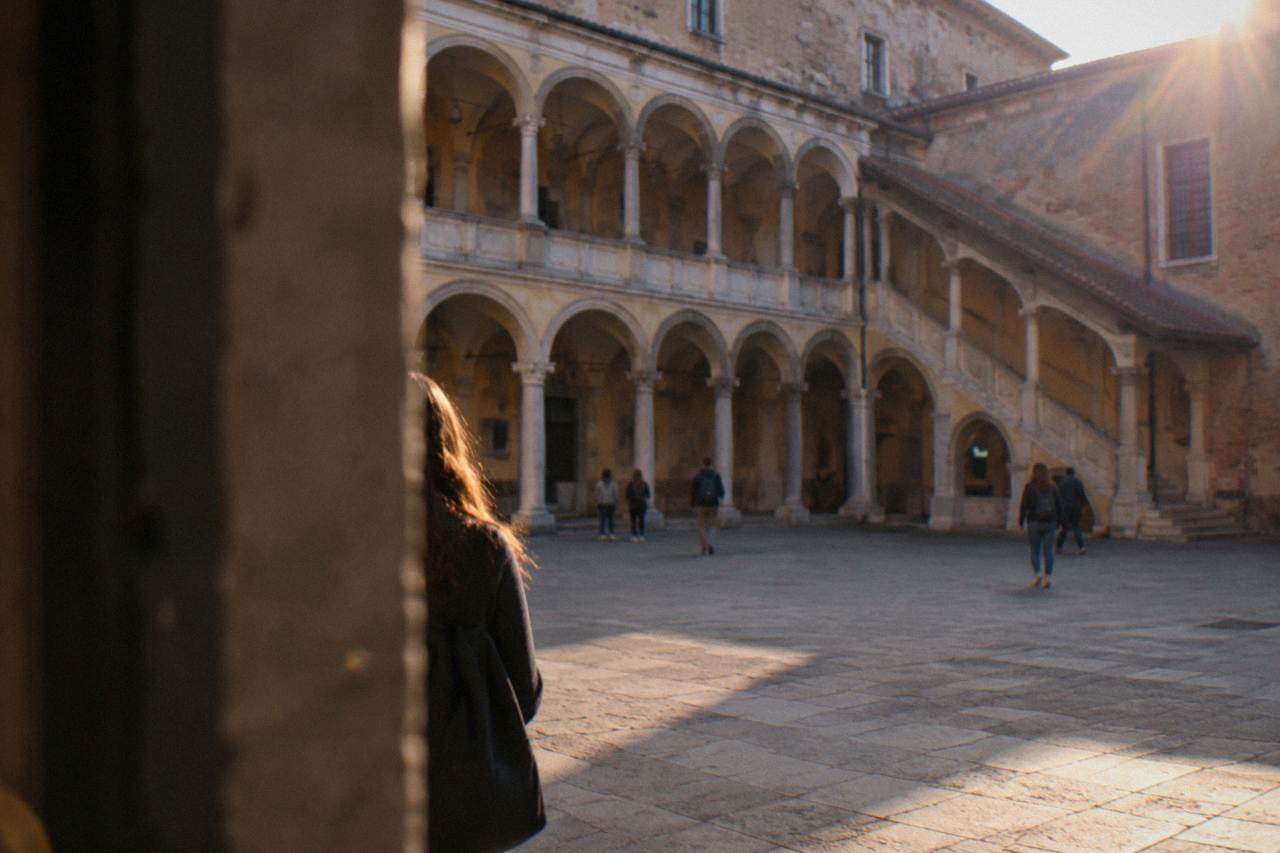
Palazzo Bo is the historic heart of the University of Padua, the Studium Patavinum founded in 1222, and it stands in the city centre of Padua (Padova), an inland city in the Veneto about 36 km in a straight line from Venice. The building cannot simply be wandered: the university's own pages present it as a guided visit, the Giro storico, which passes through the Aula Magna, the Sala dei Quaranta with Galileo's chair, the anatomical theatre of 1594 and the statue of Elena Cornaro Piscopia. This page from the Padua Travel Guide sets out what the tour covers, what it costs, how to book it and how it fits alongside the Scrovegni Chapel and the other sights of the old centre.
What Is Palazzo Bo In Padua?
Palazzo Bo is the historic seat of the University of Padua, the Studium Patavinum founded in 1222, and it houses the anatomical theatre inaugurated in 1594, the chair associated with Galileo's teaching years from 1592 to 1610 and the statue of Elena Cornaro Piscopia, who graduated in philosophy on 25 June 1678 as the first woman on record to take a university degree.
The university describes itself as among the oldest in Italy, and its own history pages report it as second-oldest after Bologna. The name "Bo" comes from the building's earlier life as an inn, the "Bo", a detail the university's heritage pages mention in passing when they trace the seat's move to this site. What matters for a visitor is simpler: this is a working university building, not a museum with open rooms, and access runs through the guided Giro storico rather than free-flowing wandering.
The university's presence shapes the whole city. Its own pages put the student body at about 76,000, and the institution's dates anchor much of Padua's story: the Orto Botanico founded in 1545, the anatomical theatre of 1594, Galileo's eighteen years here. The wider university story is covered in the site's University of Padua guide, and Galileo's Padua years in Galileo in Padua.
What Does The Palazzo Bo Tour Include And What Does It Cost?
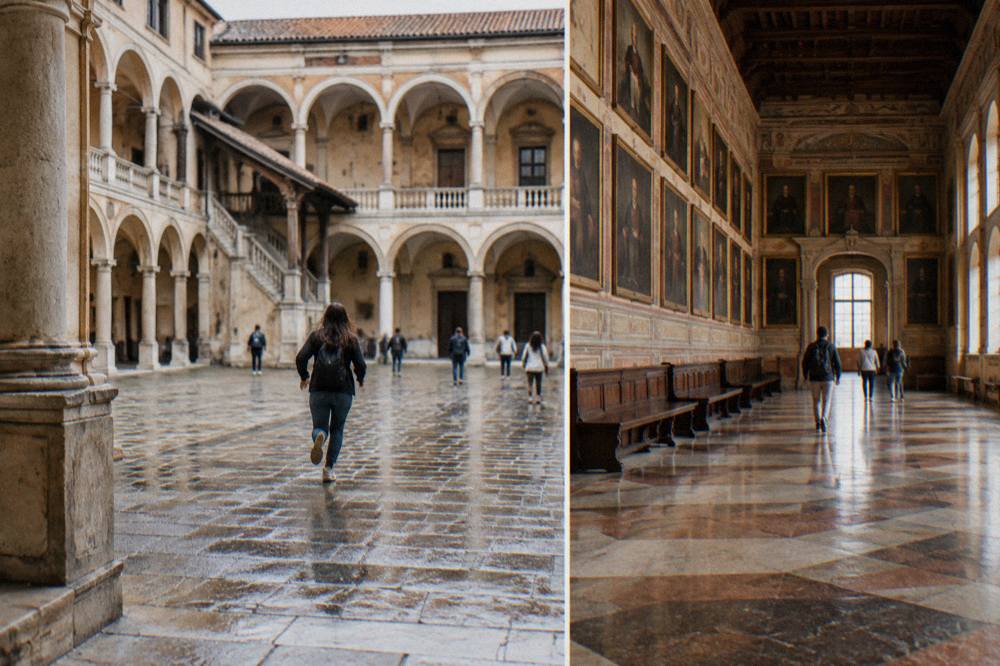
The Giro storico of Palazzo Bo costs EUR 10 full price for ages 26 to 64, EUR 8 reduced for visitors 65 and over, teachers and mixed groups of 10 to 30, EUR 6 special reduced for ages 6 to 25 and EUR 5 for school groups, runs about 45 minutes with alternating Italian and English slots, and passes the Aula Magna, Galileo's chair in the Sala dei Quaranta, the anatomical theatre, the Medicine and Law halls and the statue of Elena Cornaro.
The university's booking pages state those figures, and they add one caveat worth planning around: not every room is guaranteed every day. The route is fixed in outline but individual halls can close for academic use, so the theatre and the Sala dei Quaranta are the two anchors to expect in every case. Slots alternate between languages, for example 12:30 in Italian, 13:30 in English, 15:30 in Italian, 16:30 in English and 17:30 in Italian, per the university's own listing.
| Ticket | Price | Who it applies to |
|---|---|---|
| Full | EUR 10 | Ages 26 to 64 |
| Reduced | EUR 8 | Visitors 65 and over, teachers, mixed groups of 10 to 30 |
| Special reduced | EUR 6 | Ages 6 to 25 |
| School groups | EUR 5 | School parties |
There is also an integrated ticket, "Padova Citta della Scienza", which the university lists as combining Palazzo del Bo, the Orto Botanico and the Museo della Natura e dell'Uomo. If both the garden and the university are on the list, ask at the booking centre whether the combined ticket works out cheaper than separate entries; the Orto Botanico's full ticket has been EUR 15 since 1 September 2026, EUR 12 in winter from November to February, per the garden's own tariff page.
Palazzo Bo sits in the densest cluster of sights in the city. The Scrovegni Chapel and the Musei Civici Eremitani are a short walk north, Piazza delle Erbe and Palazzo della Ragione lie south, and the whole stretch can be done in a day. The site's one day in Padua itinerary sequences them.
What Is The Anatomical Theatre At Palazzo Bo?
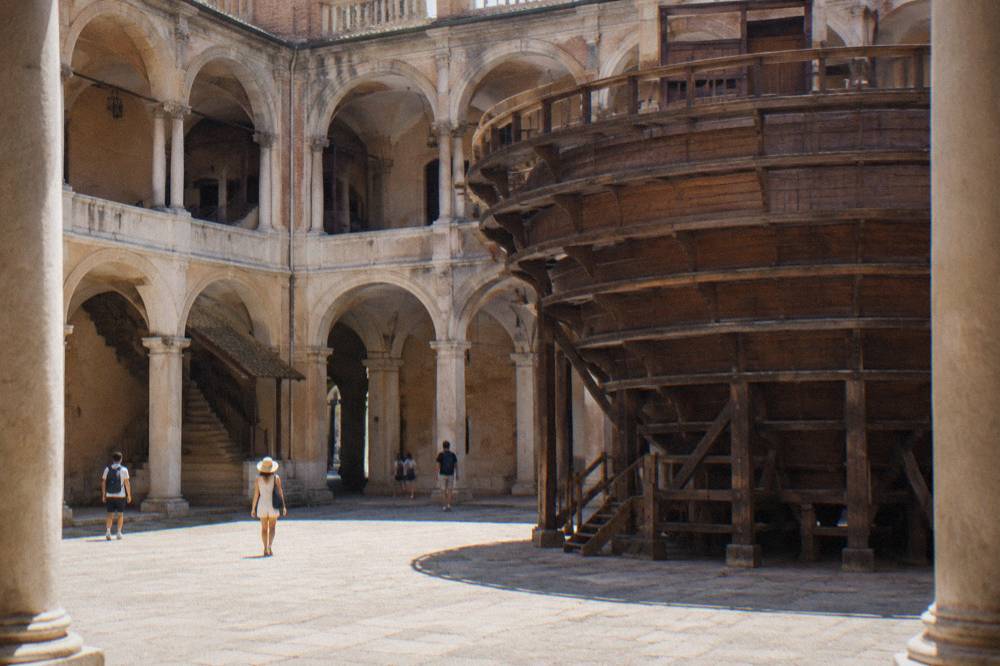
The anatomical theatre at Palazzo Bo is a carved wooden structure inaugurated in 1594, described by the University of Padua as the first permanent anatomical theatre, built for public dissections and medical teaching, with tiered galleries ringing a central table where the anatomy lesson took place.
The form is the striking part. Six tiers of balconies rise in a narrowing ellipse, so that students stood in rings looking down on the dissection table at the centre, and the whole room was designed around sightlines to a single point. The university's profile page names 1594 as the inauguration year and calls it the first permanent anatomical theatre, a phrase worth repeating exactly rather than paraphrasing into a ranking. For the wider context of what anatomical theatres were and why universities built them, the site's what were anatomical theatres page goes deeper.
The theatre belongs to a medical faculty with a long record. The same university pages note the Orto Botanico of 1545, grown for the study of medicinal plants, and Elena Cornaro Piscopia's doctorate of 1678. Medicine, botany and anatomy were neighbouring disciplines here in a way that a modern departmental map no longer shows, and the Giro storico's route, theatre to Medicine hall to Law hall, reflects how the building was used.
Padua's medical and scientific story continues beyond Palazzo Bo. The Orto Botanico, a UNESCO World Heritage site since 1997, is the living counterpart of the anatomy room, and the La Specola observatory building belongs to the same scientific tradition, though the site's guidance on visiting it is simple: check directly before planning a visit.
Where Is Galileo's Chair In Palazzo Bo?
Galileo's chair stands in the Sala dei Quaranta inside Palazzo Bo, and it is associated with Galileo's years at the University of Padua from 1592 to 1610, when he held the chair of mathematics and later called them, in his own words, "the best eighteen years of all my life"; Sidereus Nuncius, the book announcing his telescopic observations, is dated 1610.
The university's Galileo pages supply the dates and the quotation. The chair itself is the object the tour stops at: a lectern and seat that the university associates with his teaching, displayed in a hall lined with portraits. The Sala dei Quaranta takes its name from the forty scholars whose images decorate it, and it is one of the fixed points of the Giro storico route.
Galileo's Padua period is the stretch in which he did the work that made his name, and the city holds several markers of it. Beyond the room at Palazzo Bo, the university's heritage pages trace his steps, and the site's Galileo in Padua guide collects the dates in order. The eighteenth of his years here, 1610, is the year of Sidereus Nuncius, published while he was still in Padua.
For visitors pairing science with art, the sequence works well in a single morning: Palazzo Bo first for the chair and the theatre, then the walk north to the Scrovegni Chapel, where Giotto's frescoes were painted between 1303 and 1305, per the chapel's own site. The chapel requires its own timed booking in every case, at most 25 people every 15 minutes, and it closes 16 to 27 November 2026 for the annual fresco inspection.
Who Was Elena Cornaro Piscopia?
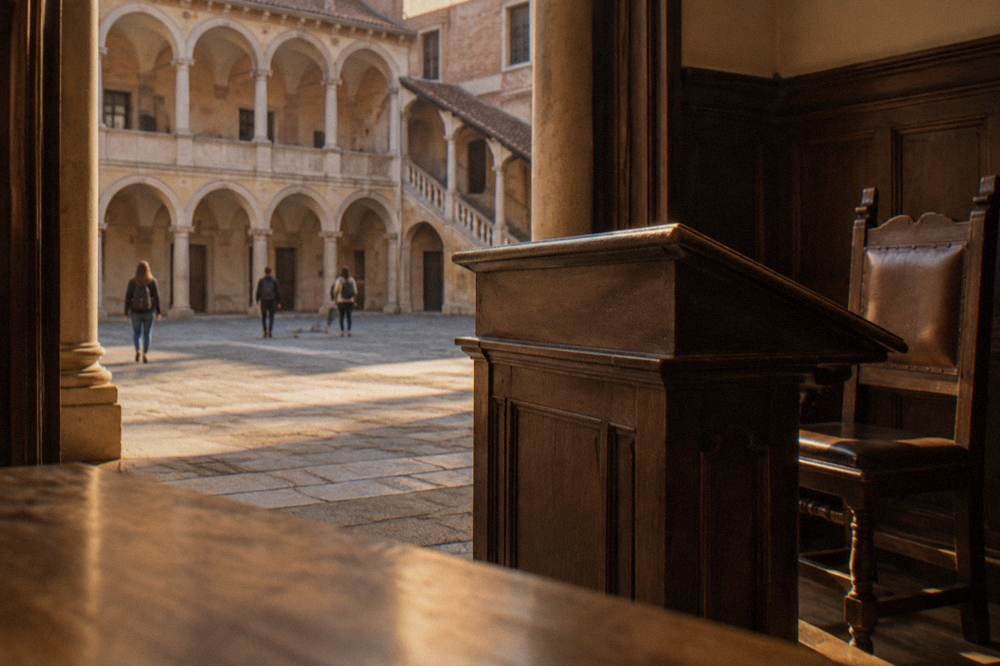
Elena Lucrezia Cornaro Piscopia graduated in philosophy at the University of Padua on 25 June 1678, and the university records her as the first woman to take a university degree on record; her statue stands inside Palazzo Bo and the Giro storico passes it, alongside the coat of arms of the university she joined.
The date is the university's own, from its page on Cornaro. The degree was in philosophy, defended in the hall the university still shows, and the statue commemorating her is one of the stops named in the Giro storico route listing. For a building whose tours run through Medicine and Law halls named for the men who taught in them, the statue is the point where the record visibly widens.
Her presence in the same tour as the anatomical theatre is not a curatorial accident. The university presents its history as a continuous thread, 1222 to the present, and Cornaro's 1678 doctorate sits between the theatre of 1594 and the modern institution with its about 76,000 students, a figure from the university's own profile pages. The University of Padua guide gives the fuller chronology.
How Do You Book The Giro Storico At Palazzo Bo?
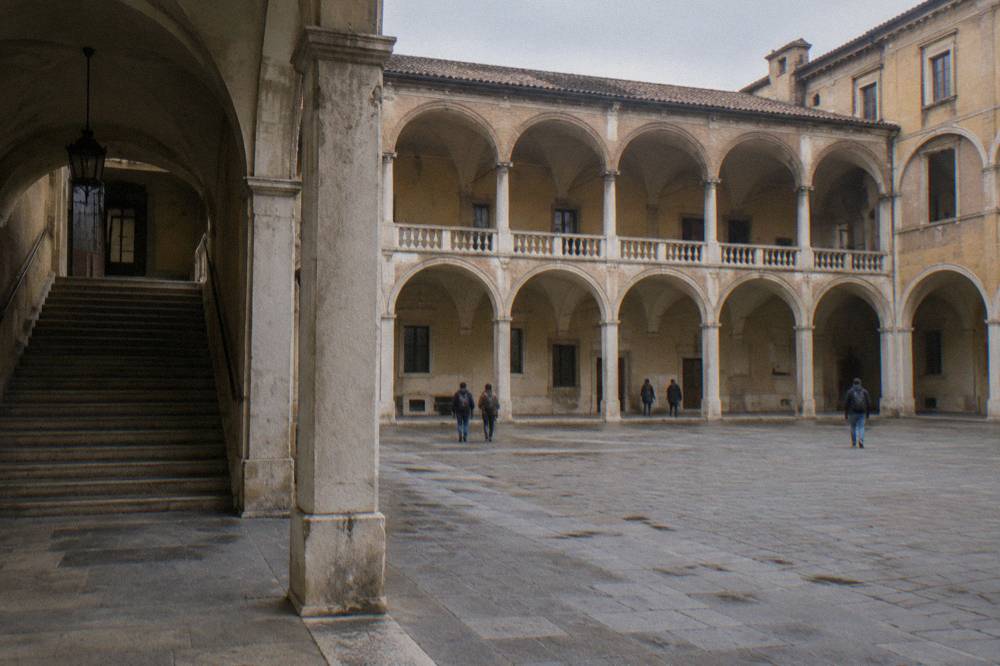
Bookings for the Giro storico at Palazzo Bo go through the university's booking centre on 049 827 3939, with alternating Italian and English tour slots listed by the university at times such as 12:30, 13:30, 15:30, 16:30 and 17:30, and the tour runs about 45 minutes at EUR 10 full price, EUR 8 or EUR 6 reduced.
The telephone number and the slot pattern come from the university's own information page for the tour, which also lists the ticket tiers shown above. Groups and school parties are the obvious candidates for advance booking, but the alternating-language schedule means individual travellers should also fix a slot rather than arriving on spec, since an English-language tour may be the next one but one. The same page notes that the route cannot promise every room every day, so a booking confirms a time, not a fixed list of halls.
The practical sequence for a day built around Palazzo Bo is then straightforward. Fix the Giro storico slot first, since the times are fixed. Then book the Scrovegni Chapel around it: the chapel's daytime ticket, EUR 15 full plus a EUR 1 booking fee, also covers the Musei Civici Eremitani and Palazzo Zuckermann, and entry is timed at 25 people every 15 minutes with about 15 minutes inside. The chapel's own booking page states that same-day online booking does not exist, so both anchors of the day need forward planning.
| Booking step | Where | What to fix |
|---|---|---|
| Giro storico slot | University booking centre, 049 827 3939 | Time and language (Italian or English) |
| Scrovegni Chapel | Chapel booking site or call centre, +39 049 2010020 | Timed slot, up to the day before |
| Orto Botanico | Garden's own ticket page | Date; closed non-holiday Mondays |
| Integrated ticket | Ask at the booking centre | Bo plus Orto Botanico plus Museo della Natura e dell'Uomo |
A guided visit to the chapel is one way to combine the two mornings, and the site's Scrovegni Chapel tickets page covers the official channels. Check availability for a guided Giotto option if that suits the plan better than a self-booked slot.
Can You Visit Palazzo Bo Without A Guided Tour?
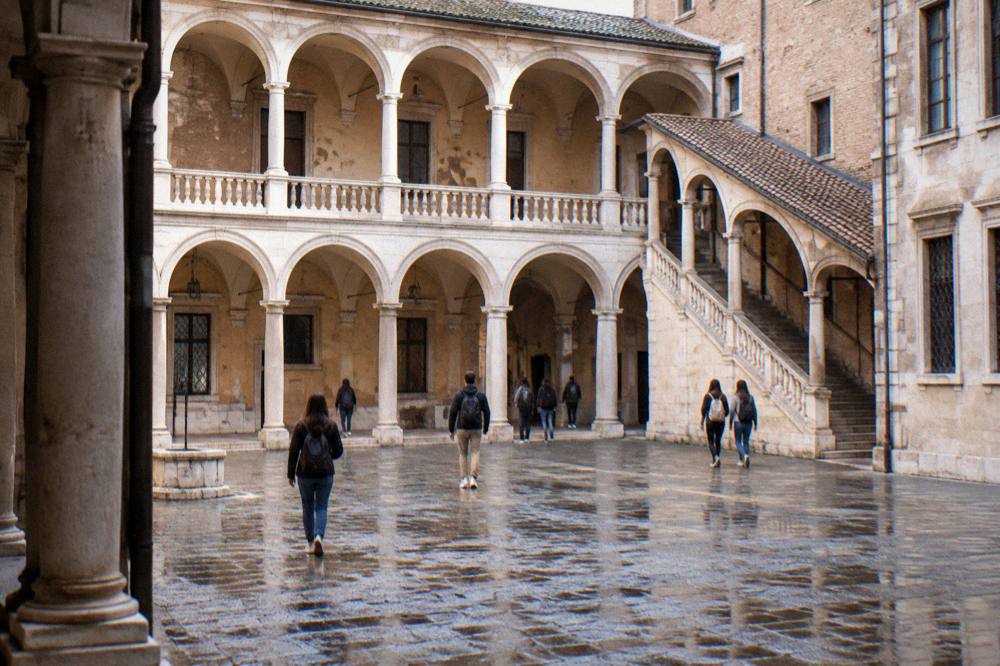
No, the historic rooms of Palazzo Bo, the anatomical theatre, the Sala dei Quaranta, the Aula Magna and the Medicine and Law halls, are shown on the guided Giro storico, and the university presents no self-guided ticket for those interiors; the courtyards can be glimpsed from the entrances but the visit itself is the guided one, about 45 minutes, booked through the centre on 049 827 3939.
That constraint is unusual in Padua, where the civic museums run on ordinary tickets. The Musei Civici Eremitani at Piazza Eremitani 8 open 9:00 to 19:00, Palazzo Zuckermann on Corso Garibaldi opens Tuesday to Sunday 10:00 to 19:00, and both are covered by the Scrovegni daytime ticket. Palazzo della Ragione, EUR 8 full and EUR 6 concessions with Tuesday to Sunday hours, sells tickets at the IAT office at Piazza delle Erbe 52. The university building works differently because it is a university first.
The trade-off is that the guided format carries information the rooms would not give up alone. The theatre's carvings, the portraits in the Sala dei Quaranta and the emblems in the Aula Magna are read to the group rather than labelled for individuals, and the university's route notes name what each stop signifies. Whether that suits depends on the traveller; the tour's 45-minute length keeps it compatible with a chapel slot on the same morning.
For a fuller sense of the surrounding quarter, the site's centro storico guide walks the streets between Palazzo Bo, the Basilica of Saint Anthony, which keeps the Saint's tomb and admits visitors free, and Prato della Valle with its canal and double ring of statues, declared communal space by the Venetian Senate in 1767.
How Does Palazzo Bo Fit Into A Day In Padua?
Palazzo Bo sits between the two great clusters of Padua sights: the Scrovegni Chapel, the Musei Civici Eremitani and Palazzo Zuckermann to the north, and Piazza delle Erbe, Palazzo della Ragione, Caffe Pedrocchi and the Basilica of Saint Anthony running south and east, so a natural day pairs a booked Giro storico slot in the late morning with a chapel slot before it and the market squares and the Santo after it.
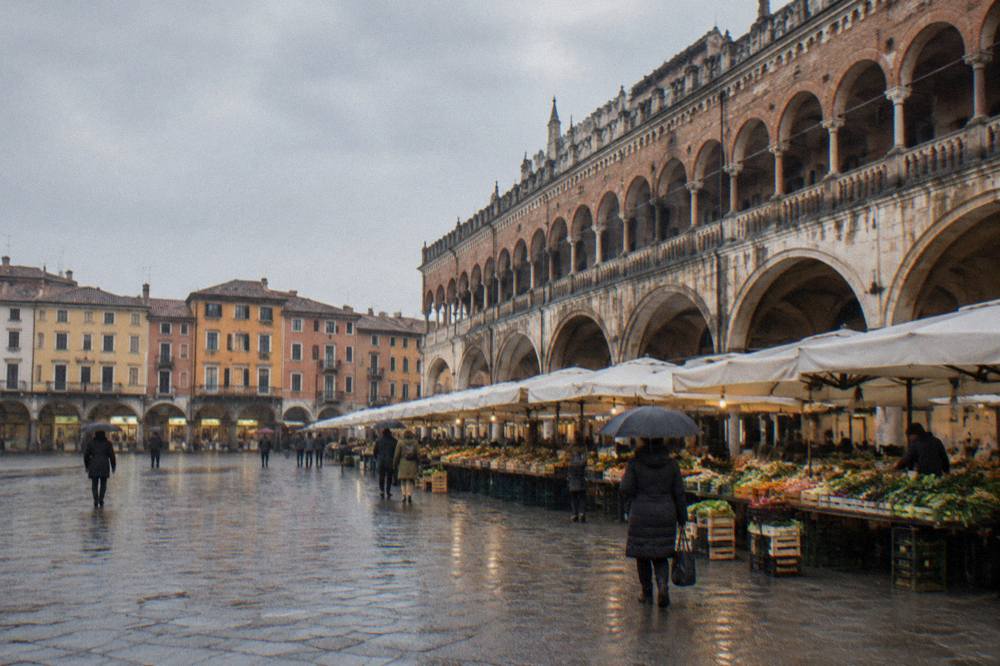
The walk between them is short and arcaded. From the chapel area, Piazza delle Erbe holds its market Monday to Friday 7:30 to 13:30 and Saturday 7:30 to 20:00, per the Comune di Padova's market page, and the permanent food market under Palazzo della Ragione, Sotto il Salone, runs underneath the square. Caffe Pedrocchi, opened in 1831, stands a few streets from Palazzo Bo itself, though its current opening hours are best checked on its own site before a planned stop.
| Stop | Sights | Booking needed |
|---|---|---|
| Morning | Scrovegni Chapel, Musei Civici Eremitani | Yes, timed chapel slot |
| Late morning | Palazzo Bo Giro storico | Yes, fixed slot and language |
| Midday | Piazza delle Erbe, Sotto il Salone, Caffe Pedrocchi | No |
| Afternoon | Palazzo della Ragione, Basilica of Saint Anthony, Prato della Valle | Basilica free; Ragione ticket at IAT |
The order can flip. An afternoon Giro storico at 15:30 or 16:30 leaves the morning for the chapel and the museums, and the chapel's evening openings, "Giotto sotto le stelle" from 25 March to 1 November, 19:00 to 22:00 every 20 minutes, chapel only, extend the day at the other end. The full sequencing, with timings and the two-night version, is in Padua in one day and Padua in two days.
What Dates Frame A Visit To Palazzo Bo?
The University of Padua was founded in 1222, the Orto Botanico dates to 1545, Galileo held the chair of mathematics from 1592 to 1610, the anatomical theatre was inaugurated in 1594, Elena Cornaro Piscopia graduated on 25 June 1678, and the 8 February 1848 student uprising is recorded by the university's heritage pages, so the Giro storico walks through rooms spanning more than six centuries of the institution's history.
Those dates are the spine of the visit, and each is anchored to a stop. The theatre carries 1594, the Sala dei Quaranta carries the Galileo years and the 1610 of Sidereus Nuncius, the statue carries 1678, and the Aula Magna and the halls carry the later institution, including the 1848 uprising that the heritage pages record among the university's Risorgimento episodes.
| Year | Event | Where it shows at Palazzo Bo |
|---|---|---|
| 1222 | Studium Patavinum founded | The institution itself |
| 1545 | Orto Botanico founded | Referenced in the integrated science ticket |
| 1592 | Galileo arrives to the chair of mathematics | Galileo's chair, Sala dei Quaranta |
| 1594 | Anatomical theatre inaugurated | The theatre itself |
| 1610 | Sidereus Nuncius | Galileo's Padua years, ended 1610 |
| 1678 | Elena Cornaro Piscopia's doctorate | Her statue and hall |
| 1848 | Student uprising of 8 February | Recorded in the university's heritage pages |
A visitor with time for only one university stop should weigh Palazzo Bo against the Orto Botanico, and the honest answer is that they measure different things. The garden is a UNESCO World Heritage landscape, inscribed in 1997, founded 1545, with a EUR 15 full ticket since 1 September 2026. Palazzo Bo is interiors, objects and a guided reading of them. A full day fits both, using the integrated ticket if the booking centre confirms it applies to the date.
Common Questions About Palazzo Bo
How much does the Palazzo Bo tour in Padua cost?
The Giro storico costs EUR 10 full price for ages 26 to 64, EUR 8 for visitors 65 and over, teachers and mixed groups of 10 to 30, EUR 6 for ages 6 to 25 and EUR 5 for school groups, per the University of Padua's own tariff page.
How long does the Palazzo Bo tour take?
About 45 minutes, per the university's listing, with slots alternating between Italian and English through the day.
Can you see the anatomical theatre without a tour?
No. The historic interiors, including the anatomical theatre of 1594, are shown on the guided Giro storico booked through the university's centre on 049 827 3939.
Is Galileo's chair at Palazzo Bo?
Yes, a chair associated with Galileo's teaching years at Padua, 1592 to 1610, stands in the Sala dei Quaranta and is a named stop on the tour route.
Do you need to book Palazzo Bo in advance?
Booking is through the university's centre on 049 827 3939, and because slots alternate between languages, fixing a time and language ahead is the practical approach.
Is there a combined ticket for Palazzo Bo and the Orto Botanico?
Yes, the university lists an integrated "Padova Citta della Scienza" ticket covering Palazzo del Bo, the Orto Botanico and the Museo della Natura e dell'Uomo; ask the booking centre whether it applies to your date.
The Giro storico of Palazzo Bo compresses the University of Padua's long record, from 1222 through 1594 and 1678, into one guided circuit, and a chapel booking on the same morning turns the day into the two-sided visit Padua does best: science and Giotto, an hour apart on foot.
