University Of Padua: Eight Centuries, Galileo And Visiting Today
Founded in 1222 in Padua, in the Veneto, the University of Padua packs Galileo's chair, the world's first permanent anatomical theatre and the first recorded woman graduate into eight centuries of continuous teaching.
Short answer
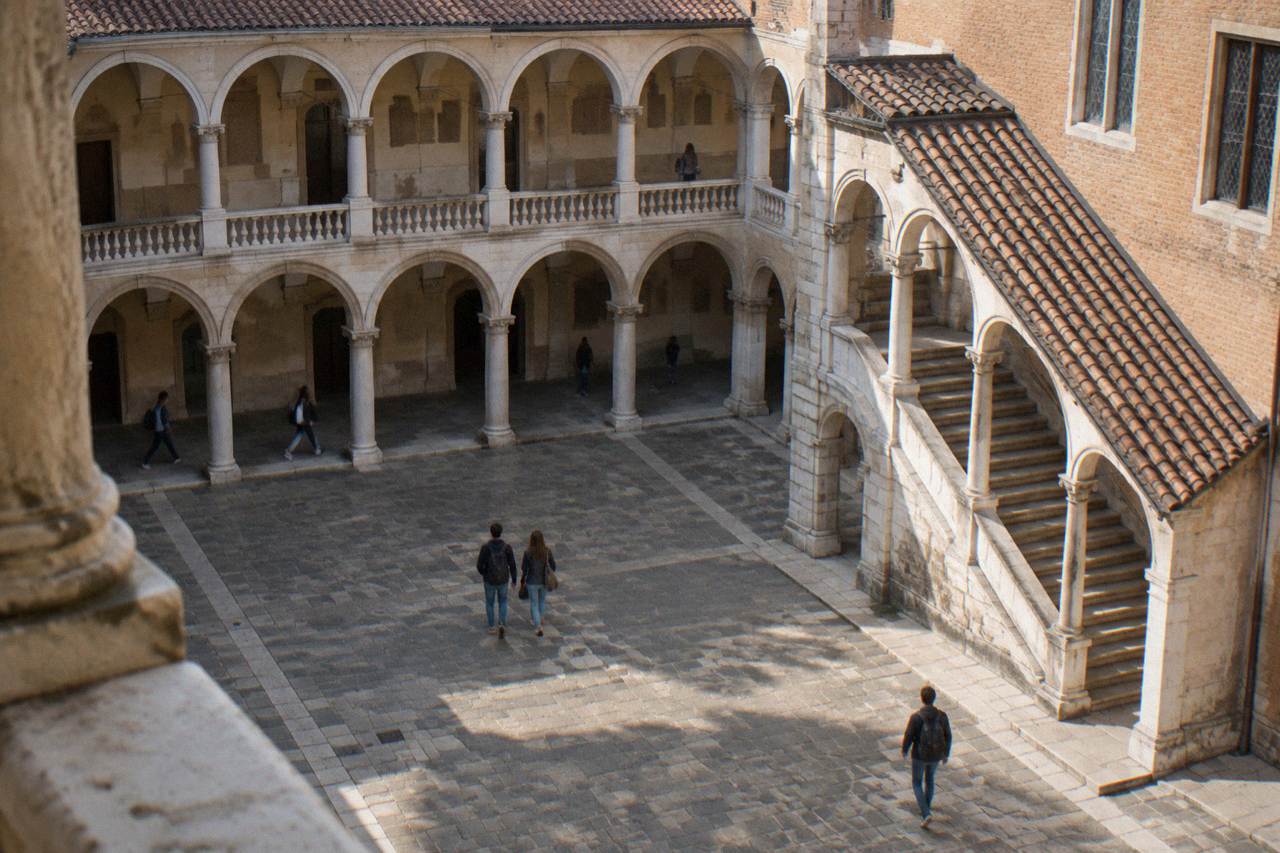
The University of Padua (Studium Patavinum) was founded in 1222 and is described by its own history pages as the second-oldest university in Italy after Bologna. Galileo held the chair of mathematics from 1592 to 1610, the anatomical theatre opened in 1594, and today about 76,000 students study here. Visitors can tour Palazzo del Bo on a guided route costing EUR 10 full.
Padua, an inland city in the Veneto about 36 km in a straight line from Venice, holds one of the great stories in European education: a university founded in 1222 that has been teaching ever since. The Studium Patavinum, as it was first called, grew out of a wave of students and teachers who arrived from Bologna, and over eight centuries it accumulated a record that few institutions anywhere can match. Galileo Galilei held its chair of mathematics from 1592 to 1610 and later called those years "the best eighteen years of all my life". The Orto Botanico, the university's botanical garden, was founded in 1545, and the first permanent anatomical theatre opened in 1594. In 1678 Elena Lucrezia Cornaro Piscopia took her degree in philosophy here, the first woman recorded to complete a university degree. This guide from the Padua Travel Guide editorial desk sets out the university's story, its key dates, and how a visitor can see the places where it happened.
Why Is The University Of Padua Famous?
The University of Padua is famous because it has taught continuously since 1222, making it among the oldest universities in the world, and because its history includes Galileo's eighteen years on the mathematics chair, the first permanent anatomical theatre of 1594, the Orto Botanico of 1545, and the first recorded woman university graduate, Elena Lucrezia Cornaro Piscopia, in 1678. The university's own history pages describe it as second-oldest in Italy after Bologna.
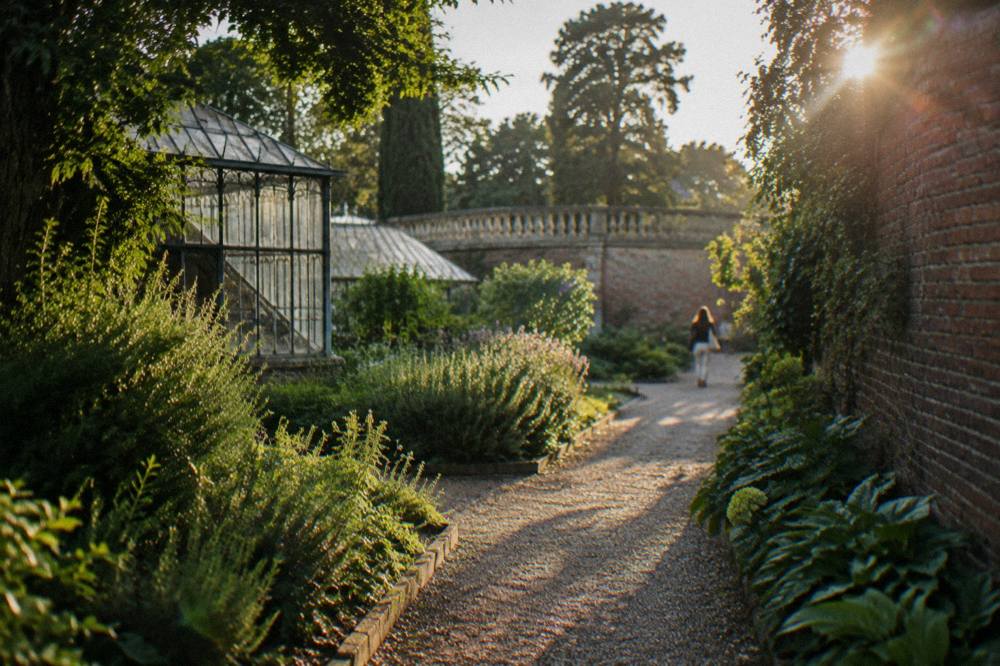
That concentration of firsts is unusual even among Italy's ancient institutions. The anatomical theatre, a wooden funnel of galleries built inside Palazzo del Bo, was inaugurated in 1594 for public dissections and medical teaching, and the university describes it as the first permanent anatomical theatre. The Orto Botanico, planted in 1545 as a garden of medicinal plants for the faculty of medicine, is described by the university as the first university botanical garden in the world; UNESCO inscribed it in 1997. You can read more about the garden itself in the Orto Botanico visitor guide.
The student body is part of the story too. The university reports about 76,000 students for the 2026/27 academic year, and the city of Padua, with roughly 208,000 residents, absorbs that population into its cafes, markets and squares. Education is not a sideshow in Padua; it is one of the city's operating systems, and it has been for eight hundred years.
When Was The University Of Padua Founded?
The University of Padua was founded in 1222 as the Studium Patavinum, set up by students and teachers who came from Bologna, and per the university's own history pages it ranks as the second-oldest university in Italy after Bologna. Teaching has run continuously since then, through the Carrara lordship, Venetian rule from 1405 to 1797, and the modern Italian state.
The founding year sits inside a specific political moment. Padua in 1222 was a self-governing commune, and the university emerged as a corporate body of scholars rather than a state project. When Venice annexed Padua in 1405, the Studium became the university of the Venetian Republic, drawing students from across the Venetian territories and beyond. That relationship lasted until 1797.
A common question is whether Padua can be called the oldest university of all. It cannot, and the honest phrasing is the university's own: second-oldest in Italy, and among the oldest surviving universities in the world. The fuller discussion of the ranking claims, and why they are contested, is in Is Padua The Oldest University?.
| Year | Event at the University of Padua |
|---|---|
| 1222 | Studium Patavinum founded by students and teachers from Bologna |
| 1405 | Padua passes to Venice; the university serves the Venetian Republic |
| 1545 | Orto Botanico founded as a garden of medicinal plants |
| 1592 | Galileo arrives to hold the chair of mathematics |
| 1594 | First permanent anatomical theatre inaugurated at Palazzo del Bo |
| 1678 | Elena Lucrezia Cornaro Piscopia graduates in philosophy |
| 1797 | Venetian rule ends |
What Did Galileo Do In Padua?
Galileo Galilei arrived at the University of Padua in 1592 to take the chair of mathematics and stayed until 1610, years he later called "the best eighteen years of all my life". While in Padua he taught, ran a workshop, and published Sidereus Nuncius in 1610, the book that reported the observations he had made with his telescope.
The university's own pages on Galileo's Padua years are the source for the dates and the quotation, and they frame the period as the most productive of his life. Padua gave Galileo a salary, students, and the intellectual freedom of a republic that was generally tolerant of new ideas. The chair of mathematics was a practical post: Galileo taught geometry, mechanics and astronomy to students preparing for careers in medicine and engineering.
A chair survives in the Sala dei Quaranta at Palazzo del Bo that tradition connects to Galileo, and it is one of the stops on the guided tour of the building. The deeper story of his Padua years, the telescope and the 1610 book is told in the site's Galileo in Padua guide. For visitors who want a single guided walk that reaches the university quarter together with the city's headline monuments, the site's featured premium private tour of Padua covers the Scrovegni Chapel, the Basilica and the historic centre; Check availability on the operator's live listing.
Can You Visit Palazzo Del Bo?
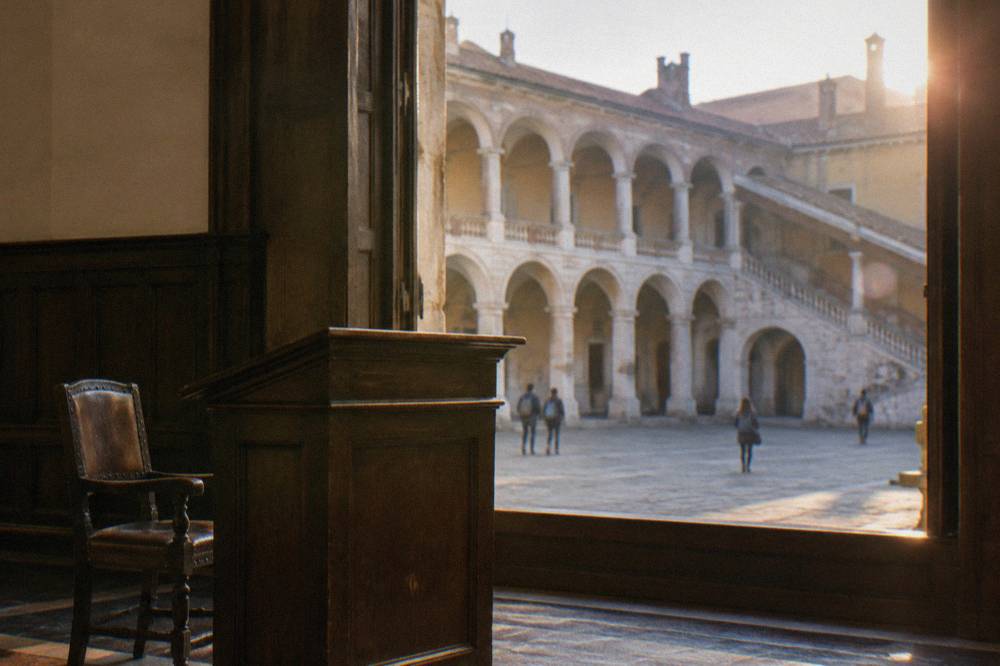
Yes, Palazzo del Bo, the historic seat of the University of Padua, can be visited on a guided "Giro storico" tour that costs EUR 10 full price for ages 26 to 64, EUR 8 reduced for visitors 65 and over, teachers and mixed groups of 10 to 30, EUR 6 for ages 6 to 25, and EUR 5 for school groups. The tour runs in alternating Italian and English slots.
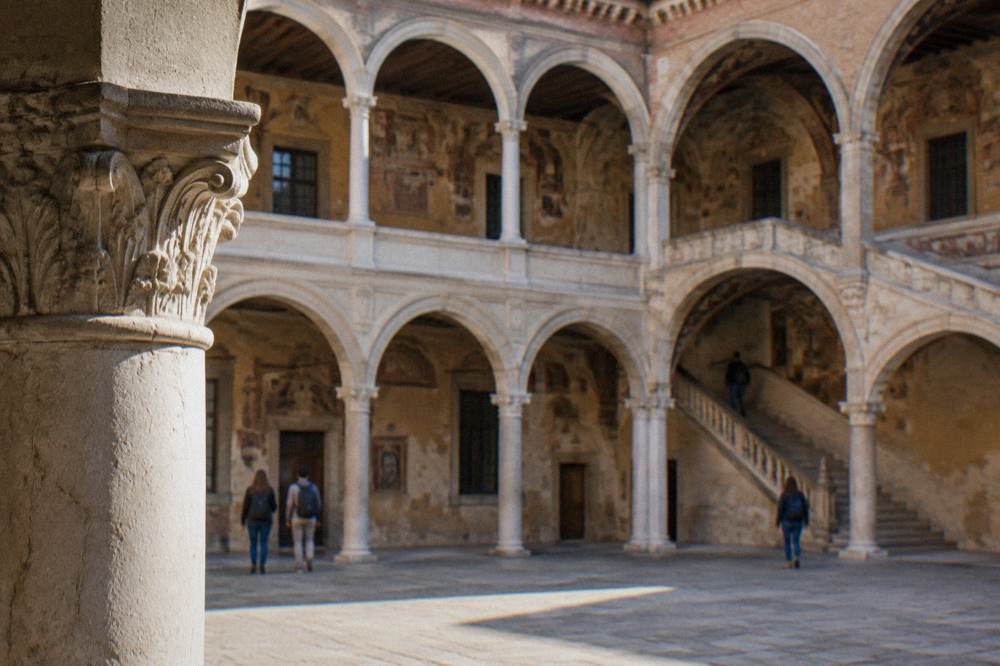
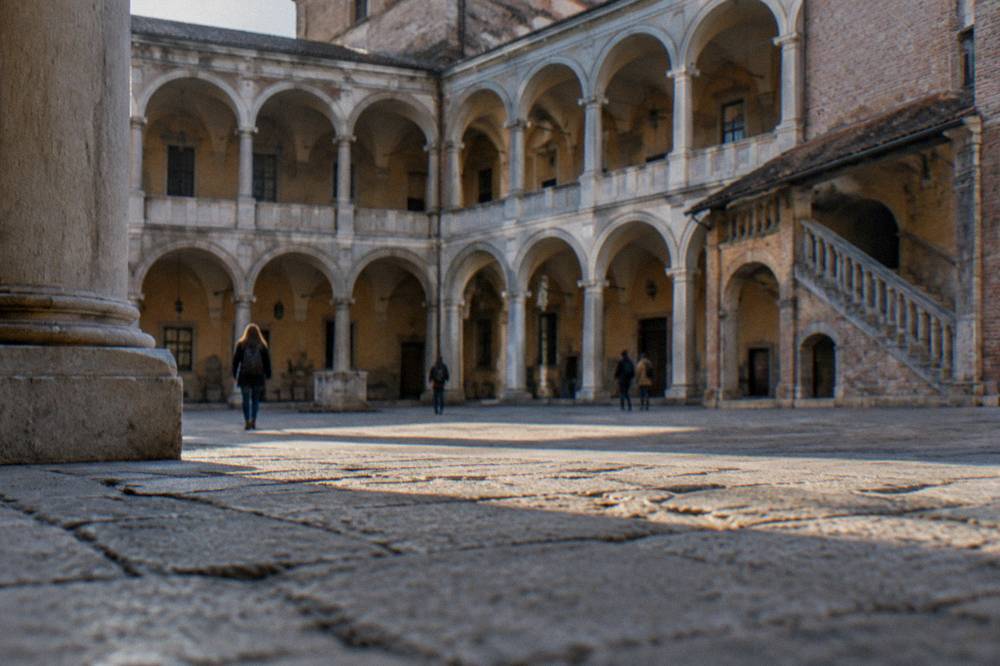
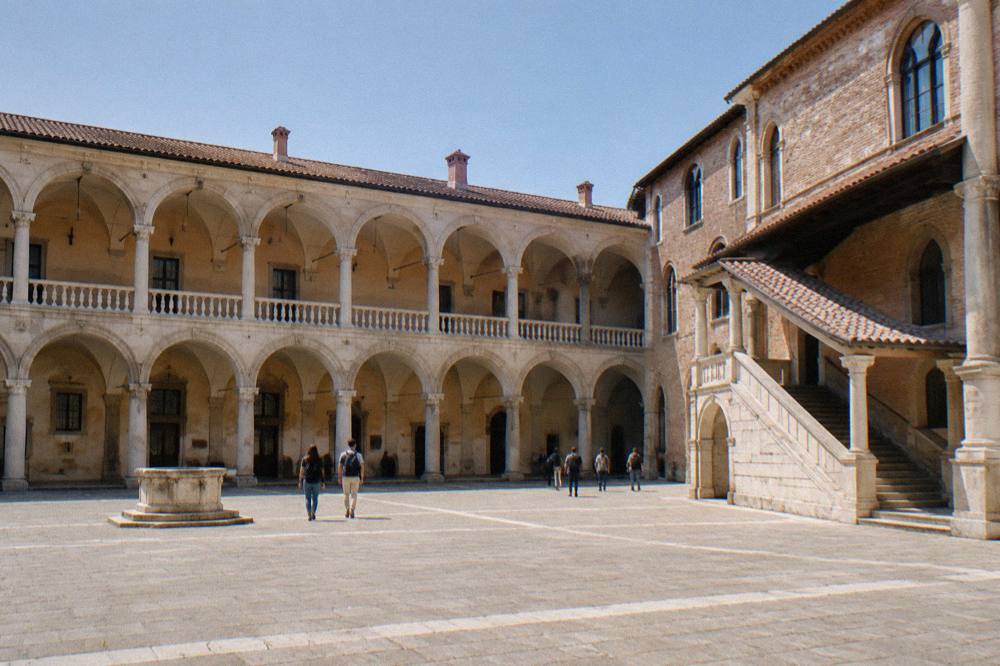
The route, as the university describes it, includes the Aula Magna, Galileo's chair in the Sala dei Quaranta, the anatomical theatre of 1594, the Medicine and Law halls, and the statue of Elena Cornaro. Not every room is guaranteed on every day, so the exact itinerary can shift. Booking runs through the university's tour centre on 049 827 3939, and the university also sells an integrated ticket called "Padova Citta della Scienza" that combines Palazzo del Bo with the Orto Botanico and the Museo della Natura e dell'Uomo, useful for anyone planning a science-themed day in the city.
Palazzo del Bo sits a short walk south of the city's market squares, which makes it easy to fold into a day that also takes in Piazza delle Erbe and the Caffè Pedrocchi, the 1831 cafe that has its own dedicated guide on this site's overview page.
| Palazzo del Bo "Giro storico" ticket | Price |
|---|---|
| Full, ages 26 to 64 | EUR 10 |
| Reduced, 65+, teachers, mixed groups of 10 to 30 | EUR 8 |
| Special reduced, ages 6 to 25 | EUR 6 |
| School groups | EUR 5 |
What Is The Anatomical Theatre Of 1594?
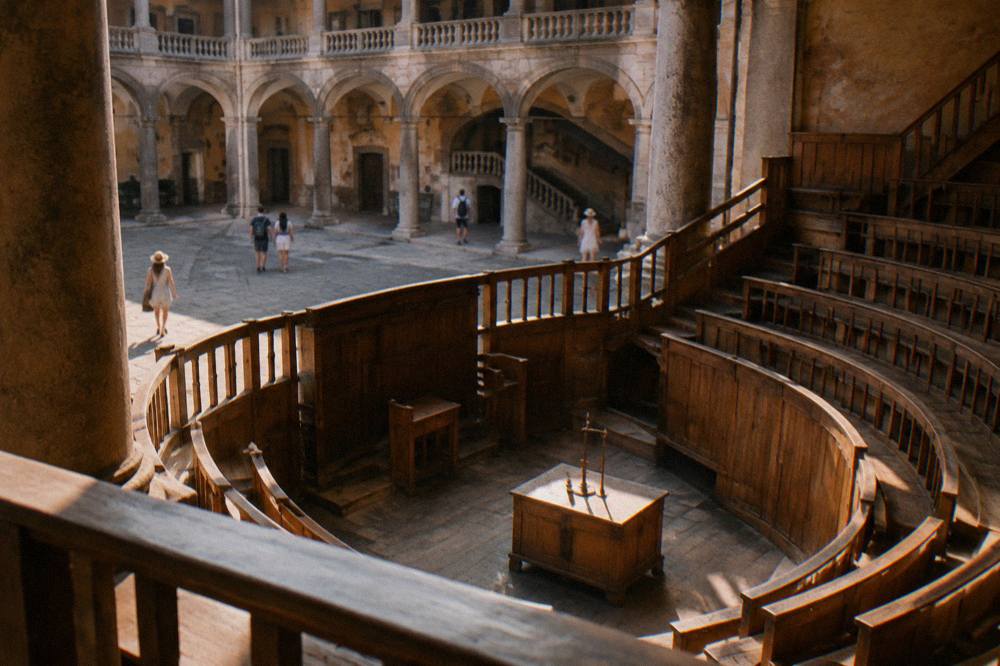
The anatomical theatre at Palazzo del Bo is a small steep wooden amphitheatre, inaugurated in 1594, that the University of Padua describes as the first permanent anatomical theatre in the world. Spectators stood in its tiered wooden galleries to watch dissections performed on the central table, a teaching format that made Padua a leading centre of Renaissance medicine.
The theatre is the physical proof of how medicine changed in this city. Before 1594, dissections had been temporary events, with scaffolding erected and dismantled for each occasion. A permanent structure meant anatomy became a regular part of the curriculum, and students travelled to Padua from across Europe to attend. The design is functional rather than decorative: carved wooden galleries, narrowing upward, each row giving a view of the table below, with the whole room small enough that standing spectators pressed close to the work.
The theatre still stands inside Palazzo del Bo and is a stop on the guided "Giro storico" tour. The nearby Baptistery of the Cathedral carries Giusto de' Menabuoi's fourteenth-century frescoes, part of the Padova Urbs Picta UNESCO inscription of 2021, so a morning of anatomy and a morning of frescoes sit within the same quarter of the city; the Urbs Picta guide maps all eight inscribed complexes.
Who Was Elena Cornaro Piscopia?
Elena Lucrezia Cornaro Piscopia took her doctorate in philosophy at the University of Padua on 25 June 1678, and the university records her as the first woman to receive a university degree in recorded history. Her statue stands inside Palazzo del Bo, on the guided tour route, and her graduation is one of the dates the university itself highlights in its official history.
Her degree was in philosophy, not theology, which is itself part of the story the university tells: she had sought examination in theology, and philosophy was the degree finally conferred. The ceremony drew a large crowd, and the university's pages on Cornaro preserve the event as a milestone of both the institution and European education generally. For a sense of how rare her achievement was, no comparable doctorate by a woman is recorded before it.
Padua marks her in stone. Inside Palazzo del Bo, the statue of Elena Cornaro appears among the stops named by the university for the Giro storico, a few rooms away from Galileo's chair, so a single tour places the two figures side by side.
How Big Is The University Of Padua Today?
The University of Padua today reports about 76,000 students for the 2026/27 academic year, in a city of roughly 208,000 residents, and it operates across multiple campuses and departments in and around Padua, including the Orto Botanico, the museums and hospital facilities. The figure of 76,000 comes from the university's own institutional pages.
The practical effect on a visit is that Padua feels like a university city in a literal sense. Term-time squares, tram cars and markets carry a large student population, and the university's buildings are scattered through the historic centre rather than gathered behind one gate. The Bo is the ceremonial heart, but the faculty of medicine's history is written across the Orto Botanico and the anatomical theatre, and the science museums extend it further.
The student share also shapes the city's rhythms and prices in general ways: markets, bakeries and inexpensive eateries cluster near the university quarter, and the what to eat in Padua guide covers the dishes that define the local tables, from bigoli to baccalà.
| University of Padua today | Figure |
|---|---|
| Students, 2026/27 academic year | about 76,000 |
| Founded | 1222 |
| Botanical garden | Orto Botanico, founded 1545 |
| Anatomical theatre | 1594 |
| City population | about 208,000 |
What Other History Should A Visitor Know?
A visitor should know that the University of Padua's history also includes the 1848 student uprising of 8 February 1848, when Padua's students joined the Risorgimento revolts against Austrian rule, an event recorded on the university's heritage pages, and that Palazzo del Bo's current form grew around the original "bo", the inn that gave the building its name.
The 1848 uprising belongs to the political chapters of the university's story. Padua was under Austrian control after 1797, and the February 1848 rising in the city was one of the early revolts of the Italian Risorgimento; students from the university took part on 8 February, and the university's heritage pages record the date. A few steps from the Bo, the Caffè Pedrocchi, opened in 1831, served as a meeting point during the same political ferment, and its Museo del Risorgimento continues the thread.
The university's museums and collections fill out the rest of a visit. The Orto Botanico is the flagship, but the Museo della Natura e dell'Uomo and the integrated "Padova Citta della Scienza" ticket bundle several stops into one science itinerary, as described earlier in this guide.
How Do You Plan A University-Themed Day In Padua?
A university-themed day in Padua works best as a walking loop: start at Palazzo del Bo for a guided Giro storico slot booked through 049 827 3939, continue to the Caffè Pedrocchi and the market squares, then finish at the Orto Botanico, whose ticket is EUR 15 full from 1 September 2026. The whole route stays inside the historic centre, which is compact and walkable.
Booking the Bo tour ahead matters because slots alternate between Italian and English and groups are limited. The Orto Botanico also runs fixed-time guided tours on weekends and holidays, with times published seasonally, and its audioguide is included in the ticket. Between the two, Piazza delle Erbe and Piazza dei Frutti give the market break, with stalls on weekdays until 13:30 and on Saturdays into the evening, and the city's food culture gets a full treatment in the restaurants guide.
If the day leaves time for one more monument, the Scrovegni Chapel is the city's other great draw, and it demands its own planning: entry is timed, with at most 25 people admitted every 15 minutes, booking is required, and the chapel closes 16 to 27 November 2026 for the annual fresco inspection. The full booking walkthrough is in the Scrovegni Chapel tickets guide.
| Stop on a university-themed day | Key figure |
|---|---|
| Caffè Pedrocchi | opened 1831 |
| Orto Botanico | EUR 15 full from 1 Sept 2026 |
| Orto Botanico guided tours | fixed times, weekends and holidays |
| Scrovegni Chapel (extension) | timed entry, max 25 every 15 minutes |
What About The University Quarter And Getting Around?
The university quarter spreads south and east of Padua's market squares, anchored by Palazzo del Bo, with the Caffè Pedrocchi, the Orto Botanico and the Basilica of Saint Anthony all within walking distance, and the city's tram and bus network uses a EUR 1.70 urban ticket valid for 90 minutes, payable by contactless card on board.
Walking remains the practical way to see the quarter. Padua's historic centre is compact, arcaded and flat, and the distances between the Bo, the Orto Botanico and Prato della Valle are short. For longer hops, the urban TU1 ticket covers 90 minutes of travel on city buses and the SIR1 tram line, which runs north to south across the city; a daily ticket is also sold. Tickets load through the operator's app, or a contactless bank card can be tapped on board.
Arriving and leaving is simple. Trains call at Padova station on the Venice-Milan line, with Venice about 26 to 40 minutes away by regional service, and the station's tourist office sits at the exit of platform 1. The full arrival picture is in the how to get to Padua guide, and the getting around guide covers the tram in detail.
When Is The Best Time To Visit Padua For The University Sights?
The best time to visit Padua for the university sights is spring or early autumn: the ERA5 reanalysis 1991-2020 gives July and August a mean daily high of 28.8 C and January a mean high of 7.3 C, while April to June and September sit between those extremes with moderate rain, and the Orto Botanico's plants and the walking distances both reward milder weather.
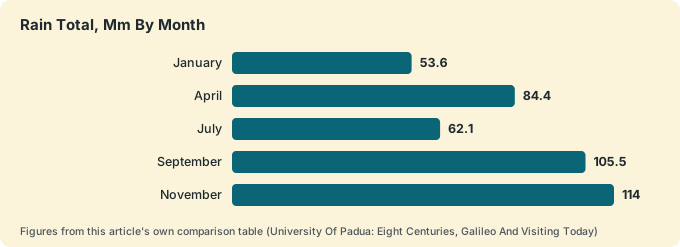
Rain matters more in Padua than many visitors expect. The same reanalysis puts November as the month with the highest total, 114 mm, with September and October near 105 mm each, and January the lowest at about 54 mm. The university buildings themselves are indoor stops, but a Padua visit is largely a walking visit, so the seasonal detail in the Padua weather guide and the best time to visit guide is worth reading before fixing dates.
One date to avoid for the chapel extension is 16 to 27 November 2026, when the Scrovegni Chapel closes for its annual fresco inspection; Palazzo del Bo tours and the Orto Botanico continue, but the headline frescoes need a different week.
| Month | Mean daily high, ERA5 1991-2020 | Rain total, mm |
|---|---|---|
| January | 7.3 C | 53.6 |
| April | 17.6 C | 84.4 |
| July | 28.8 C | 62.1 |
| September | 23.6 C | 105.5 |
| November | 12.6 C | 114.0 |
Where Should You Stay And What Else Should You Combine?
For a university-focused visit, staying in or near the historic centre of Padua keeps Palazzo del Bo, the Orto Botanico and the market squares within a short walk, and the city also works as a base for Venice, about 36 km away in a straight line, with regional trains taking about 26 to 40 minutes. The where-to-stay guide on this site maps the neighbourhoods.
Padua's accommodation collects a city tourist tax, charged per person per night for up to five consecutive nights and collected by the accommodation itself; rates by category are published by the city, so confirm the amount when booking. Beyond the city, the university theme extends naturally outward: the Scrovegni Chapel and the other seven Padova Urbs Picta sites weave medieval frescoes into the same streets, and the Basilica of Saint Anthony guide covers the church that gives the city its other great pilgrimage story.
Venice as a day trip, or Padua as a base with Venice bolted on, is a common pattern, and both directions are covered in the Padua as a base for Venice guide and the Venice to Padua guide.
Common Questions About The University Of Padua
When was the University of Padua founded?
The Studium Patavinum was founded in 1222 by students and teachers who arrived from Bologna, and per the university's own history pages it is second-oldest in Italy after Bologna.
Can you visit the University of Padua?
Yes.
Did Galileo teach at the University of Padua?
Galileo held the chair of mathematics in Padua from 1592 to 1610 and later described the period as the best eighteen years of all his life. Sidereus Nuncius was published in 1610.
What is the anatomical theatre at Palazzo del Bo?
It is a steep wooden amphitheatre inaugurated in 1594, described by the university as the first permanent anatomical theatre, and it is a stop on the guided tour of Palazzo del Bo.
Who was the first woman to graduate from a university?
Elena Lucrezia Cornaro Piscopia took her doctorate in philosophy at the University of Padua on 25 June 1678, recorded as the first woman to receive a university degree.
How many students does the University of Padua have?
The university reports about 76,000 students for the 2026/27 academic year.
