What To Eat In Padua: Bigoli, Torresani And Gallina Padovana
Padua's kitchen runs through its market squares: gallina padovana, bigoli, risotto ricco alla padovana and a mint coffee at Caffè Pedrocchi, in the city where Aperol was created in 1919.
Short answer
The dishes the Padua tourism board itself names are risotto ricco alla padovana, capon alla canevera made with the gallina padovana chicken, and torta pazientina; bigoli pasta and baccalà are the other standard local plates, best encountered around the market squares of Piazza delle Erbe and Piazza dei Frutti.
Padua, in the Veneto in northern Italy, is a market city before it is a museum city, and the two meet in the same square kilometre of arcades and food stalls. The Padua tourism board names three patented local recipes, risotto ricco alla padovana, capon alla canevera and torta pazientina, and the everyday kitchen around them runs on bigoli pasta, baccalà and the gallina padovana, a local chicken breed with its own place in the city's agricultural history. This guide walks through the dishes, the squares where they are eaten, the coffee and spritz culture, and how to taste a lot of it in a short stay. For the sights between meals, start with Things To Do In Padua.
What Are The Dishes Padua Is Known For?
The Padua tourism board names three signature local recipes: risotto ricco alla padovana, capon alla canevera made with the gallina padovana chicken, and the torta pazientina cake. Around them sit the everyday plates of the Venetian mainland, above all bigoli, the thick strand pasta, and baccalà, salt cod cooked in the northern Italian style. None of these are tourist inventions; they are the market cooking of a city that has fed itself from Piazza delle Erbe for centuries.
The risotto ricco alla padovana is the rich version of the city's rice dish, a legacy of the rice paddies of the Venetian plain. Capon alla canevera is the festive bird: the gallina padovana is a local chicken breed, and the canevera in the name refers to the cane spit the bird is roasted on, a method the tourism board presents as one of the city's three patented recipes. Torresani, the pigeons of the Veneto tradition, appear on roasting spits in the same family of dishes.
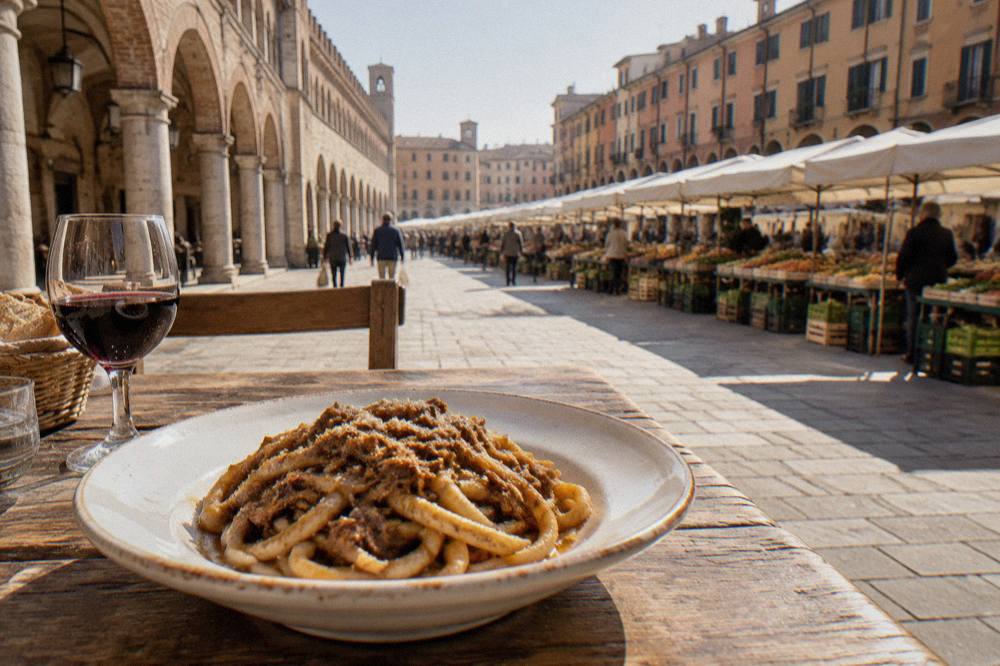
Bigoli deserves its own word. It is a thick, rough-surfaced pasta strand, traditionally extruded under pressure so the sauce clings to it, and in Padua it is classically served with duck ragù, onion sauce or sardine and anchovy sauce. Baccalà, whipped or stewed salt cod, is the other constant of the Venetian mainland table. Neither is exclusive to Padua, but both belong to the city's standard repertoire, and a menu without either is a menu from somewhere else.
| Dish | What it is | Status in Padua |
|---|---|---|
| Risotto ricco alla padovana | Rich local risotto from the rice-growing Venetian plain | Named by the tourism board as a patented local recipe |
| Capon alla canevera | Chicken roasted on a cane spit, made with the gallina padovana breed | Named by the tourism board as a patented local recipe |
| Torta pazientina | A layered patience cake, the city's signature dessert | Named by the tourism board as a patented local recipe |
| Bigoli | Thick rough pasta strand, served with duck, onion or sardine sauce | Standard local plate |
| Baccalà | Salt cod, whipped or stewed | Standard local plate |
| Torresani | Roasted pigeons of the Venetian tradition | Festive local plate |
The practical way to meet several of these in one afternoon is a guided walk from the market to an osteria, where the tastings add up to a meal. The site's featured food tour covers exactly that arc: Check availability for the operator's live listing.
Where Does Padua Actually Eat: The Markets And Squares?
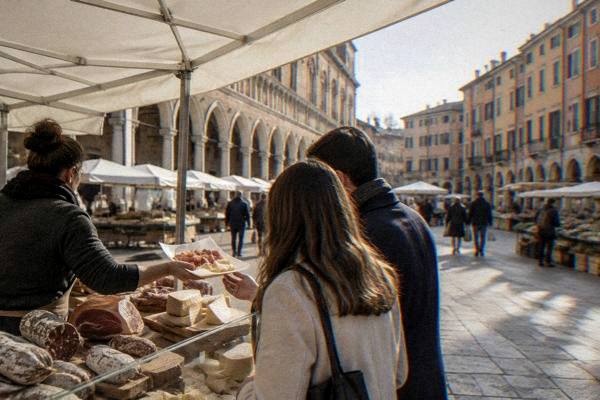
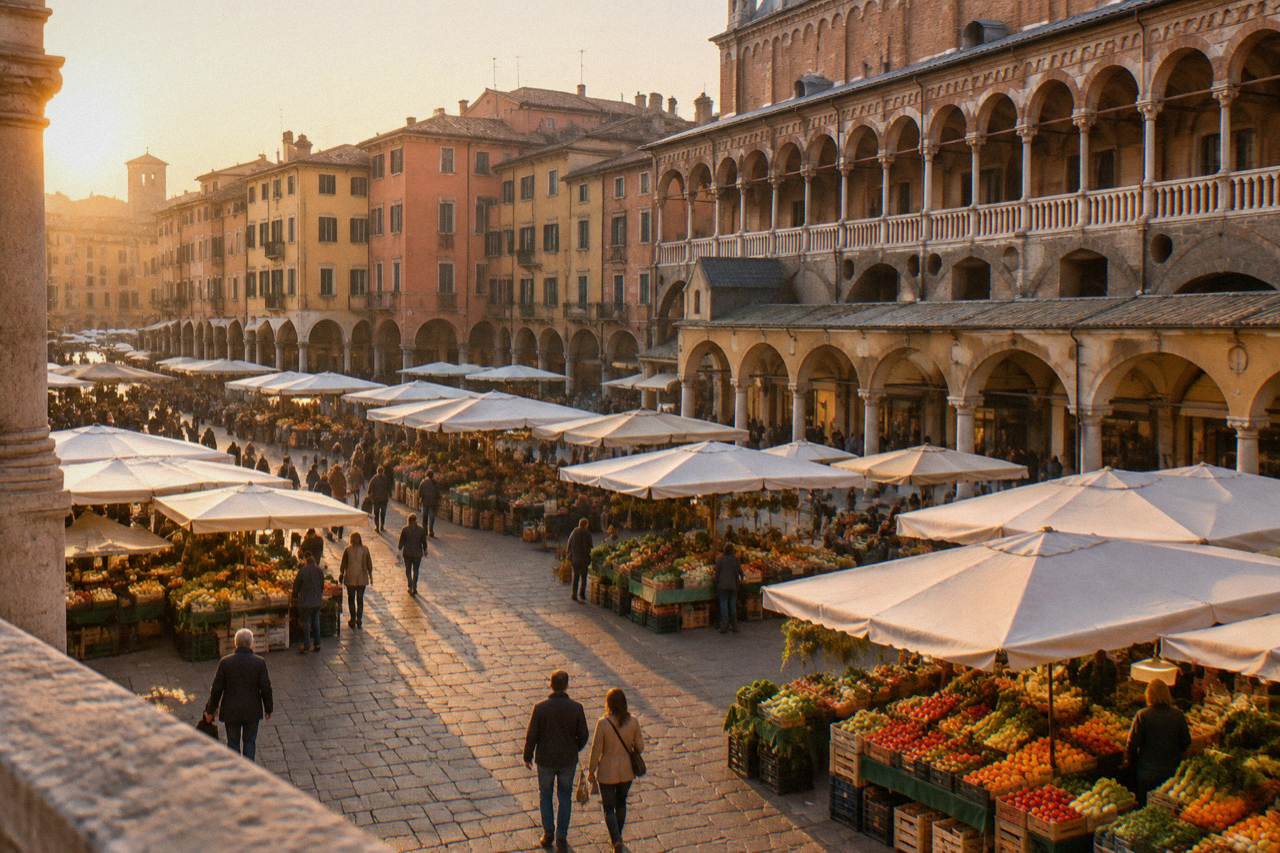
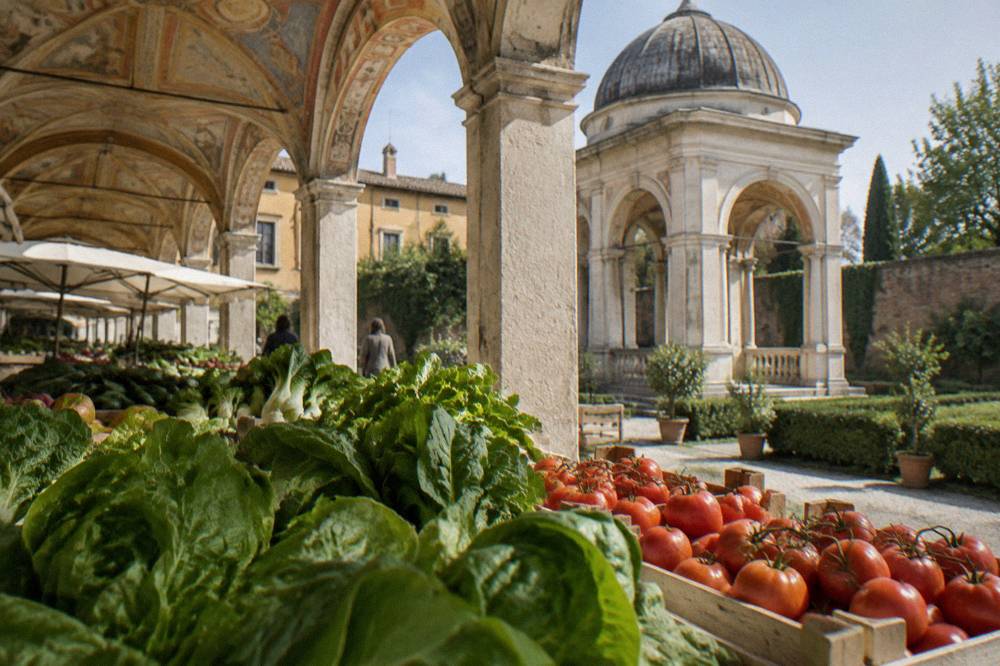
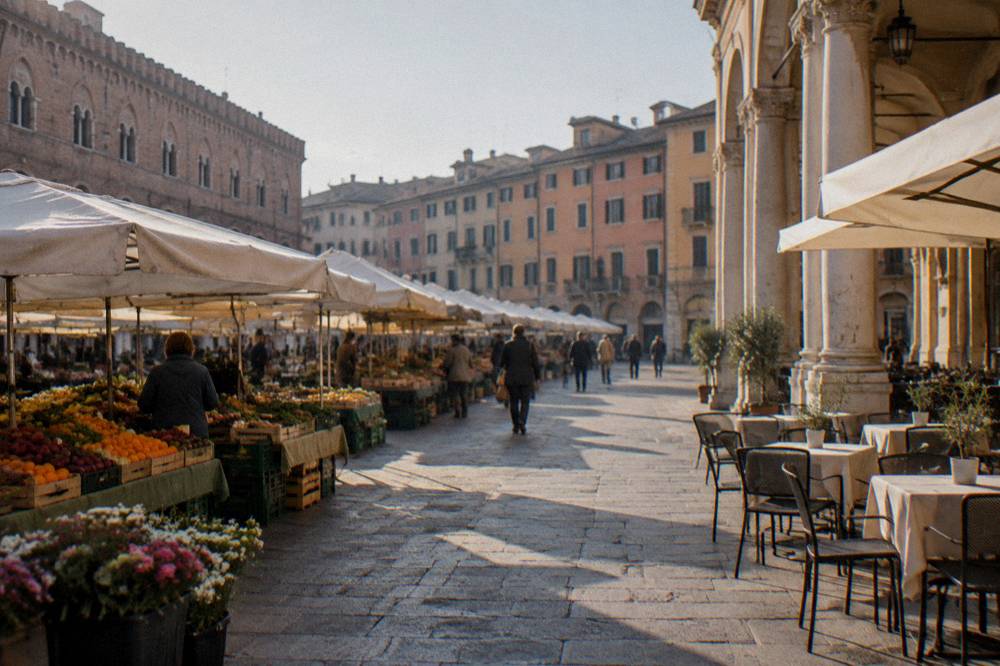
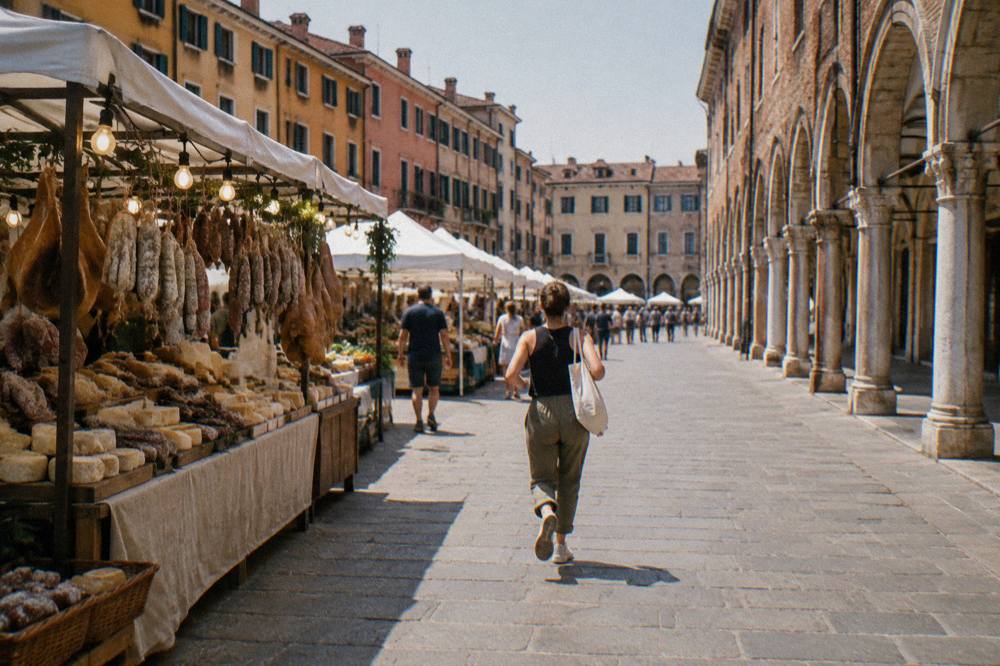
Padua's food life is anchored by three city markets run by the Comune: Piazza delle Erbe with 52 stalls of fruit, vegetables and flowers, Piazza dei Frutti for food and non-food stalls across the week, and the Saturday market on Prato della Valle. Sotto il Salone, the covered food market under Palazzo della Ragione, described by the tourism board as running for eight centuries, keeps the specialty traders under the city's great hall.
The hours are published by the Comune di Padova and are worth planning around. Piazza delle Erbe runs Monday to Friday from 7:30 to 13:30 and Saturday from 7:30 to 20:00. The Piazza dei Frutti food market runs Monday to Wednesday from 8:00 to 14:00 and Thursday to Saturday from 8:00 to 19:00, with non-food stalls Tuesday to Friday from 8:00 to 14:00 and Saturday from 8:00 to 19:00. The Prato della Valle market is Saturday only, 8:00 to 19:00 in winter and 8:00 to 20:00 in summer, and on the third Sunday of each month the same square and via Umberto I host the antiques market from 8:00 to 20:00.
| Market | Days and hours | What it sells |
|---|---|---|
| Piazza delle Erbe | Mon-Fri 7:30-13:30, Sat 7:30-20:00 | 52 stalls, mostly fruit, vegetables, flowers |
| Piazza dei Frutti, food | Mon-Wed 8:00-14:00, Thu-Sat 8:00-19:00 | Food stalls |
| Piazza dei Frutti, non-food | Tue-Fri 8:00-14:00, Sat 8:00-19:00 | Non-food stalls |
| Prato della Valle | Saturday, 8:00-19:00 winter, 8:00-20:00 summer | Non-food, plants, flowers, fruit and vegetables |
| Antiques market | Third Sunday of the month, 8:00-20:00 | Antiques, at Prato della Valle and via Umberto I |
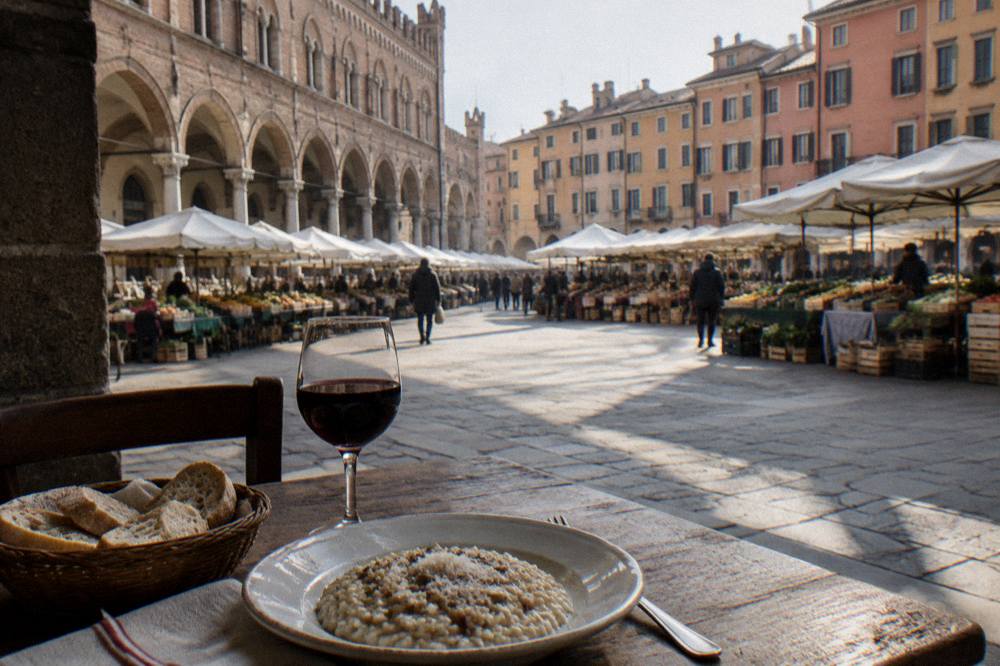
In the evening the same squares change character. The tourism board describes Piazza delle Erbe and Piazza dei Signori as the centre of the city's aperitivo life, with spritz and botteghe, small wine and food shops, spilling across the pavement. The squares, not any single venue, are the address. For how the evening unfolds from there, see Padua Nightlife and the companion guide to Spritz In Padua.
A market walk answers the shopping question, but the cooking question is better answered in a kitchen. A small-group class that begins at the market and ends around a table covers both halves of the same afternoon.
What Is Gallina Padovana And Why Does One Chicken Matter?
The gallina padovana is a local chicken breed with a crested head, raised in the Paduan countryside and used for capon alla canevera, the cane-spit roast the tourism board lists among the city's three patented recipes. It ties the city's cooking to the farmland of the Venetian plain, the same hinterland that produces the Euganean Hills oil and wine, and it is the bird to look for on a traditional Paduan menu.
The breed is part of a wider rural identity. The Euganean Hills begin about 8 km in a straight line from the city centre, and the hills' olive oil and wine reach Paduan tables through the same market network. A tasting trip into the hills is the easiest way to taste that hinterland without a car, and the operator's listing covers the mills and wineries visited.
What Is Bigoli And How Is It Served In Padua?
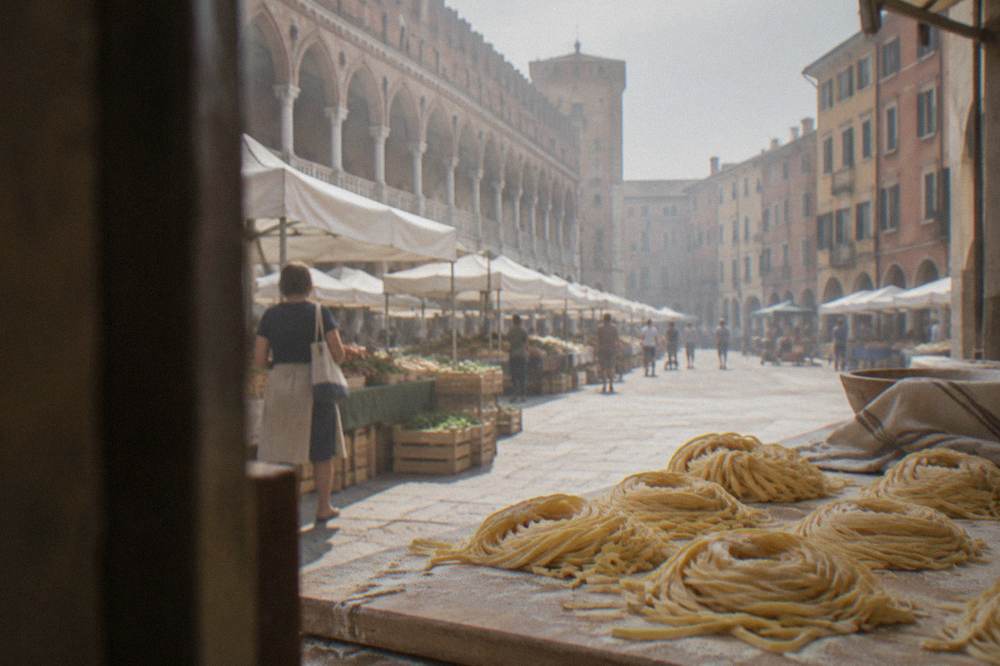
Bigoli is a thick, coarse-stranded pasta, traditionally pressed through a die that leaves a rough surface so the sauce grips it, and in Padua the classic pairings are duck ragù, an onion-based sauce, or a salty sardine and anchovy sauce. It is the everyday pasta of the Venetian mainland, heavier than spaghetti and made to be eaten with slow, fatty sauces rather than light ones.
The duck ragù version, bigoli co l'arna, is the one that shows the dish at its fullest: the bird is braised until it breaks down into a sauce, and the pasta does the carrying. The onion and anchovy versions are cheaper, older and equally local. None of these dishes need a famous address, which is convenient, because this guide names no venue: the squares and the market are the reliable starting point, and Best Restaurants In Padua is the companion page for how to choose one.
What Is Torta Pazientina And What Should You Eat For Dessert?
Torta pazientina is the layered cake the Padua tourism board names as the third of the city's patented recipes: a patient, multi-stage dessert built from layered biscuits, cream and chocolate. It is the city's answer to the question of what to eat after bigoli, and it appears in the pastry shops and on the menus of the historic centre alongside the standard Venetian sweets rather than instead of them.
The name comes from pazienza, patience, because the cake is assembled in stages. It is the dessert to order when the menu offers a choice between it and the generic Italian standards. Beyond it, the Venetian tradition of fritole and galani belongs to the Carnival season, and no Padua Carnival dates for 2027 had been announced when the city's event calendars were last checked, so plan dessert around the cake instead.
| Sweet | What it is | When to look for it |
|---|---|---|
| Torta pazientina | Layered biscuit, cream and chocolate cake, a tourism-board patented recipe | Year-round |
| Caffè Pedrocchi with mint | The historic cafe's signature layered coffee with mint | Year-round at Caffè Pedrocchi |
| Fritole | Venetian fried dough sweets | Carnival season |
Why Is Caffè Pedrocchi Part Of Eating In Padua?
Caffè Pedrocchi opened in 1831 in a neoclassical building by Giuseppe Jappelli and was long known as the cafe without doors, a name earned in the era when it stayed open around the clock; its signature drink is the caffè Pedrocchi, a layered coffee with mint. The coffee house sits opposite the university quarter, and the tourism board presents it as a stop in its own right rather than a simple bar.
The mint coffee is the thing to order, and the building's three floors, including the Museo del Risorgimento on the upper level, make it a sight as much as a cafe. The museum runs Tuesday to Sunday, 9:30 to 12:30 and 15:30 to 18:00, with a full-price ticket of EUR 5, per the civic museums' own price page. A short walk connects the cafe to Palazzo del Bo, the historic university building where Galileo taught from 1592 to 1610, so the coffee stop fits neatly before or after a visit, and the University Of Padua guide covers the rest of that story.
Was Aperol Really Invented In Padua?
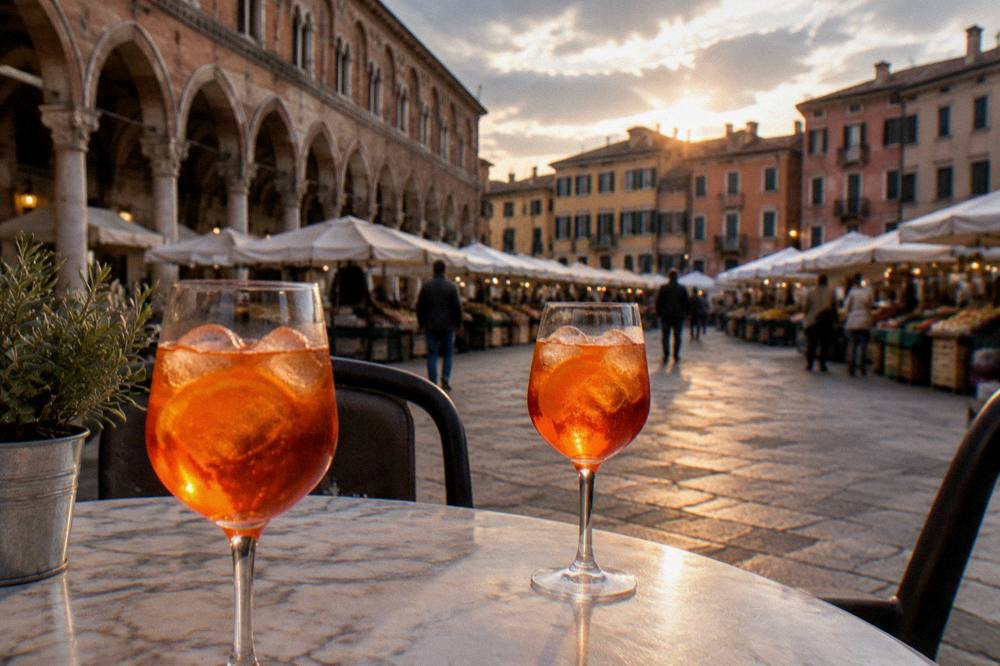
Yes: Aperol was created and first presented in Padua in 1919 by the Barbieri brothers, at the city's fair, and the spritz built on it became the standard Venetian aperitivo. The base idea of diluting wine with something bitter and fizzy predates the brand, so the honest line is that the modern orange spritz's most famous ingredient is Paduan, not that the spritz itself was invented here.
That 1919 fact is the city's quiet claim on the global aperitivo. The aperitivo scene the tourism board describes is concentrated on Piazza delle Erbe and Piazza dei Signori, where the evening drink comes with the squares' painted facades overhead. Ordering is simple: a spritz, an ombra of wine, or a bitter and tonic, each standing in. What this page will not do is rank the bars or name one, because no venue on this site has been reviewed.
How Do You Taste A Lot Of Padua In One Day?
The efficient answer is to link the market in the morning, a guided tasting walk across the centre at midday, and the aperitivo squares in the evening, letting a single day carry the city's food from raw produce to finished drink. A guided food walk compresses a dozen decisions into one booking, and the city's compactness, everything from Piazza delle Erbe to Prato della Valle is walkable, makes the chain possible without transport.
A realistic skeleton: the Piazza delle Erbe and Piazza dei Frutti stalls in the morning, while the market is in full swing before the 13:30 or 14:00 closes; a tasting walk or a market-to-cooking-class format through the middle of the day; the squares again for the aperitivo; and dinner inside the same ring of arcades. The itineraries on this site, including Padua In One Day, slot the meals around the Scrovegni Chapel, whose timed-entry tickets need booking ahead, covered in Scrovegni Chapel Tickets.
| Time of day | Where | What |
|---|---|---|
| Morning | Piazza delle Erbe, Piazza dei Frutti | Market stalls, fruit, vegetables, flowers |
| Midday | Historic centre | Guided food walk or market-and-cooking class |
| Afternoon | Caffè Pedrocchi, via the university quarter | Mint coffee, Risorgimento museum |
| Evening | Piazza delle Erbe, Piazza dei Signori | Aperitivo and spritz |
| Saturday | Prato della Valle | Market, 8:00 to 19:00 winter, 8:00 to 20:00 summer |
What Food Events Mark The Padua Calendar?
The fixed food dates in the city's calendar are the Salone dei Sapori, which ran 11 to 18 October 2026 as eight days of food and wine producers at the Sotto il Salone market tradition, the Sherwood Festival from 10 June to 12 July 2026, and the feast of Saint Anthony on 13 June, closing the Tredicina that ran 31 May to 12 June in 2026. The Padova Marathon on 18 April 2027 finishes at Prato della Valle, where the Saturday market stands.
The Salone dei Sapori is the one to plan a food trip around: an annual autumn event tied to the permanent Sotto il Salone market, with dedicated evenings during its run in 2026. The Sherwood Festival adds the music-and-food summer layer at Park Nord by the Stadio Euganeo. The Tredicina is religious rather than gastronomic, but the thirteen days before 13 June fill the streets around the Basilica of Saint Anthony, and the squares eat accordingly. The full calendar, including what had not been announced for 2027, sits in Padua Events And Festivals.
Is Padua Expensive For Eating?
Eating in Padua sits on the affordable side of the Veneto because the city's food culture runs through its markets and standing aperitivo rather than through formal dining: the Piazza delle Erbe stalls run until 13:30 on weekdays and 20:00 on Saturday, and a spritz in the evening squares follows the standard Venetian pricing of the region.
The costs that do need budgeting are the sightseeing tickets, not the food: the Scrovegni Chapel at EUR 15 full plus a EUR 1 booking fee, and the Orto Botanico at EUR 15 full from 1 September 2026.
The tourist tax is per person per night, capped at five consecutive nights and collected by the accommodation, with rates set by category and under-16s exempt. Getting around to eat costs little: the urban 90-minute ticket is EUR 1.70, and the whole historic centre is walkable between meals, as the companion guide to Getting Around Padua details. For the wider budget picture, including free sightseeing to balance the spending, see Padua On A Budget and Free Things To Do In Padua.
| Cost item | Figure | Notes |
|---|---|---|
| Scrovegni Chapel, full ticket | EUR 15 plus EUR 1 booking fee | Includes Musei Civici Eremitani and Palazzo Zuckermann, daytime |
| Orto Botanico, full ticket | EUR 15 from 1 Sept 2026 | EUR 12 winter rate, November to February |
| Palazzo del Bo guided tour | EUR 10 full, EUR 8 reduced | About 45 minutes, alternating Italian and English slots |
| Urban transport ticket | EUR 1.70 for 90 minutes | Contactless card tap accepted on board |
| Tourist tax | Collected per person per night | Capped at five consecutive nights, under-16s exempt |
Should You See The Food With A Guide Or On Your Own?
Doing it alone works well in Padua because the markets publish their hours and the squares are obvious, but a guide adds three things: access to producers and counters that a first-time visitor would not pick, translation of the menu vocabulary, and a route that links the tastings into a meal rather than a series of snacks. The market-to-osteria format does exactly this, and the cooking-class formats add the recipe to the tasting.
The honest split is this: if the goal is to eat well tonight, walk the squares alone. If the goal is to understand bigoli, gallina padovana and the pazientina before leaving, a guided tasting walk or class earns its price on the first plate. The site's featured tour runs from the market stalls to an osteria with tastings and wine, and the wider selection below covers both the food formats and a sightseeing walk to fill the gaps between them.
Common Questions About Eating In Padua
What to eat in Padua?
The Padua tourism board's three named local recipes are risotto ricco alla padovana, capon alla canevera made with the gallina padovana, and torta pazientina. Bigoli pasta with duck or onion sauce and baccalà are the other standard plates, best found around the market squares of Piazza delle Erbe and Piazza dei Frutti.
What food is Padua known for?
Bigoli, baccalà, the gallina padovana chicken, risotto ricco alla padovana and the torta pazientina cake, plus the mint coffee at Caffè Pedrocchi and the spritz, whose famous ingredient Aperol was created in Padua in 1919 by the Barbieri brothers.
Where do locals eat in Padua?
The city's food life concentrates on its market squares: Piazza delle Erbe with its 52 stalls, Piazza dei Frutti, and the Saturday market at Prato della Valle, with Sotto il Salone, the covered market under Palazzo della Ragione, described by the tourism board as running for eight centuries. In the evening the aperitivo scene moves across Piazza delle Erbe and Piazza dei Signori.
What is the most famous cafe in Padua?
Caffè Pedrocchi, opened in 1831 in a neoclassical building by Giuseppe Jappelli and long known as the cafe without doors. Its signature drink is the caffè Pedrocchi, a layered coffee with mint.
When are Padua's markets open?
Per the Comune di Padova: Piazza delle Erbe runs Monday to Friday 7:30 to 13:30 and Saturday 7:30 to 20:00; the Piazza dei Frutti food market runs Monday to Wednesday 8:00 to 14:00 and Thursday to Saturday 8:00 to 19:00; the Prato della Valle market is Saturday only, 8:00 to 19:00 in winter and 8:00 to 20:00 in summer; and the antiques market fills the third Sunday of each month from 8:00 to 20:00.
Is Aperol from Padua?
Yes. Aperol was created and first presented in Padua in 1919 by the Barbieri brothers at the city's fair. The older idea of a wine-based spritz predates the brand, so the modern drink's signature ingredient is Paduan even though the spritz concept is not.
Padua rewards eating the way it arranges itself: slowly, in squares, between a chapel and a market stall, with a plate of bigoli in the middle and a mint coffee at the end. The Padua Travel Guide covers where to sleep after all of it in Where To Stay In Padua.