Getting Around Padua: Tram, Bus And On Foot
Padua rewards travellers who arrive by train and never touch a car: one tram line, a dense bus network, a EUR 1.70 urban ticket and an old town where the main sights sit within a short walk of the market squares.
Short answer
Padua's urban ticket costs EUR 1.70 for 90 minutes on bus and tram, the SIR1 tram runs north to south through the city, and the historic centre is compact enough that the main sights need no vehicle at all.
Padua (Italian: Padova) is an inland city in the Veneto, about 36 km in a straight line from Venice, and it is one of the easiest cities in northern Italy to move around without a car. A single tram line crosses it north to south, a bus network fills the gaps, the urban ticket is EUR 1.70 for 90 minutes on either, and the whole weight of the city, the Scrovegni Chapel, the Basilica of Saint Anthony, Prato della Valle, the Orto Botanico and the two market squares, sits inside a walking radius no bigger than the centre itself. This guide sets out what the operators and the city publish: ticket prices, the tram's route, the station layout, the walkable old town, and how the trains connect Padua to the day-trip cities around it.
How Do You Get Around Padua Without A Car?
You do not need a car in Padua: the urban transit system is a tram line plus a bus network run under one fare zone, a 90-minute ticket costs EUR 1.70 and a contactless bank card tapped on board pays the same fare, while the historic centre is compact and every major sight lies within a short walk of the market squares. Per the operator's fare page, tickets are digital, bought in the app or with a tap, and there is no paper ritual to learn. Cars, for their part, sit awkwardly in a city whose centre is arcaded, pedestrian in stretches and guarded by a limited-traffic zone; the details of that zone are covered on the Padua ZTL and parking page.
The frame to hold in your head is a small one. Padua's population is about 208,000 and its university adds roughly 76,000 students in term, which is the reason transit runs late and often. The city is built along the Bacchiglione and its canals, not on a lagoon, and the rail line that brings you in from Venice, Verona or Milan passes straight through the north of the centre at Padova station.
Distances inside the city are short. The city-tier landmarks, from the Scrovegni Chapel across to Prato della Valle and down to the Basilica of Saint Anthony, all fall within about 3 km of the centre point, a computed figure from the site's own geodata rather than a marketing claim. In practice that means the decision is rarely "which bus" but "whether to bother".
Does Padua Have A Tram?
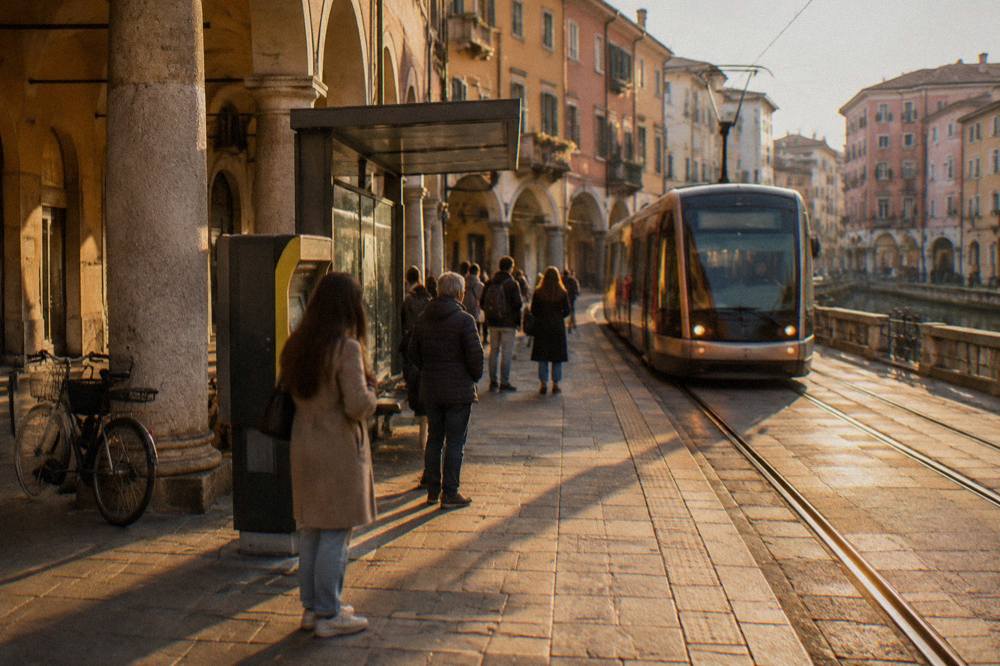
Yes, Padua has a rubber-tyred tram, the SIR1, a Translohr line running north to south for about 10.5 km through 26 stops from Vigodarzere to Guizza, reported by the city's own project documents, with a second line, the SIR3 from the station to Voltabarozzo, still in pre-service testing with service targeted for the end of 2026. The SIR1 has run since March 2007 on a route that crosses the city centre, and it is the one line a visitor is likely to board, because it links the station area with the south of the city.
The SIR3 needs careful wording. Local press reports say testing resumed and pre-service running is under way, aimed at the end of 2026, but no opening date has been fixed, and a traveller should plan around the SIR1 and the buses only. When the SIR3 enters service it will connect the station to the Voltabarozzo district, again per the press reports, not the city's final timetable.
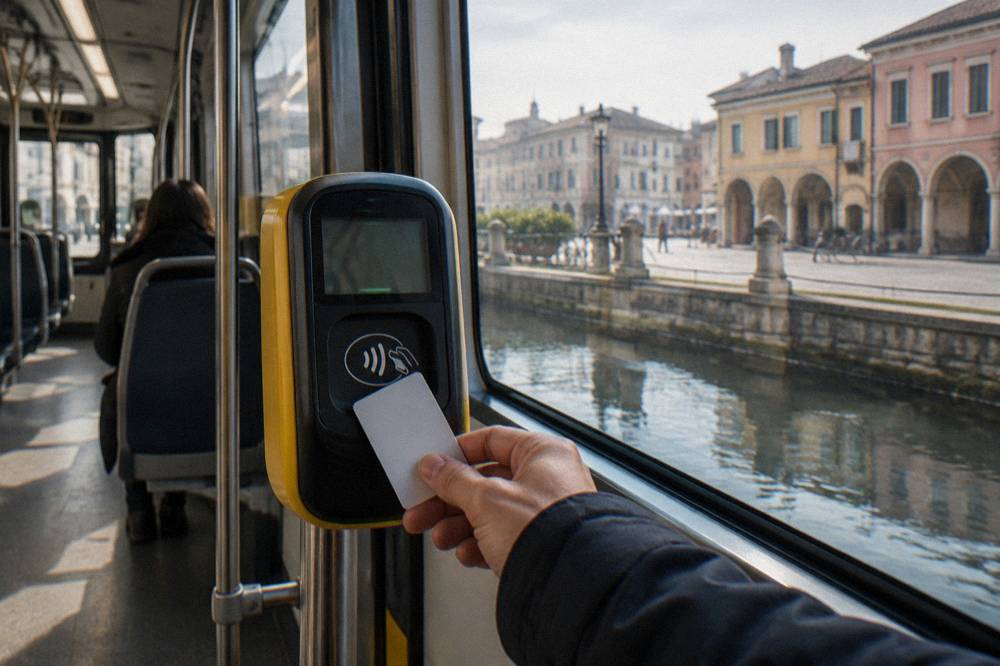
What the tram does well for a visitor is simple: it is frequent, step-aboard transit that takes the same EUR 1.70 ticket as the buses, and a contactless card tapped at the platform validator buys the same ride. It is not a sightseeing line, and it does not reach the Basilica of Saint Anthony's door; for that, feet or a bus do the work.
How Much Is Public Transport In Padua?
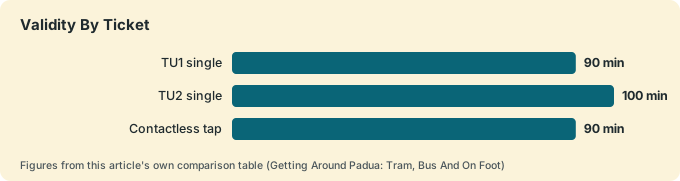
The standard fare is the TU1 Orange Zone ticket at EUR 1.70 for 90 minutes, valid on urban buses and the tram, bought digitally or by tapping a contactless card on board; the operator's pages also report a TU1 day ticket at EUR 4.70 and a TU2 Blue Zone ticket at EUR 2.00 for 100 minutes covering the wider conurbation. The EUR 1.70 and the contactless tap appear on the operator's own English pages; the day and TU2 figures are reported fares, so check the operator's site before buying anything longer than a single.
| Ticket | Zone | Validity | Price | Notes |
|---|---|---|---|---|
| TU1 single | Orange (city) | 90 minutes | EUR 1.70 | Bus and tram, digital or contactless tap |
| TU1 daily | Orange (city) | One day | EUR 4.70 | Reported on the operator's fare page |
| TU2 single | Blue (conurbation) | 100 minutes | EUR 2.00 | Reported; covers the wider urban belt |
| Contactless tap | Orange (city) | 90 minutes | EUR 1.70 | One tap per vehicle within the validity |
Where to buy matters more than the price. The operator sells through its app and the DropTicket app, and the contactless option works on board both bus and tram, one tap per vehicle inside the 90 minutes. Ticket shops and agents exist around the station and the centre. Buying before boarding, where you are not tapping a card, is the rule; the fine print is on the operator's fare pages.
Is Padua Walkable?
Yes, Padua is walkable to a degree few Italian cities of its size match: the historic centre is a compact tangle of arcaded streets, and every city-tier landmark, the Scrovegni Chapel, Piazza delle Erbe, Palazzo della Ragione, the Basilica of Saint Anthony, Prato della Valle, the Orto Botanico and the university's Palazzo del Bo, lies within about 3 km of the centre point. That 3 km figure is computed from geodata, not estimated from a brochure, and it means the longest centre-to-landmark leg is a single walk, not a journey.
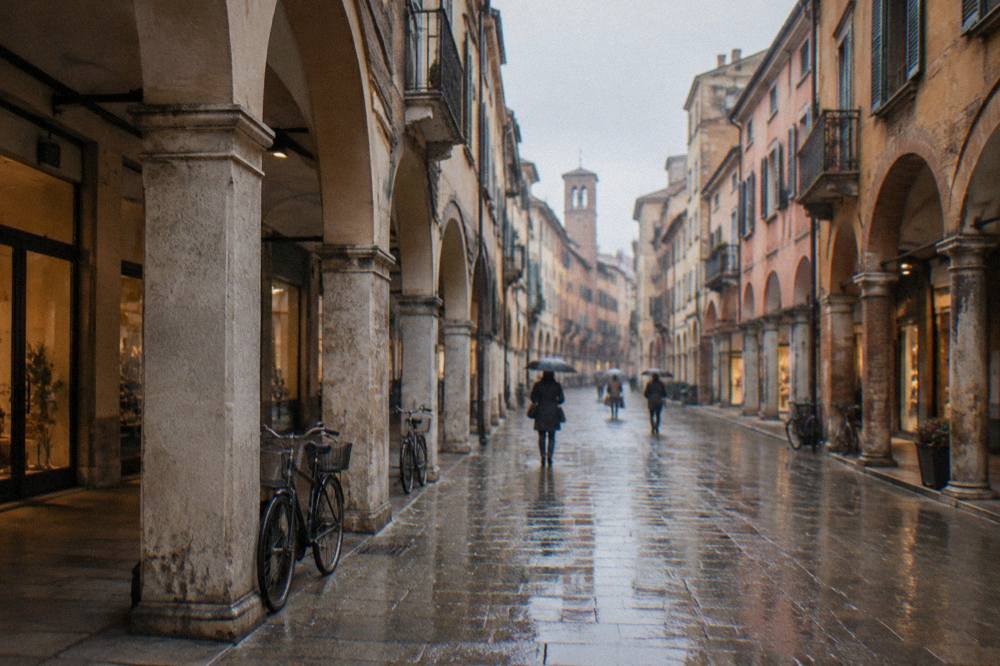
The walking city has a texture worth naming. Porticoes line the streets in long runs, which changes the arithmetic of rain and summer sun; a walker in Padua moves under cover for much of the way between the great squares. The two market squares, Piazza delle Erbe and Piazza della Frutta, sit at the heart of it, with Palazzo della Ragione stretched between them, and the centro storico fans out from there in every direction.
The one destination that tests the legs is Prato della Valle in the south-east, and even that pairs naturally with the Basilica of Saint Anthony, which stands between it and the centre. The city walls walk is the other long stroll, and it is a circuit rather than a commute. For everything else, the tram and buses are a convenience, not a dependency.
A guided walk is one way to convert the compact geography into a structured day.
Do You Need A Bus In Padua?
A visitor staying inside the ring of the old city rarely needs a bus, since the landmarks cluster within walking distance, but buses earn their keep for the station-to-hotel haul with luggage, for districts beyond the tram line such as the south and east, and for the SIR3 corridor that is still in testing, all under the same EUR 1.70 ticket as the tram. The network is dense, university-fed and run in one fare structure, so there is no second system to learn.
The honest division of labour is this: the tram gives you one fast north-south spine, the buses give you everything else, and the centre gives you an excuse to use neither. If your hotel sits near the station, the whole visit can plausibly happen on foot with one tram ride as a novelty. If it sits out towards Arcella or the southern districts, the TU1 ticket is the working tool.
There is also a hop-on-hop-off option, the City Sightseeing Padova tour, which wraps a bus loop around the sightseeing question for those who prefer commentary to timetables; the listing shows the current rate. Beyond that, day trips to the Euganean Hills use regional and extraurban services, and their timetables live on the operator's journey planner rather than the urban fare table.
How Do You Get From Padua Station To The Centre?
Padova station sits on the northern edge of the centre and the walk into the historic core is short and flat, while the tram stop outside and the urban buses cover the same ground for EUR 1.70; the IAT tourist office at the exit of platform 1 is open Monday to Saturday 9:00 to 19:00 and Sunday and holidays 10:00 to 16:00, closed 25 and 26 December and 1 January, per the tourism board's own page. Luggage can be left at the station's left-luggage office at platform 1, open daily 6:00 to 20:00 at EUR 5 per 6 hours, per the tourism board.
The station is Padua's front door for a reason: high-speed and regional trains stop here on the Venice-Milan line, and the Venice airport to Padua connection is a direct Busitalia coach at EUR 13 one-way, about 45 minutes, 54 runs a day. From the platforms, the city opens south: across the street, through the arcades, and the Scrovegni Chapel and the Eremitani complex are the first landmarks in reach.
| Station facility | Detail | Source |
|---|---|---|
| Left luggage | Platform 1, daily 6:00-20:00, EUR 5 per 6 hours | Tourism board page |
| IAT tourist office | Platform 1 exit, Mon-Sat 9:00-19:00, Sun 10:00-16:00 | Tourism board page |
| Airport bus | EUR 13 adult one-way, about 45 minutes, every 40 minutes | Operator page |
| Tram SIR1 | Stops serve the station area, north-south line | City project documents |
| Urban buses | Multiple routes from the station forecourt, TU1 EUR 1.70 | Operator fare page |
For arrivals from the airports, the two practical pages are Treviso airport to Padua and the Venice one above, and the general arrival overview sits at how to get to Padua.
Can You Get Around Padua By Bike?
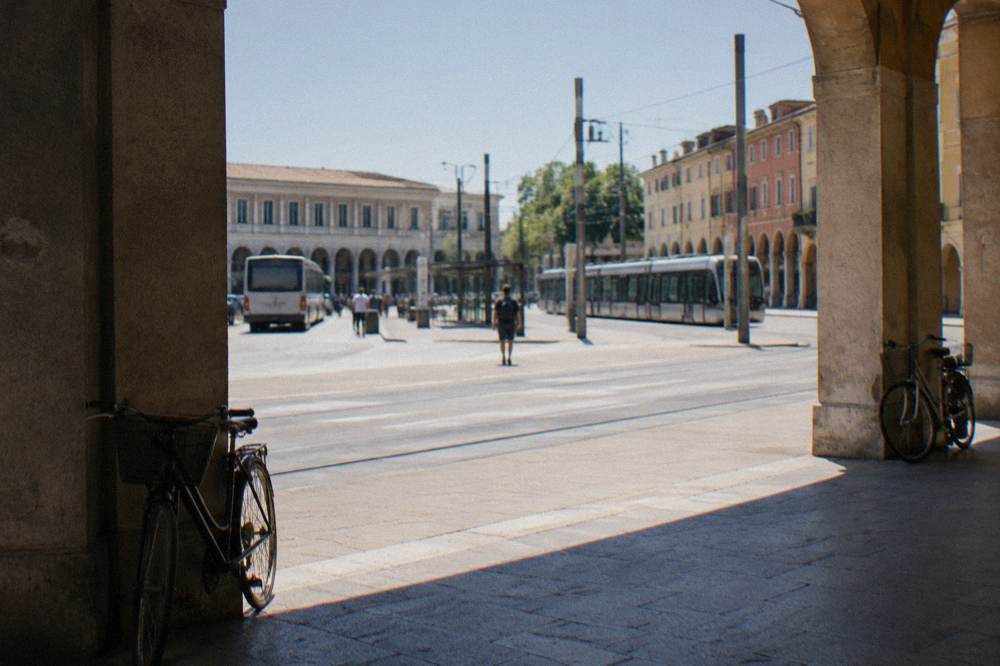
Padua is a flat, student-heavy city where bicycles are a normal part of the street scene, but the site's research could not confirm any current bike-share operator or tariff, so no scheme, price or app can be named here; a visitor who wants two wheels should check locally at the tourist office or look for whatever hire services currently operate near the station and centre. What can be said plainly is the geography that makes cycling attractive: the centre is compact, the terrain between the station, the squares and Prato della Valle holds no hills worth naming.
A private bike or a hired one turns the wider city into a single system: the walls circuit, the canal-side streets, the run out towards the Euganean Hills bike paths beyond Abano Terme. The city's own cycling infrastructure is not something this site can quantify, and the older bike-share figures floating around the web belong to defunct or changed services.
The one warning the practical sources do carry is theft: Padua is a student city and bicycle theft is a common petty crime, so a lock is not optional. That aside, two wheels suit the place, and the flat grid of the centre makes the question of route-planning almost trivial. The rest of the planning pages sit on Padua Travel Guide.
Can You Drive In Padua?
Driving into central Padua is possible but largely counterproductive: the historic core is arcaded and partly pedestrian, a limited-traffic zone controls car access to the centre, and the site's research confirmed no reliable published detail on ZTL hours or fines, so check the dedicated guidance and the city's own pages before bringing a car in. Park at the edge, or at the hotel, and walk; that is the pattern the geography itself recommends.
Car hire in Padua makes sense mainly for the Euganean Hills and the smaller walled towns, not for the city itself.
The full picture, including parking options and the limited-traffic rules as far as they are known, lives on the ZTL and parking guide, and car-rental logistics have their own page. The short version for transit purposes: a car parked on day one and untouched until departure is the only car that behaves well in Padua.
Which Day Trips From Padua Work By Train?
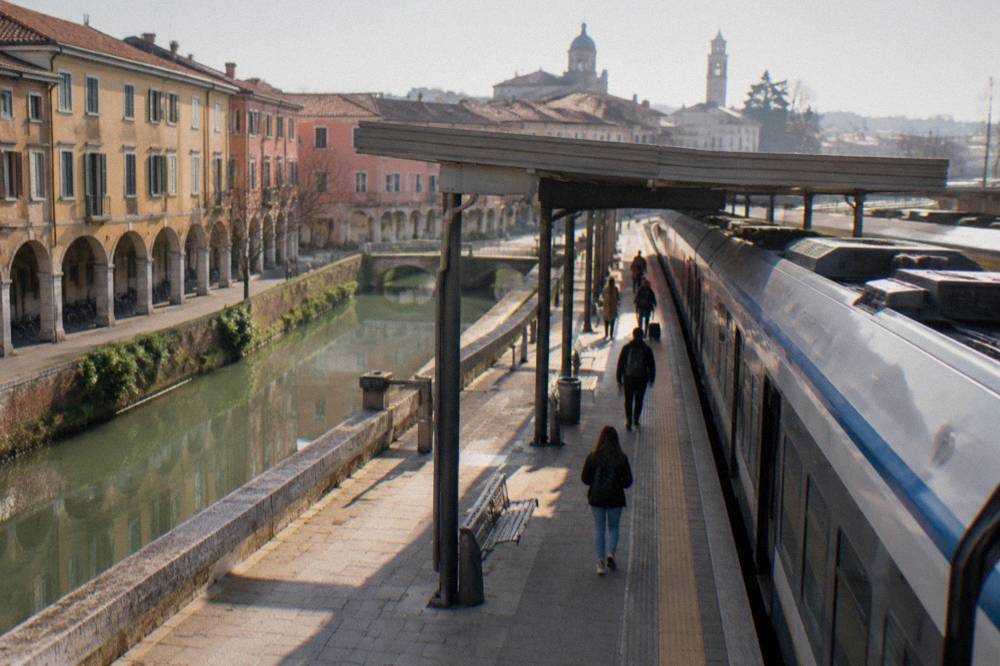
Padova station makes an exceptional base for rail day trips: Venice is about 26 to 40 minutes away by regional train for about EUR 5, Vicenza about 16 to 25 minutes for about EUR 6, Verona about 43 to 60 minutes and Treviso about 28 to 60 minutes, all reported times from rail-aggregator data, so confirm on Trenitalia before travelling. The straight-line distances, computed rather than estimated, frame the map: Venice 36 km, Vicenza 30, Treviso 41, Verona 69.
| Destination | Straight-line distance | Reported train time | Reported fare |
|---|---|---|---|
| Venice (Venezia S. Lucia) | about 36 km | about 26-40 min | regional about EUR 5 |
| Vicenza | about 30 km | about 16-25 min | about EUR 6 |
| Verona | about 69 km | about 43-60 min | check Trenitalia |
| Treviso | about 41 km | about 28-60 min, sometimes a change | check Trenitalia |
| Bassano del Grappa | about 42 km | about 1 h regional | check Trenitalia |
Venice deserves the headline and a caveat. The trains are frequent and cheap, and the Venice to Padua and Padua as a base for Venice pages cover the pattern in depth; on fees, the Venice day-tripper access-fee trial ended on 27 July 2026 and no 2027 decision had been announced, so a day-tripper from Padua should check the current position rather than assume a charge. Beyond Venice, Vicenza, Verona and Treviso are all straightforward rail outings, and the pairing of Padua as a base with those cities is the classic use of the station.
One day trip leaves the rails entirely: the Brenta Riviera boat cruise, which runs between Padua and Venice along the villa-lined river in both directions from March to October, per the boat operator's own site. It is this page's featured product because it is the one journey in the Padua orbit where the transport is the attraction, and the tour page carries the details.
How Do The Sights Sit On The Map For Transit?
The transit-relevant geography of Padua is a narrow north-south strip: the station and the Scrovegni Chapel sit at the north end, the market squares and Palazzo della Ragione in the middle, and the Basilica of Saint Anthony and Prato della Valle at the south, with the Orto Botanico and the university buildings strung between, so one tram spine and a pair of legs cover the lot. The SIR1 happens to run along the same north-south axis, which is why it is the one transit line a visitor might actually use more than once.
| Sight | Position relative to centre | Transit approach |
|---|---|---|
| Scrovegni Chapel | North, near the station | Walk from station or centre |
| Piazza delle Erbe and Palazzo della Ragione | Centre | On foot |
| Basilica of Saint Anthony | South of centre | Walk or bus |
| Prato della Valle | South-east | Walk via the Basilica, or bus |
| Orto Botanico | Centre-south, near Prato | On foot |
| Palazzo del Bo | Centre, via Via VIII Febbraio | On foot |
Booking notes attach to two of these. The Scrovegni Chapel is timed entry only, 25 people every 15 minutes, with no same-day online booking, and it closes 16 to 27 November 2026 for the annual fresco inspection; the Scrovegni Chapel tickets guide carries the full procedure. The Orto Botanico's full ticket rose to EUR 15 from 1 September 2026, EUR 12 in winter, per the garden's own tariff page.
The sightseeing infrastructure also includes a food-and-walk axis: the market squares carry the Piazza delle Erbe market on fixed city-published hours, and a food tour from market to osteria turns the same streets into a meal. Neither needs a vehicle.
What Should A First-Time Visitor Actually Do On Arrival?
On arrival at Padova station, the sequence that works is: collect a map or advice at the IAT office by platform 1 if the desk is open, leave bags at the left-luggage office at EUR 5 per 6 hours if the hotel is not yet possible, buy nothing more than a EUR 1.70 ticket or tap a contactless card if a ride is needed, and otherwise walk south into the centre, where every major sight is reachable without another fare. The station's position at the top of the sightseeing strip makes the first hour unusually simple.
A first day can run Scrovegni Chapel (booked ahead, timed) in the morning, the Eremitani museums that the same ticket covers, then the walk down through the squares to the Basilica and Prato della Valle. The Padua in one day itinerary sequences exactly that, and how many days you need in Padua is the follow-up question if the city earns more time, as it usually does.
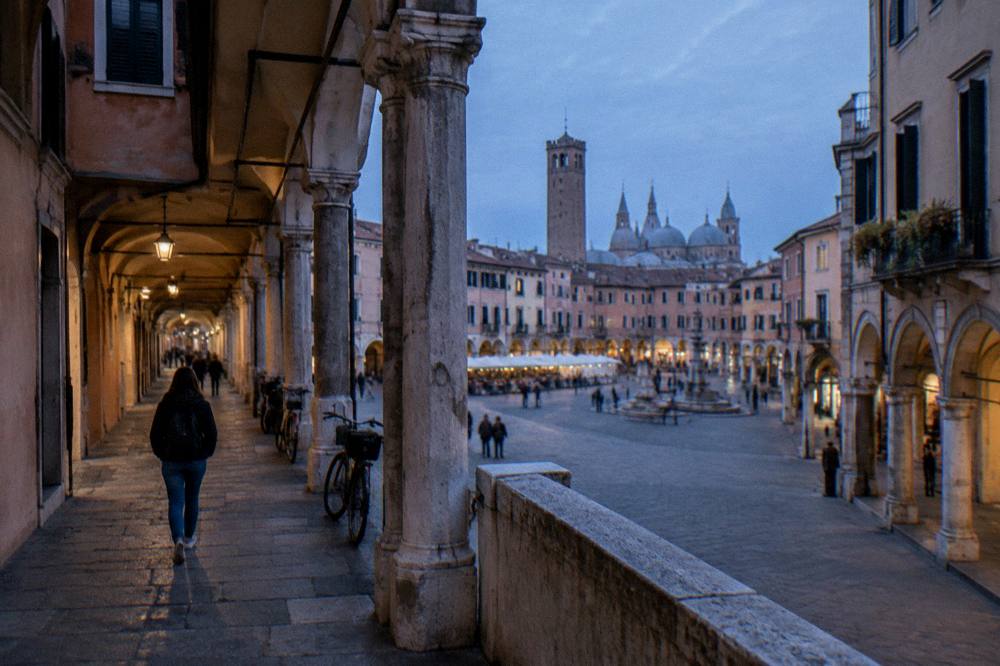
For an evening, the same geography keeps working: the squares carry the aperitivo culture the tourism board describes, and an evening visit to the Scrovegni Chapel exists as a separate chapel-only ticket from 25 March to 1 November, 19:00 to 22:00, per the chapel's own site. A guided evening option, the evening tour with chapel admission, bundles the two ideas, and the operator's listing has the current dates.
Is Padua Easy For Visitors With Limited Mobility?
Padua's historic centre is flat and its tram is step-aboard, but the site can make no claim about lifts, ramps or step-free access at specific buildings such as the Scrovegni Chapel, the Basilica or Palazzo del Bo, because no detail on those interiors is available; the Scrovegni's timed visit does run through a climate-controlled waiting room, per the chapel's own visitor page. The honest advice is to ask each site directly before planning a route around it.
The streets themselves are kind: few gradients, long arcade runs, and a tram that takes the same contactless tap as the buses. The distance figures on this page are straight-line kilometres and short ones, which is the relevant fact for anyone measuring a day's walking. Beyond that, the city's accessibility specifics live with each museum and church, not in a published city-wide register this site can cite.
What About The Weather And The Season For Getting Around?
The ERA5 reanalysis for Padua, 1991-2020, shows a January mean high of 7.3 C with a mean low of -0.2 C, July and August mean highs of 28.8 C, and November as the month with the highest rain total at 114.0 mm, with September and October close behind at about 105 mm each; the porticoes change how those numbers feel on foot. Rain in Padua is partly an architectural problem the city solved centuries ago, and the arcaded streets mean a wet day costs less walking comfort than the rainfall table suggests.
Season by season, the transit implications are modest: winter walks are cold rather than hostile, summer ones are hot at midday and pleasant in the evening, and the rain peaks in autumn. The fuller picture, including what it means for timing a visit, sits on the Padua weather and best time to visit Padua pages. Snow is rare: a long climate study of the city reports an average of about 4.4 snowy days per year in recent decades.
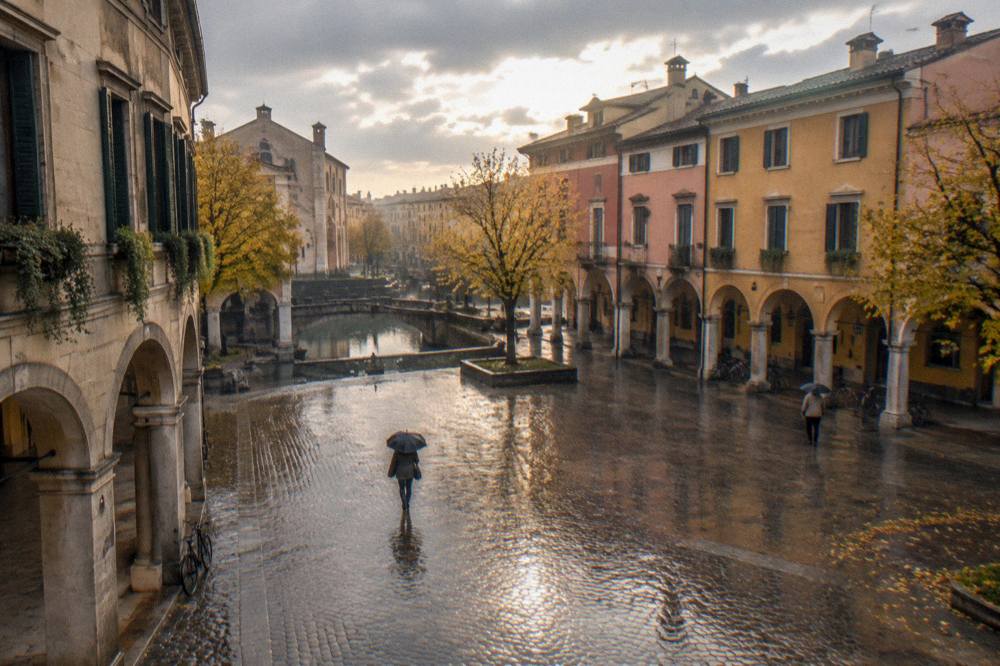
The last piece of the seasonal picture is the calendar. The Sherwood Festival ran 10 June to 12 July in 2026 as an annual summer music event, the Salone dei Sapori food week ran 11 to 18 October 2026, and the Padova Marathon is set for 18 April 2027 with the finish at Prato della Valle, an event that reshapes the streets it crosses for a morning. None of these change the transit fares, but they change the streets, and that is a transport fact too.
Common Questions About Getting Around Padua
How much does public transport cost in Padua?
The urban TU1 ticket is EUR 1.70 for 90 minutes on buses and the tram, per the operator's own fare page, and a contactless card tapped on board charges the same. A day ticket is reported at EUR 4.70 and the wider TU2 zone ticket at EUR 2.00.
Does Padua have a metro or tram?
Padua has a rubber-tyred tram, the SIR1, about 10.5 km north to south with 26 stops. A second line, the SIR3 from the station to Voltabarozzo, is in pre-service testing with service targeted for the end of 2026, but no opening date has been fixed.
Is Padua walkable for tourists?
Yes. Every city-tier landmark, from the Scrovegni Chapel to Prato della Valle, lies within about 3 km of the centre point, and the streets between them are flat and largely arcaded.
How do I get from Padua station to the city centre?
Walk: the station sits at the northern edge of the centre and the core is a short, flat stroll away. The tram and urban buses from the forecourt cover the same ground for EUR 1.70, and the IAT tourist office at the platform 1 exit can help on arrival.
Can I use a contactless card on Padua buses and trams?
Yes. The operator's page confirms contactless payment on board both bus and tram in the TU1 zone at the EUR 1.70 fare, with one tap per vehicle inside the 90-minute validity.
Is there luggage storage at Padua station?
Yes, at platform 1, open daily 6:00 to 20:00 at EUR 5 per 6 hours, a figure published on the tourism board's own luggage-storage page.
Getting around Padua, in the end, is a small problem by design: one tram, one fare, one walkable core, and a station that puts Venice, Vicenza, Verona and Treviso within a morning's reach.