What Were Anatomical Theatres?
Anatomical theatres were purpose-built rooms for public dissection in early modern universities. Padua, in the Veneto, built the first permanent one in 1594, and you can still see it inside Palazzo del Bo.
Anatomical theatres were the operating rooms of early modern medical teaching, and Padua (Italian: Padova), an inland city in the Veneto about 36 km in a straight line from Venice, built the one that changed the format: the first permanent anatomical theatre, inaugurated at the University of Padua in 1594 inside Palazzo del Bo. Before that date, dissections happened on temporary wooden platforms, assembled for a lecture or two and then taken apart again, in whatever hall a university could borrow.
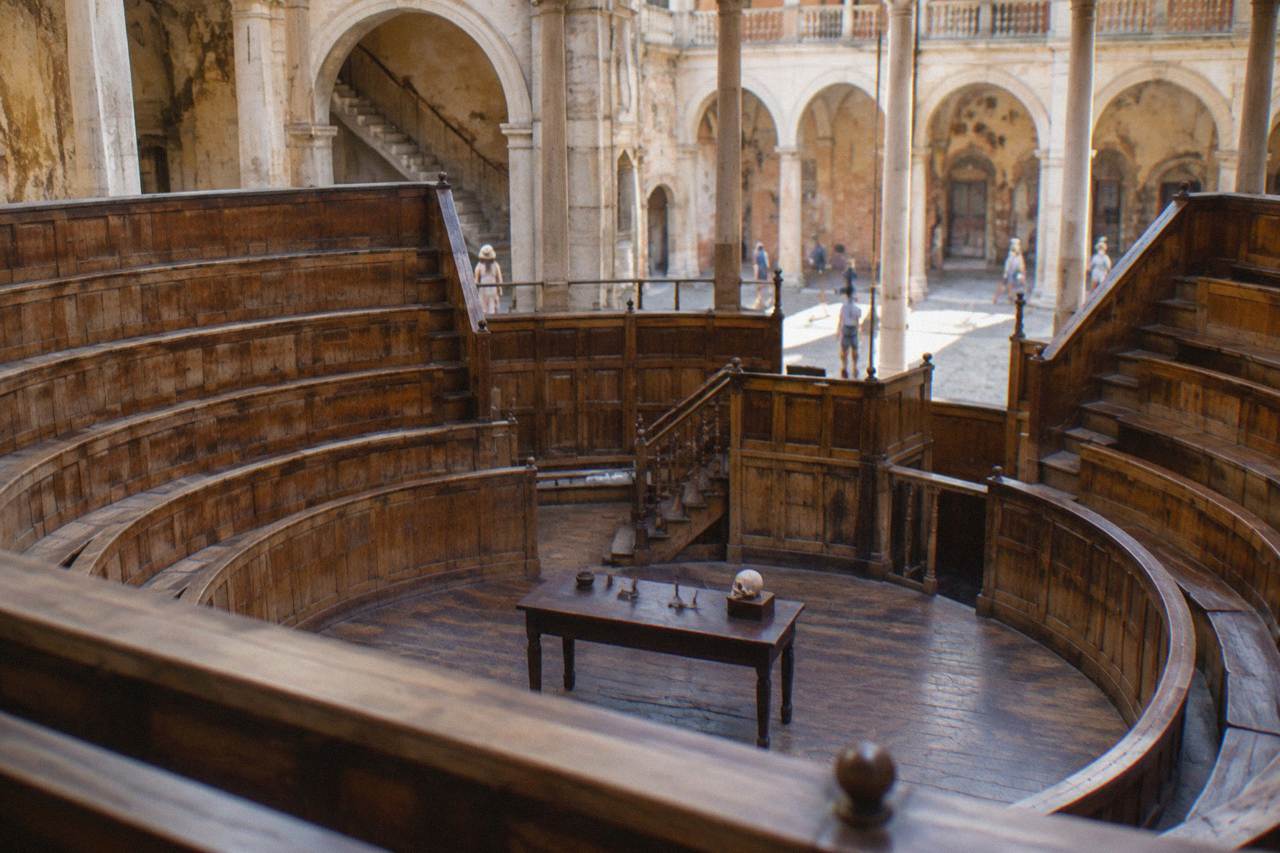
The idea was simple and, at the time, radical. Medicine had long been taught from books, with professors reading out the anatomical doctrines of ancient authors while a barber-surgeon cut the cadaver below. The anatomical theatre inverted that arrangement: the body itself became the text, and the room was engineered so that dozens of spectators could see it from tiered galleries arranged like the rings of an amphitheatre. Padua's university, founded in 1222 and reported on its history pages as the second-oldest in Italy after Bologna, made that inversion permanent.
What Were Anatomical Theatres?
Anatomical theatres were purpose-built, tiered lecture rooms in early modern universities where medical students and invited publics watched the dissection of human cadavers, built in an steep elliptical or circular form so that everyone could see the解剖 table on the floor below. The University of Padua inaugurated the first permanent one in 1594 at Palazzo del Bo, and its carved wooden galleries survive in the same building today.
The form borrowed deliberately from the theatre. Narrow rows of standing room rose steeply around a central well, where the dissection took place by candlelight and, later, lantern light from an overhead oculus. Because the view was the whole point, capacity was tight: the crowd leaned inward over the railings, and bodies packed the galleries in a vertical funnel. A professor lectured from a raised chair, a demonstrator pointed with a wand, and the corpse supplied the evidence.
The purpose was a shift in authority. Where a textbook lesson asked students to trust Galen, a public dissection asked them to trust their own eyes. Anatomy moved from recitation to observation, and the room built for it became the ancestor of the modern lecture theatre and the operating theatre alike. Padua's version, dated 1594 on the university's own pages, is the model other universities copied: permanent, purpose-built and standing in the heart of the medical faculty.
Why Did Padua Build The First Permanent Anatomical Theatre?
Padua built the first permanent anatomical theatre in 1594 because its medical faculty had the students, the cadaver supply and the legal freedom to teach anatomy by dissection at scale, a combination rarer than it sounds. The University of Padua, founded in 1222, taught medicine at a moment when its professors and their students were pushing observation over book authority, and a standing theatre made that method routine rather than exceptional.
The Venetian Republic, which ruled Padua from 1405 to 1797, governed the university with a light hand and drew students from across Europe, and the medical faculty's reputation made anatomy its showcase. Galileo arrived in 1592 to the chair of mathematics, two years before the theatre opened, and stayed until 1610, years he later called "the best eighteen years of all my life". The same institution had already founded the Orto Botanico in 1545 for the empirical study of plants, and in 1678 it awarded Elena Lucrezia Cornaro Piscopia her doctorate in philosophy on 25 June 1678, the first woman to take a university degree on record.
The theatre, in other words, was not an isolated marvel but part of a working scientific culture. A dated outline of that culture, all from the university's own pages:
| Year | Event at the University of Padua |
|---|---|
| 1222 | Studium Patavinum founded |
| 1545 | Orto Botanico founded, the first university botanical garden |
| 1592 | Galileo arrives to the chair of mathematics, staying until 1610 |
| 1594 | First permanent anatomical theatre inaugurated at Palazzo del Bo |
| 1678 | Elena Lucrezia Cornaro Piscopia graduates in philosophy, the first recorded woman graduate |
| 1610 | Galileo publishes Sidereus Nuncius |
What Does Padua's Anatomical Theatre Look Like Inside?
Padua's anatomical theatre at Palazzo del Bo is a compact, steeply raked funnel of carved pear wood, with narrow standing galleries ringed around a central dissection floor and light drawn from above, built small enough that the spectators at the top rail stood only a few metres from the body below. The university describes the guided route as taking in the theatre together with the Aula Magna and Galileo's chair.
The geometry is the drama. Rather than the wide semicircle of a playhouse, the room rises almost vertically, so the viewing positions stack tightly and the whole audience hovers over the same small table. The university's guided visit, the "Giro storico", walks through the anatomical theatre, the Aula Magna, the Sala dei Quaranta with Galileo's chair, the Medicine and Law halls and the statue of Elena Cornaro, though not every room is guaranteed every day. Slots alternate between Italian and English, and the visit runs about 45 minutes.
| Palazzo del Bo "Giro storico" ticket | Price |
|---|---|
| Full (ages 26 to 64) | EUR 10 |
| Reduced (65+, teachers, mixed groups of 10 to 30) | EUR 8 |
| Special reduced (ages 6 to 25) | EUR 6 |
| School groups | EUR 5 |
Bookings go through the university's own centre at 049 827 3939, and an integrated ticket called "Padova Citta della Scienza" covers Palazzo del Bo together with the Orto Botanico and the Museo della Natura e dell'Uomo. More on the building and its tours is in the Palazzo del Bo attraction guide.
How Did Anatomical Theatres Change Medicine?
Anatomical theatres changed medicine by making direct observation of the human body the core of anatomical teaching, replacing a tradition in which students learned anatomy from classical texts read aloud while a hired cutter worked below the professor's chair. Once a university committed a permanent room to dissection, anatomy became a discipline of seeing, correcting and publishing, and Padua's 1594 theatre stood at the start of that shift.
The consequences ran outward from rooms like Padua's. Professors who had watched the same body from the same galleries published corrected anatomies that overturned ancient claims, and the graduates of faculties with theatres carried the observational method into their own teaching cities. Later universities in Italy and beyond raised their own permanent theatres on the pattern, each one a statement that the discipline now required a dedicated instrument, a building whose only job was to make a body visible. More of these guides are collected on Padua Travel Guide.
Padua's theatre also belongs to the city's wider story of looking closely at things: the botanical garden for plants from 1545, Galileo's telescopic work culminating in the Sidereus Nuncius of 1610, the dissection room for the body from 1594. A reasonable question for any visitor is whether the city repays the time, and the is Padua worth visiting page takes that up in full.
Can You Visit The Anatomical Theatre In Padua Today?
Yes, the anatomical theatre at Palazzo del Bo can be visited today, but only on the university's guided "Giro storico" tour, which costs EUR 10 full, EUR 8 reduced, EUR 6 for ages 6 to 25 and EUR 5 for school groups, runs about 45 minutes and alternates Italian and English departure slots. Booking goes through the university centre at 049 827 3939, and the theatre stop is not guaranteed on every tour.
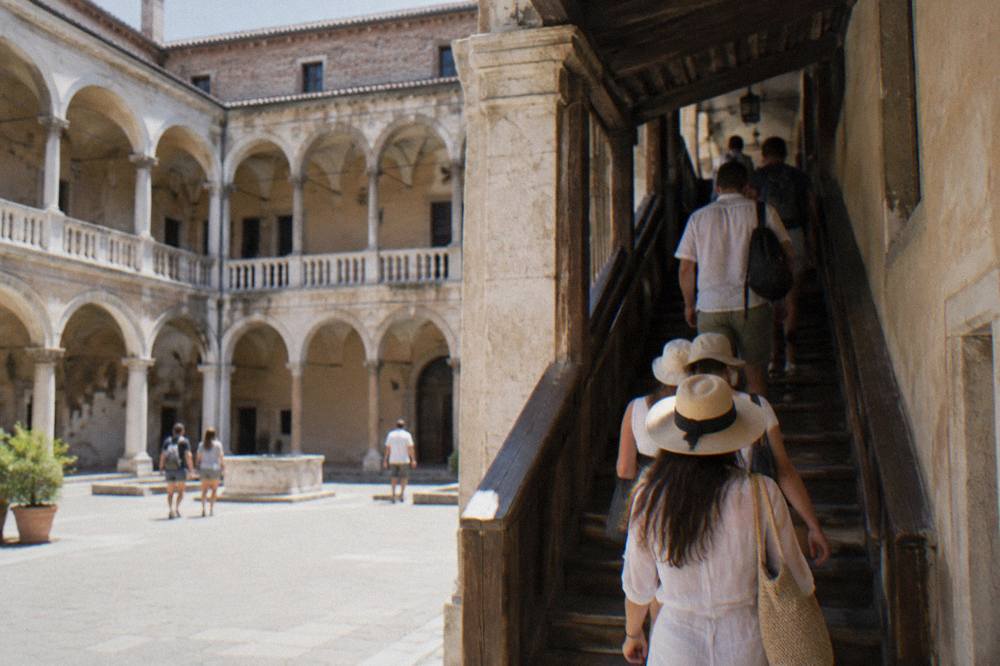
The theatre sits inside Palazzo del Bo, the historic seat of the university a short walk from Piazza delle Erbe and the Caffè Pedrocchi, which opened in 1831. Because the visit is guided and room access varies, it pairs naturally with a walking tour of the centre: the private city walking tour with the Scrovegni Chapel visit covers the historic centre and then takes in Giotto's frescoes, and Check availability on the operator's live listing before locking a date.
Planning a wider stay is worth a moment, since the theatre is an hour of a day and the city offers far more, as the how many days do you need in Padua page sets out. Remember that the Scrovegni Chapel itself is timed entry only, with groups of at most 25 people every 15 minutes and advance booking required.
Where Else Can You See Anatomy And Science History In Padua?
Beyond the theatre itself, Padua's science history runs through the Orto Botanico, founded in 1545 and inscribed by UNESCO in 1997, the Museo della Natura e dell'Uomo, and the Sala dei Quaranta with Galileo's chair, all reachable on foot or by tram in the historic centre. The city holds two UNESCO listings, the garden from 1997 and the fourteenth-century fresco cycles of Padova Urbs Picta from 2021.
The garden is the closest sibling to the theatre in spirit: both were instruments for studying real specimens rather than descriptions of them. Orto Botanico tickets cost EUR 15 full from 1 September 2026, with a winter tariff of EUR 12 from November to February, and the visit includes an audioguide. The "Padova Citta della Scienza" integrated ticket bundles the garden, Palazzo del Bo and the Museum of Nature and Humankind for anyone planning all three.
For the fresco side of the city's heritage, the what is Padua famous for page is the overview, and the wider things to do in Padua page collects the full list of sights, tours and day trips into the Euganean Hills, the Brenta Riviera and Venice itself.
Common Questions About Anatomical Theatres In Padua
What Were Anatomical Theatres?
Anatomical theatres were tiered, purpose-built rooms in early modern universities where students watched dissections of human cadavers, arranged so everyone could see the central table. Padua inaugurated the first permanent one in 1594 inside Palazzo del Bo.
Is Padua's anatomical theatre the first one ever built?
It is the first permanent anatomical theatre, inaugurated in 1594, per the University of Padua's own pages. Earlier dissections took place on temporary wooden platforms rather than in a standing structure.
How long does the Palazzo del Bo tour take?
The guided "Giro storico" runs about 45 minutes and includes the anatomical theatre, the Aula Magna, Galileo's chair in the Sala dei Quaranta, the Medicine and Law halls and the statue of Elena Cornaro, though not every room is guaranteed every day.
How much does it cost to visit the anatomical theatre?
The Giro storico costs EUR 10 full, EUR 8 reduced, EUR 6 for ages 6 to 25 and EUR 5 for school groups, with bookings through the university centre at 049 827 3939.
Can you visit Palazzo del Bo without a tour?
The university runs the building on guided visits, and the booking centre at 049 827 3939 handles reservations, so check the current arrangements on the university's own pages before you go.
