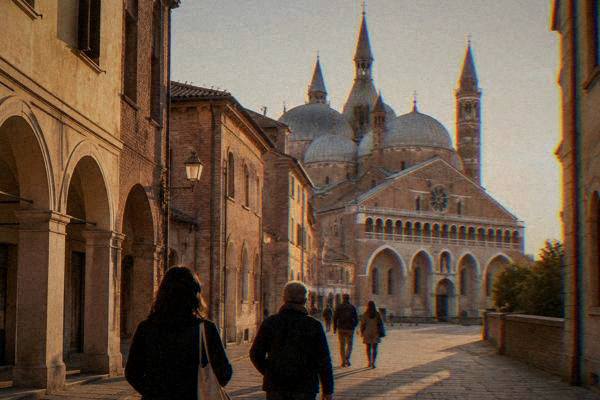
The Santo And Prato Della Valle Quarter
The Santo and Prato della Valle quarter is Padua's spiritual and monumental southeast: the Basilica of Saint Anthony, the Oratory of San Giorgio, Santa Giustina and the vast canal-ringed Prato della Valle.
Short answer
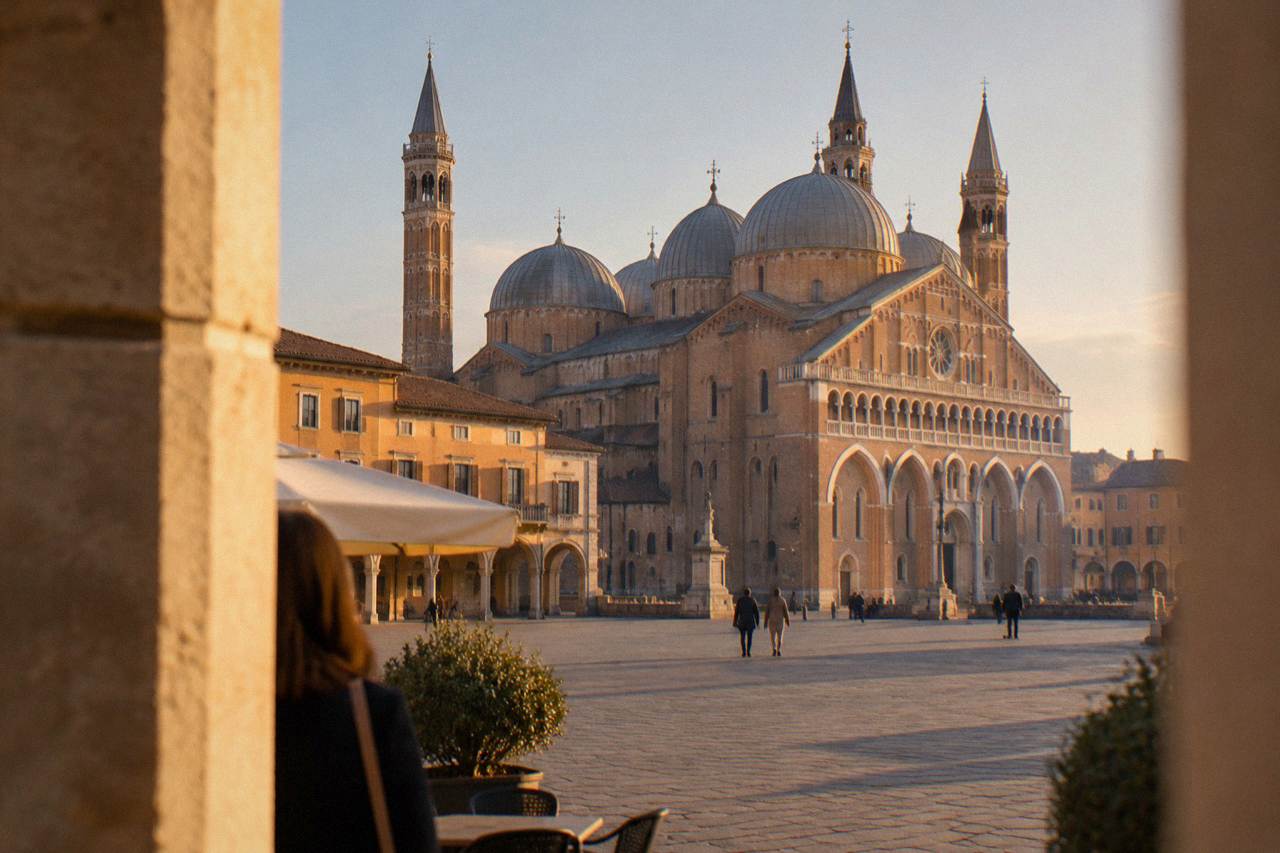
The Santo and Prato della Valle quarter is the area of Padua around the Basilica of Saint Anthony and the canal-ringed Prato della Valle square, in the Veneto in northern Italy. Entry to the basilica is free, the square hosts a Saturday market and a third-Sunday antiques market, and the whole district sits within walking distance of the historic centre.
The Santo and Prato della Valle quarter is the monumental southeast of Padua, an inland city in the Veneto in northern Italy about 36 km in a straight line from Venice. The district takes its name from the Basilica of Saint Anthony, known simply as the Santo, and from Prato della Valle, the enormous square whose canal and double ring of statues frame the basilica's approach. Between them stand the Basilica of Santa Giustina, the Oratory of San Giorgio and the parkland of the square itself, which together hold one of the densest concentrations of religious and civic architecture anywhere in the city. This page from the Padua Travel Guide sets out what the quarter contains, what it costs to see, and how it fits into a visit.
What Is The Santo District In Padua?
The Santo district is the quarter of Padua that stretches from the Basilica of Saint Anthony and its square through Prato della Valle to the Basilica of Santa Giustina, southeast of the historic centre in the Veneto region of northern Italy. It is a district of pilgrimage and open space rather than of market arcades: the basilica draws visitors to Saint Anthony's tomb, the Oratory of San Giorgio and the basilica itself form part of the UNESCO fresco listing, and Prato della Valle spreads around its canal as the city's grandest public room. The whole district can be covered on foot from Piazza delle Erbe in the historic centre in a single morning or afternoon.
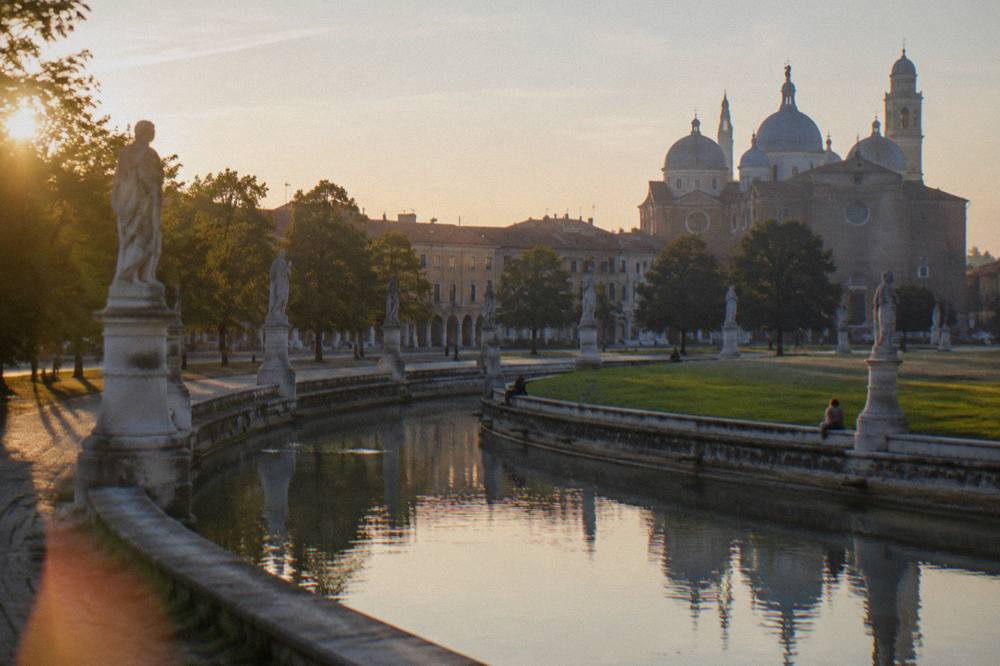
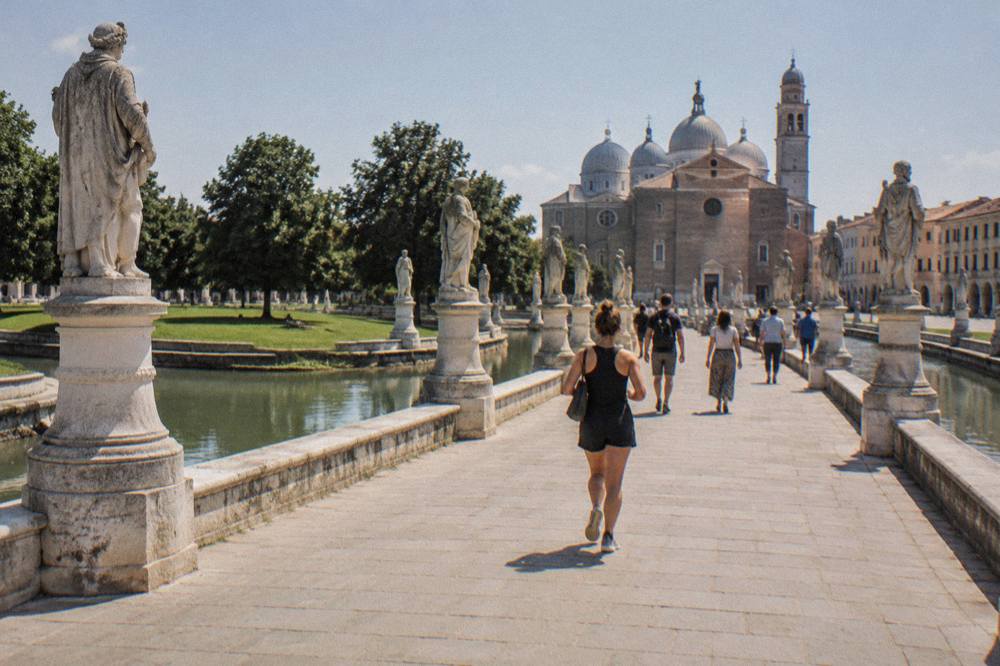
The name works two ways. "The Santo" is the common Italian shorthand for the Basilica of Saint Anthony itself, and by extension for the streets around it. Prato della Valle is the square at the district's heart, a space the Venetian Senate declared communal in 1767 and which was reclaimed under Andrea Memmo, per the Padua tourism board's own page for the square. The Senate declaration and Memmo's reclamation are the two dated facts the sources attach to the square's design, and they frame everything a visitor sees there today: the canal, the island reached by bridges, and the double ring of statues of famous people that runs around the water's edge.
What gives the district its weight in a Padua itinerary is the stacking of major sights within a few minutes' walk of one another. The Basilica of Saint Anthony, the Oratory of San Giorgio, the Basilica of Santa Giustina and Prato della Valle itself form a chain, and the Scrovegni Chapel and the Eremitani complex sit a longer walk away to the north near the station side of the city. Visitors working from a one-day plan usually pair the Santo quarter with the market squares and the Scrovegni, as in the site's one day in Padua itinerary.
| Feature | The Santo District, Padua |
|---|---|
| City | Padua (Padova), Veneto, northern Italy |
| Character | Pilgrimage basilica, monumental square, university and residential streets |
| Anchor sights | Basilica of Saint Anthony, Prato della Valle, Basilica of Santa Giustina, Oratory of San Giorgio |
| UNESCO connection | Part of the basilica and convent complex lies within Padova Urbs Picta (2021) |
| Basilica entry | Free |
| Key annual event | Tredicina, 31 May to 12 June in 2026, feast day 13 June |
| Square markets | Saturday market; antiques market every third Sunday |
What To See Around The Basilica Of Saint Anthony In Padua?
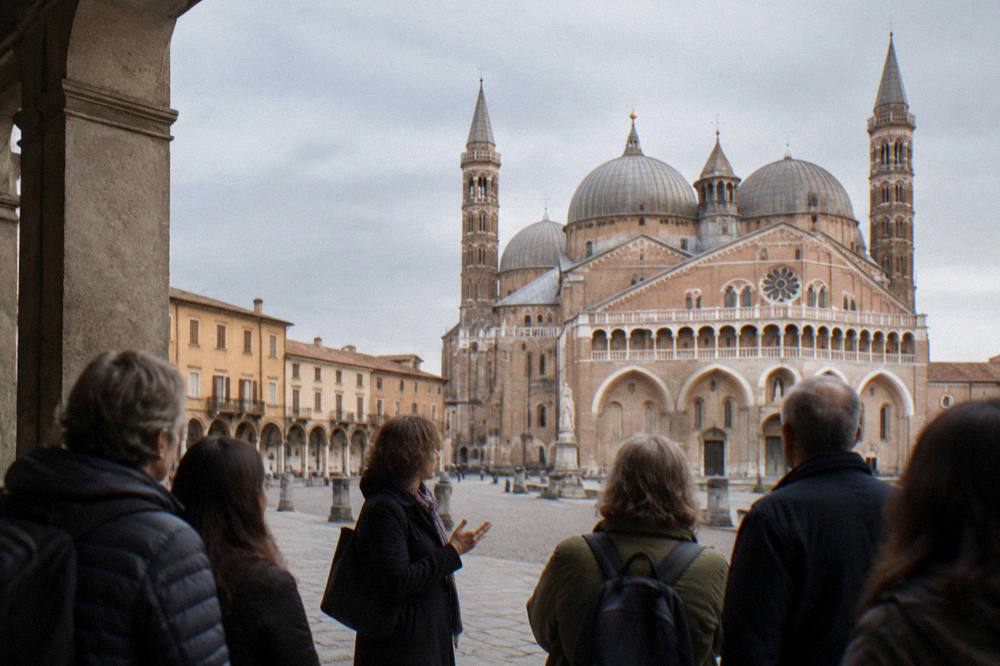
Around the Basilica of Saint Anthony the sights are the saint's tomb and the Chapel of the Relics inside the basilica, Donatello's high altar and his Gattamelata equestrian statue in the square outside, and the Oratory of San Giorgio and the Scuola del Santo nearby, all free or modestly priced and all within a short walk of Prato della Valle. The basilica is the district's centre of gravity. Saint Anthony died on 13 June 1231, and construction of the basilica began in 1232, the year after his death. Entry is free, and the reported highlights are the tomb and the Chapel of the Relics; a dress code suitable for a church applies, again per the basilica's own regulation page.
The Oratory of San Giorgio and the Scuola del Santo sit close to the basilica and belong to the same complex of devotion. The Oratory of San Giorgio is one of the eight components of Padova Urbs Picta, the UNESCO listing of Padua's fourteenth-century fresco cycles inscribed in 2021. The full list runs from the Scrovegni Chapel through the Eremitani church, Palazzo della Ragione, the Reggia Carrarese chapel, the Baptistery, the Basilica and Convent of Sant'Antonio, the Oratory of San Giorgio and the Oratory of San Michele, so a visitor standing in the Santo quarter is already inside two of the eight sites. The site's Padua churches guide collects them all in one place.
The Gattamelata statue, Donatello's equestrian monument to Erasmo da Narni, stands in the square outside the basilica, and Donatello's work on the high altar inside is likewise reported by the sources covering the basilica. Beyond the basilica's orbit, the Basilica of Santa Giustina closes the eastern side of Prato della Valle, and the whole ensemble can be walked end to end without transport. The district also connects westward to the Portello area and the old city gate on the canal of the same name.
How Do You Visit The Basilica Of Saint Anthony In Padua?
To visit the Basilica of Saint Anthony in Padua, walk in: entry is free, no ticket is sold, and the two things to plan around are the dress code, described on the basilica's own site as suitable for a church environment, and the service schedule, since hours shift around functions and the basilica's own site should be checked before a visit. Allow time for the tomb and the Chapel of the Relics, the two features the sources consistently name.
The comparison that matters for a Padua plan is with the Scrovegni Chapel on the other side of the centre. The Scrovegni Chapel is timed entry only, 25 people every 15 minutes, booked ahead, with a 15-minute visit and a 1 EUR booking fee on top of the 15 EUR full daytime ticket, and it is closed 16 to 27 November 2026 for the annual fresco inspection. The basilica imposes nothing of the sort. A sensible morning therefore books the Scrovegni slot first and leaves the Santo quarter flexible around it.
One dated event belongs in any planning conversation: the Tredicina, the thirteen days of devotion that ran 31 May to 12 June in 2026 with the feast of Saint Anthony on 13 June. It is an annual event, and the 2026 edition is the latest confirmed one. Around the feast the basilica and its square fill with pilgrims and the city marks the saint's day; the site's page on the Basilica of Saint Anthony carries the detail. No 2027 dates had been announced at the time of the sources used for this page.
| Visit detail | Basilica of Saint Anthony, Padua |
|---|---|
| Entry price | Free |
| Ticketing | None, no timed slot |
| Dress code | Suitable for a church environment, per the basilica's regulation page |
| Hours | Not fixed on this page; check the basilica's own site, hours change around services |
| Key interior features | Saint's tomb, Chapel of the Relics |
| Construction began | 1232, a year after the saint's death on 13 June 1231 |
| Principal annual event | Tredicina and feast of Saint Anthony, 13 June |
Why Is Prato Della Valle Famous?
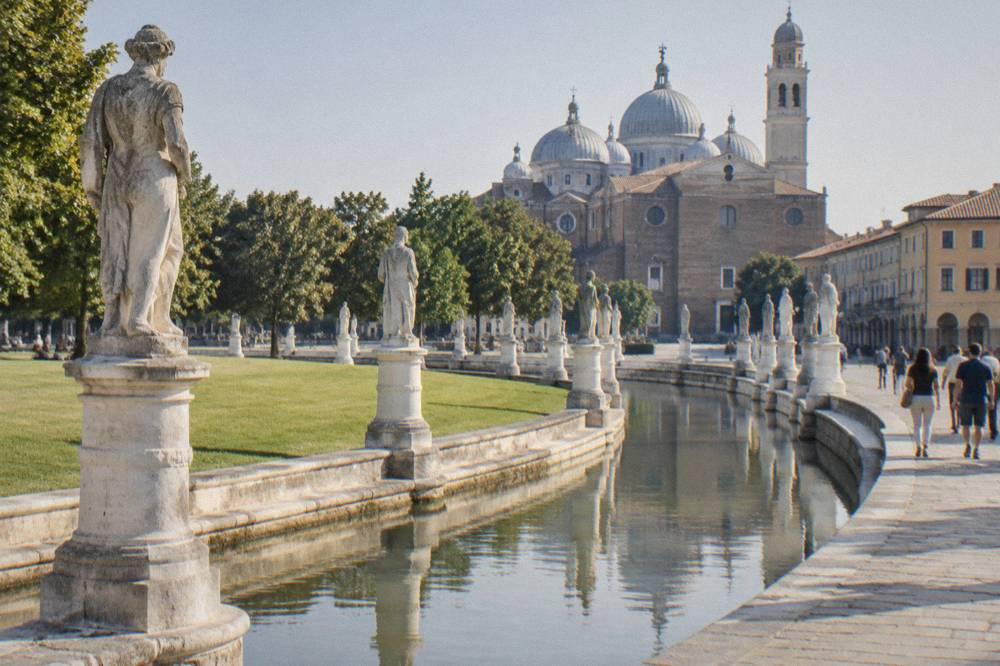
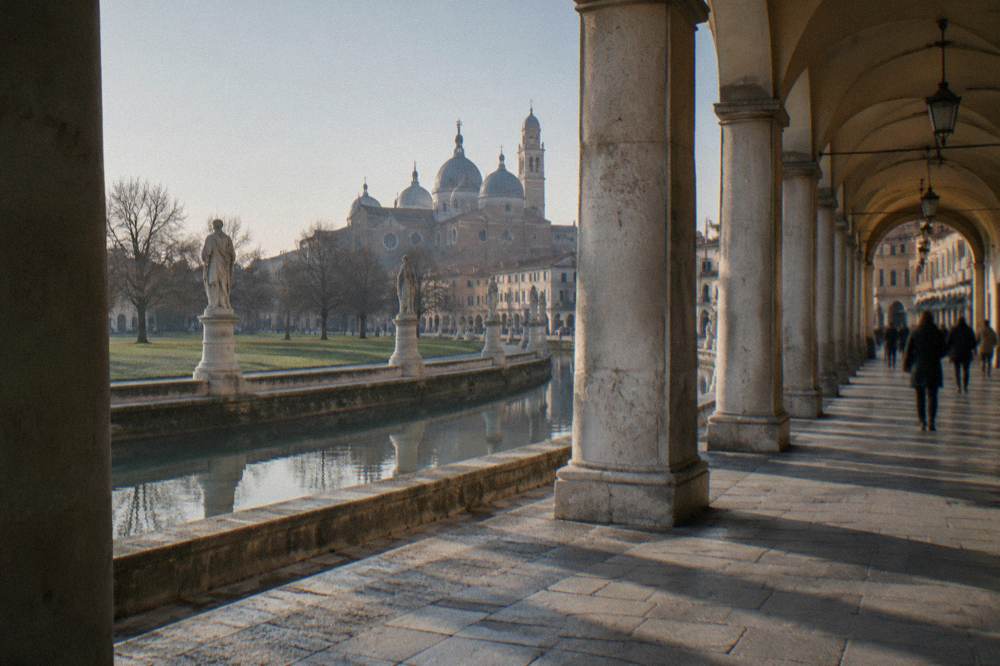
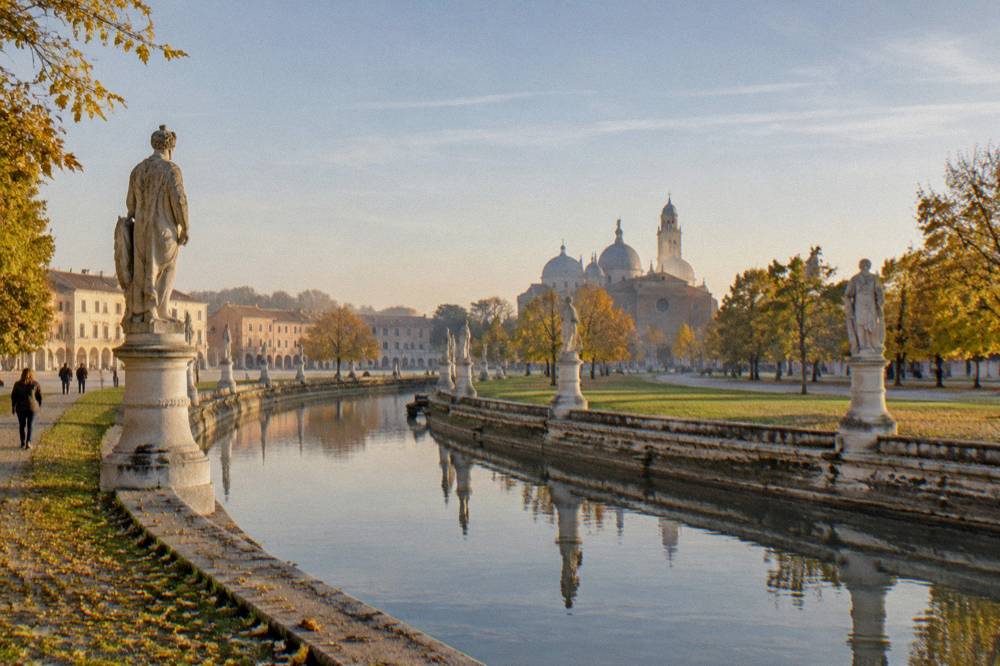
Prato della Valle is famous as the vast canal-ringed square of Padua, a public space declared communal by the Venetian Senate in 1767 and reclaimed under Andrea Memmo, whose water encircles a grassy island joined by bridges and whose edge carries a double ring of numbered statues of famous people. It is the setting that makes it famous, not a single monument: the square's own tourism-board page describes the canal, the double statue ring and the Senate declaration, and those are the facts to carry. No area figure and no statue count belongs on this page, because none was confirmed for it.
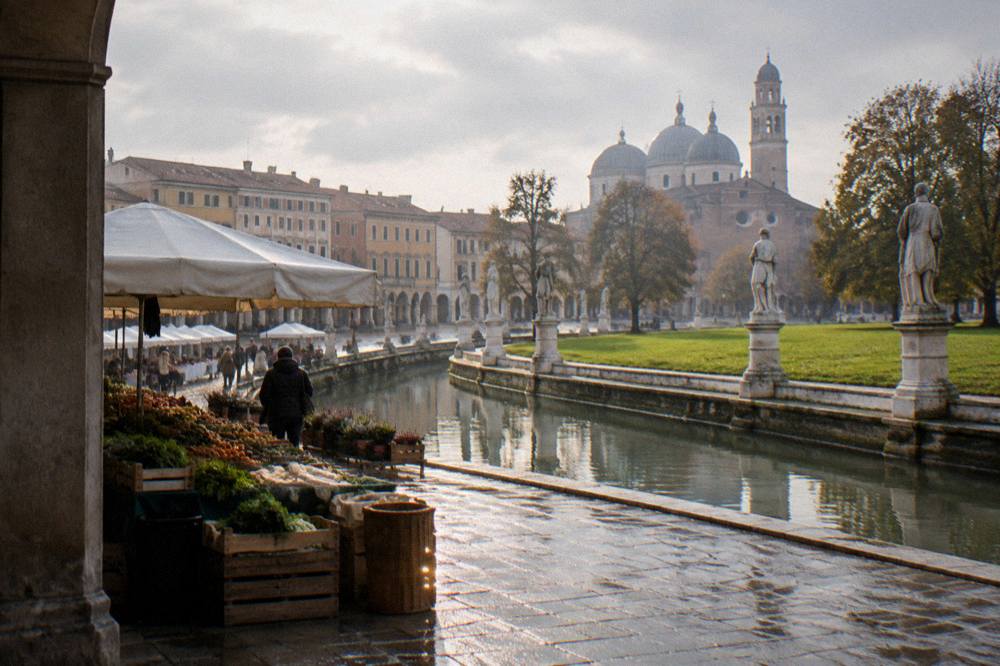
The square behaves as the city's open-air living room. On ordinary days it is a place for walking the ring, crossing to the island, and using it as the foreground for the Basilica of Santa Giustina on its east side. On Saturdays it becomes a market ground, and on the third Sunday of each month it hosts the antiques market together with via Umberto I, per the Comune di Padova's market pages. The Prato della Valle attraction page on this site covers the square in depth.
The square also anchors the city's running calendar. The Padova Marathon finishes at Prato della Valle, with the 2027 edition set for 18 April, a start at the Stadio Euganeo at 8:30 and the finish on the square itself, per the marathon's own site. Between the Saturday market, the antiques Sundays and the marathon finish, the square regularly turns from monument to venue and back.
When Are The Prato Della Valle Markets In Padua?
The Prato della Valle markets in Padua run on Saturdays, with the general market open 8:00 to 19:00 in winter and 8:00 to 20:00 in summer, and the antiques market on every third Sunday of the month from 8:00 to 20:00 across Prato della Valle and via Umberto I, all per the Comune di Padova's own market pages. The Saturday market at Prato della Valle is listed as non-food, plants and flowers, and fruit and vegetables; it is a working market rather than a craft fair, and it gives the square a different character from its weekday calm.
The antiques market is the more distinctive of the two for a visitor. It spreads along the square and via Umberto I on the third Sunday of each month, and it pairs naturally with a morning at the basilica, since both sit within the same walk. The city's other markets, at Piazza delle Erbe and Piazza dei Frutti, run Monday to Saturday and belong to the historic centre rather than this quarter; the site's overview of the whole city is on the things to do in Padua page.
| Market | Where | When | Hours |
|---|---|---|---|
| Prato della Valle general market | Prato della Valle | Saturday | Winter 8:00 to 19:00, summer 8:00 to 20:00 |
| Antiques market | Prato della Valle and via Umberto I | Third Sunday of the month | 8:00 to 20:00 |
| Piazza delle Erbe market | Piazza delle Erbe | Monday to Saturday | Mon to Fri 7:30 to 13:30, Sat 7:30 to 20:00 |
| Piazza dei Frutti food market | Piazza dei Frutti | Monday to Saturday | Mon to Wed 8:00 to 14:00, Thu to Sat 8:00 to 19:00 |
What Is The Best Walking Route Through The Santo And Prato Quarter?
The best walking route through the Santo and Prato quarter runs basilica first, then the square: start at the Basilica of Saint Anthony and the Gattamelata statue, continue to the Oratory of San Giorgio, walk the full ring of Prato della Valle past the statues, end at the Basilica of Santa Giustina on the square's east side, and return west toward the centre along the porticos, a circuit of roughly ninety minutes without hurrying. The order matters because the basilica's opening rhythm depends on services, while the square is open public ground with no schedule at all, so the flexible element should sit wherever the day allows.
From the centre, the approach is straightforward. Piazza delle Erbe and Palazzo della Ragione lie to the northwest; the walk southeast to the Santo is a direct line through the old streets. Arriving instead from the station side, the route can pair the district with the Scrovegni Chapel and the Eremitani church first, then descend to the Santo quarter. Visitors with two days can split the load, as the site's two days in Padua itinerary does, giving the Santo quarter an unhurried half day of its own.
| Stop | What it is | Practical note |
|---|---|---|
| Basilica of Saint Anthony | Pilgrimage basilica, free entry | Dress code suitable for a church; check the basilica's site for service times |
| Gattamelata statue | Donatello equestrian monument in the square outside | Open public space |
| Oratory of San Giorgio | UNESCO Urbs Picta fresco site | Part of the 2021 eight-site listing |
| Prato della Valle ring | Canal, island and double statue ring | Open ground; Saturday market and third-Sunday antiques |
| Basilica of Santa Giustina | Basilica on the square's east side | Closes the circuit |
How Does The Santo Quarter Connect To The Rest Of Padua?
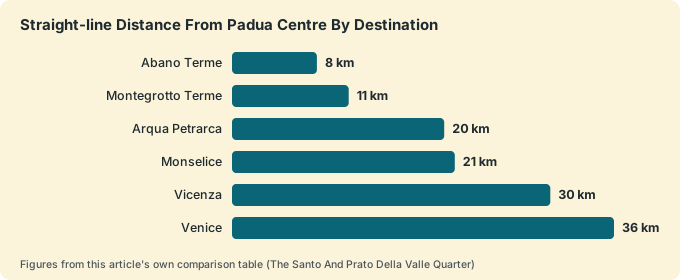
The Santo quarter connects to the rest of Padua on foot and by urban transport: the historic centre and the market squares lie a short walk to the northwest, the tram's SIR1 line runs north to south through the city, and a 90-minute urban ticket costs EUR 1.70 with contactless card payment accepted on board, per Busitalia's own fare page. The district is not isolated; it is simply at one end of the walkable core. Straight-line distances from the centre, as computed for this site's places data, put Venice 36 km away, Vicenza 30 km, Abano Terme 8 km and Montegrotto Terme 11 km, so day trips by train or bus start from the same station that serves the whole city.
For visitors using the quarter as a base, the practical anchors are known. The IAT tourist office at the station, at the exit of platform 1, is open Monday to Saturday 9:00 to 19:00 and Sunday and holidays 10:00 to 16:00, and the centre office sits at Piazza delle Erbe 52. Luggage storage at the station runs daily 6:00 to 20:00 at EUR 5 per 6 hours, on a page the publisher dates to 2024, so confirm before relying on it. Free municipal Wi-Fi under the PADOVAweb name exists in piazzas and public buildings, reported by the university's service pages.
The quarter also sits on the natural axis for the Euganean Hills. Abano and Montegrotto Terme are 8 and 11 km away in a straight line respectively, Arqua Petrarca 20 km, Monselice 21 km and Este 26 km, all computed from the site's places data, and the hills can be reached by the regional transport that fans out from the city. The site's day trip guide to Venice covers the opposite direction, the 26 to 40 minute train ride east to Venezia Santa Lucia.
| Destination | Straight-line distance from Padua centre | Typical connection |
|---|---|---|
| Abano Terme | 8 km | Regional bus and tram links |
| Montegrotto Terme | 11 km | Regional bus links |
| Arqua Petrarca | 20 km | Bus into the Euganean Hills |
| Monselice | 21 km | Bus or rail via the hills line |
| Vicenza | 30 km | Train, about 16 to 25 minutes |
| Venice | 36 km | Train, about 26 to 40 minutes |
What Is The Weather Like Around The Santo And Prato Quarter?
The weather around the Santo and Prato quarter follows Padua's continental pattern, with a January mean daily high of 7.3 C, July and August mean highs of 28.8 C, and November carrying the highest monthly rain total at 114 mm, per the ERA5 reanalysis for 1991 to 2020 for the grid cell at the centre of Padua. The district is unusually weather-tolerant by design: Prato della Valle is open ground best in dry conditions, but the basilica, the Oratory of San Giorgio and Santa Giustina are all interiors, so a wet morning can be flipped for a dry afternoon without changing the itinerary.
The numbers worth holding onto are these. Winter lows average just below freezing in January, at minus 0.2 C, so the square's statue ring is a cold walk in midwinter. Summer pairs the 28.8 C mean highs of July and August with high humidity, and the shade of the basilica's flanks and the porticos helps on the walk in. September and October both average around 105 mm of rain, so the transition months are the among the highest-rainfall months after November itself. The site's weather overview carries the full monthly table.
| Month | Mean high C | Mean low C | Rain mm |
|---|---|---|---|
| January | 7.3 | -0.2 | 53.6 |
| April | 17.6 | 7.8 | 84.4 |
| July | 28.8 | 18.9 | 62.1 |
| October | 18.4 | 10.6 | 105.4 |
| November | 12.6 | 5.5 | 114.0 |
Is The Santo And Prato District Good For A Guided Tour Of Padua?
The Santo and Prato district is strong territory for a guided tour of Padua, because its sights are dense, symbolic and easy to misread without context: a guide can unpack the basilica's tomb and relics, the Urbs Picta frescoes of the Oratory of San Giorgio, Donatello's altar and Gattamelata, and the 1767 Senate history of the square, all within the walk a tour group covers anyway. The tour roster on this site includes several options that reach the quarter, among them a private personalized walk of Padua's principal sights and a golf cart tour whose vehicle suits visitors covering the full stretch from the centre to Prato della Valle.
The choice between guided and independent comes down to depth. The basilica is free and needs no booking, and the square explains itself as a space, but the fourteenth-century fresco cycles and the layering of 1232, 1767 and 2021 dates across the quarter reward explanation. Visitors who prefer structure can compare the walking options on the site's Padua walking tour page; those who want a single decisive booking can Check availability for the private personalized walk that includes the quarter's landmarks among the city's principal sights.
How Much Time Do You Need In The Santo And Prato Quarter?
You need about half a day to see the Santo and Prato quarter properly: roughly an hour inside and around the Basilica of Saint Anthony, half an hour at the Oratory of San Giorgio, and forty-five minutes to an hour walking Prato della Valle and reaching the Basilica of Santa Giustina, with a Saturday morning or a third-Sunday antiques Sunday adding time for the market. The quarter compresses well, which is why day-trippers from Venice, arriving on the 26 to 40 minute train ride, can pair it with the Scrovegni Chapel and still be back for an evening on the lagoon. The site's one day in Padua from Venice plan does exactly that pairing.
Two cautions shape the timing. First, the basilica's rhythm follows services rather than a museum clock, so the flexible parts of the day should be the square, not the basilica. Second, if the Scrovegni Chapel is on the same day, its timed slot, booked ahead, fixes the schedule; the Santo quarter absorbs whatever remains. Visitors staying overnight should note the tourist tax, collected by the accommodation, capped at five consecutive nights, with rates set by the accommodation category and published by the Comune di Padova.
| Time budget | What it covers |
|---|---|
| 90 minutes | Basilica exterior, Gattamelata, a quick loop of Prato della Valle |
| Half day | Basilica interior, Oratory of San Giorgio, full square ring, Santa Giustina |
| Full day | All of the above plus the Saturday or antiques market at leisure |
| Two days | The quarter plus the Scrovegni, the centre and the Orto Botanico without pressure |
What Events Happen In The Santo And Prato Quarter?
The events that happen in the Santo and Prato quarter are the Tredicina and the feast of Saint Anthony on 13 June, the Saturday market and third-Sunday antiques market at Prato della Valle, and the Padova Marathon finish on the square, with the 2027 marathon set for 18 April starting at the Stadio Euganeo at 8:30 and finishing at Prato della Valle. The Tredicina ran 31 May to 12 June in 2026 with the feast day itself on 13 June; it is an annual event, and the 2026 edition is the latest confirmed one, per the basilica's own site.
The quarter's event calendar is otherwise quiet and regular rather than spectacular. The Saturday market and the antiques Sundays recur monthly, and the marathon lands once a year. Visitors planning around the feast week should expect the basilica and the square to carry the full weight of the city's devotion to its saint, with the procession of the statue and relics on the feast day itself. No 2027 feast-week detail had been announced.
Common Questions About The Santo And Prato Della Valle Quarter
Is entry to the Basilica of Saint Anthony in Padua free?
Yes, entry is free and no ticket is sold. A dress code suitable for a church environment applies, and hours change around services, so check the basilica's own site before a visit.
What is Prato della Valle in Padua?
Prato della Valle is a vast square in Padua surrounded by a canal with a double ring of numbered statues of famous people, declared communal space by the Venetian Senate in 1767 and reclaimed under Andrea Memmo.
When is the market at Prato della Valle?
The Saturday market runs 8:00 to 19:00 in winter and 8:00 to 20:00 in summer, and the antiques market runs on every third Sunday of the month from 8:00 to 20:00 across Prato della Valle and via Umberto I, per the Comune di Padova.
How far is the Santo quarter from central Padua?
The Santo quarter lies immediately southeast of Padua's historic centre, a short walk from Piazza delle Erbe and Palazzo della Ragione, and the whole circuit from basilica to Santa Giustina takes about ninety unhurried minutes on foot.
When is the feast of Saint Anthony in Padua?
The feast falls on 13 June each year, preceded by the Tredicina, which ran 31 May to 12 June in 2026. It is an annual event, and no 2027 dates had been announced.
Can you visit the Santo and Prato quarter and the Scrovegni Chapel in one day?
Yes. The Scrovegni Chapel is timed entry only and must be booked ahead, while the basilica is free with no slot, so book the chapel first and leave the quarter flexible around it. Day-trippers from Venice manage both on the 26 to 40 minute train connection.