Where To Stay In Padua: Four Bases Compared
Padua is small enough that no base is far from the sights, and the real choice is between the market squares, the Basilica quarter, the station side and the canal edge of Portello.
Short answer
The Centro Storico around Piazza delle Erbe puts the fresco-cycle sites, the markets and the evening squares within a short walk of each other; the Santo and Prato della Valle quarter suits visitors centred on the Basilica; the station side trades atmosphere for train and airport-bus convenience; Portello sits on the canal side between the two.
Padua (Padova), in the Veneto in northern Italy, is an inland city of arcaded streets and market squares about 36 km in a straight line from Venice, and it is compact enough that the choice of where to sleep matters less for distance than for character. The city's own map of areas defines the options plainly: the Centro Storico around the market squares, the Jewish Ghetto, Portello on the canal side, the Santo and Prato della Valle quarter around the Basilica of Saint Anthony, and the station and Arcella side. This page compares those bases using what the official sources actually state: walking relations between the squares, train and tram connections, the tourist tax the Comune di Padova charges, and the two UNESCO listings, the Orto Botanico (1997) and the fourteenth-century fresco cycles of Padova Urbs Picta (2021), that sit at the centre of a visit. No hotel is named and no nightly rate is quoted anywhere below; the comparison is about position, transport and what each quarter puts within walking distance.
Where To Stay In Padua: Which Of The Four Bases Fits Your Trip?
The best base in Padua depends on what the trip is built around: the Centro Storico around Piazza delle Erbe puts the Scrovegni Chapel, Palazzo della Ragione and the evening market squares within a short walk of each other; the Santo and Prato della Valle quarter centres on the Basilica of Saint Anthony and the Saturday market; the station and Arcella side trades atmosphere for the airport bus and every train line; Portello sits quietly on the canal side between them. None of these four bases is more than a walk or a short tram ride from the others, because Padua's inhabited core is that small: about 208,000 residents and roughly 76,000 students share one continuous centre, per the university's own figures.
The first question is honestly not which quarter is nicer, since this site's sources rank nothing, but which anchor a trip hangs on. A visitor coming for Giotto's frescoes, timed at the Scrovegni Chapel and closed 16 to 27 November 2026 for the annual inspection, is best placed near the Eremitani side of the centre. A visitor whose day starts at the Basilica, free to enter with the Saint's tomb inside, will find the Santo quarter puts that at the door. Someone commuting daily to Venice, about 26 to 40 minutes away by regional train, may reasonably sleep by the station and accept the scruffier evening streets around it that the practical reporting notes.
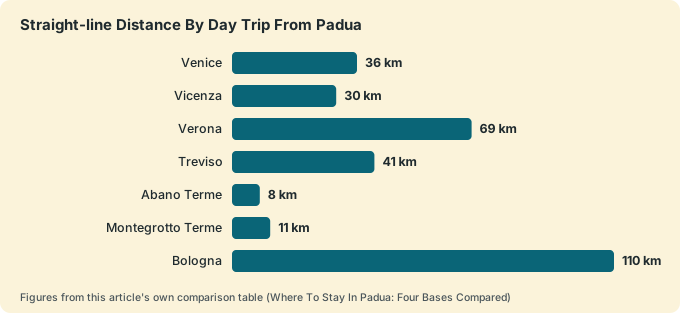
The table below is the whole decision in one view. Distances between the quarters are walking-scale: the site's computed straight-line figures place Venice 36 km away, Vicenza 30 km, Verona 69 km, Abano Terme 8 km and Montegrotto Terme 11 km, all far outside the city, while inside it everything in the table is on foot or on the tram's SIR1 line, the north-south Translohr route of about 10.5 km with 26 stops that has run since 2007.
| Base | What it puts at the door | Best for | Trade-off the sources support |
|---|---|---|---|
| Centro Storico (Piazza delle Erbe, Piazza dei Frutti) | Markets, Palazzo della Ragione, Caffe Pedrocchi, short walk to Scrovegni Chapel | First visits, the fresco cycles, evening squares | The busiest streets on market days, per the Comune's market schedule |
| Santo and Prato della Valle | Basilica of Saint Anthony (free entry), Prato della Valle with its statue-ringed canal | Pilgrimage-focused stays, Saturday market shoppers | Farther from the station and the Eremitani museums |
| Station and Arcella side | Padova station, airport bus, SIR1 tram, left-luggage office | Day-tripping to Venice, Vicenza and Verona | Station-area streets reported as scruffier after dark |
| Portello | Canal-side walks, the gate also named Porta Ognissanti, quiet position between centre and Prato | Quieter sleeps within reach of everything | Fewer sights at the door itself |
The four bases also share the same practical skeleton. The urban TU1 ticket costs EUR 1.70 for 90 minutes, or a contactless card can be tapped on board for the same fare; the airport bus to Venice Marco Polo costs EUR 13 one way, about 45 minutes, with 54 runs a day; and the IAT tourist office at the station, at the exit of platform 1, opens Monday to Saturday 9:00 to 19:00 and Sunday and holidays 10:00 to 16:00. Whichever quarter wins, those numbers hold.
Is The Centro Storico The Best Base In Padua?
The Centro Storico is the base the sources support for a first visit, because it is the one area where the Scrovegni Chapel, the Musei Civici Eremitani, Palazzo della Ragione, the Orto Botanico and the evening market squares of Piazza delle Erbe and Piazza dei Signori all sit within a compact walking radius, and because Padova Urbs Picta, the UNESCO inscription of 2021, places eight fourteenth-century fresco complexes in exactly this old centre. The universities' Palazzo del Bo and the Caffe Pedrocchi, opened 1831, sit in the same web of arcades.
The chapel is the anchor that makes the centre the safe answer. Entry is timed only, at most 25 people every 15 minutes, about 15 minutes inside, and the chapel's own booking page states that reservation ahead is required, with slots bookable by phone at +39 049 2010020 up to the day before; there is no same-day online booking. The daytime ticket, EUR 15 full plus a EUR 1 booking fee, also covers the Musei Civici Eremitani and Palazzo Zuckermann. Sleeping inside the old centre means the ticket office about 100 m from the chapel, the waiting room you must reach five minutes before your slot, and the market squares are all part of one walk.
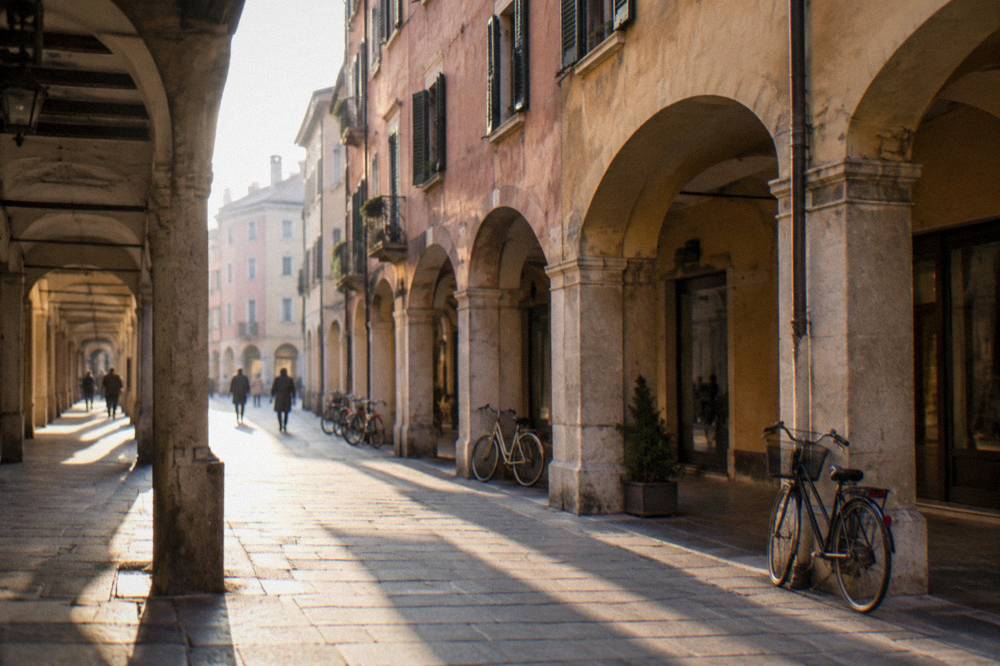
The centre is also where the daily rhythm of the city is loudest, in the literal sense of the Comune's own market schedule. Piazza delle Erbe runs 52 stalls of fruit, vegetables and flowers Monday to Friday 7:30 to 13:30 and Saturday 7:30 to 20:00; Piazza dei Frutti trades food from 8:00; and under Palazzo della Ragione the permanent Sotto il Salone market continues the food trade indoors. A bed anywhere in this web means the morning starts with the market, and the practical reporting notes petty theft around crowded piazzas and markets as the main risk, the usual vigilance of any Italian market city.
For orientation on a first evening, the walking options on this site cover the same streets: the audio-and-written-guide walk that is this page's featured route, a small-group street-food walk, and the guided Scrovegni Chapel tour are the three that pair best with a centre base, because all three work from the middle outward.
The UNESCO layer is worth spelling out, because it is the reason the centre holds its value as a base. The Padova Urbs Picta inscription of 2021 lists eight complexes, all in the old centre: the Scrovegni Chapel, the Church of the Santi Filippo e Giacomo agli Eremitani, Palazzo della Ragione, the Chapel of the Reggia Carrarese, the Baptistery of the Cathedral, the Basilica and Convent of Saint Anthony, the Oratory of San Giorgio and the Oratory of San Michele. Sleep inside that ring and the whole inscription is a set of walks, with the Basilica end of it at the edge of the Santo quarter described next. The Orto Botanico, the university's botanical garden founded 1545 and inscribed by UNESCO in 1997, sits on the same side, with its own ticket now EUR 15 full from 1 September 2026 and EUR 12 in the winter months of November to February. More on the eight sites is in Padova Urbs Picta, UNESCO Explained, and ticket mechanics are covered in Scrovegni Chapel Tickets And Booking.
Is Staying By Padua Station And Arcella A Good Idea?
Staying on the station and Arcella side is the right call when Padua is a base rather than a destination: the airport bus to Venice Marco Polo leaves from there every 40 minutes for EUR 13, regional trains reach Venice in about 26 to 40 minutes and Vicenza in 16 to 25, and the station holds the official left-luggage office and an IAT tourist office, all of which the centre cannot match. What the sources say against it is narrower: the practical reporting describes the station area as scruffier after dark.
The station case rests on numbers that are all checked against official sources. The Busitalia airport link runs 54 times a day between 05:30 and 22:50 from Padua, about 45 minutes each way, with a child fare of EUR 6.50. The left-luggage office on platform 1 opens daily 6:00 to 20:00 at EUR 5 per 6 hours, per the tourism board's page, which dates from 2024, so confirm at arrival. The tram's SIR1 line runs north-south through the station corridor, and a second line, SIR3, is in pre-service testing toward Voltabarozzo with service targeted by the end of 2026, though no opening date should be promised. Getting to and around this side is detailed in Getting Around Padua and The Padua Train Station Area.
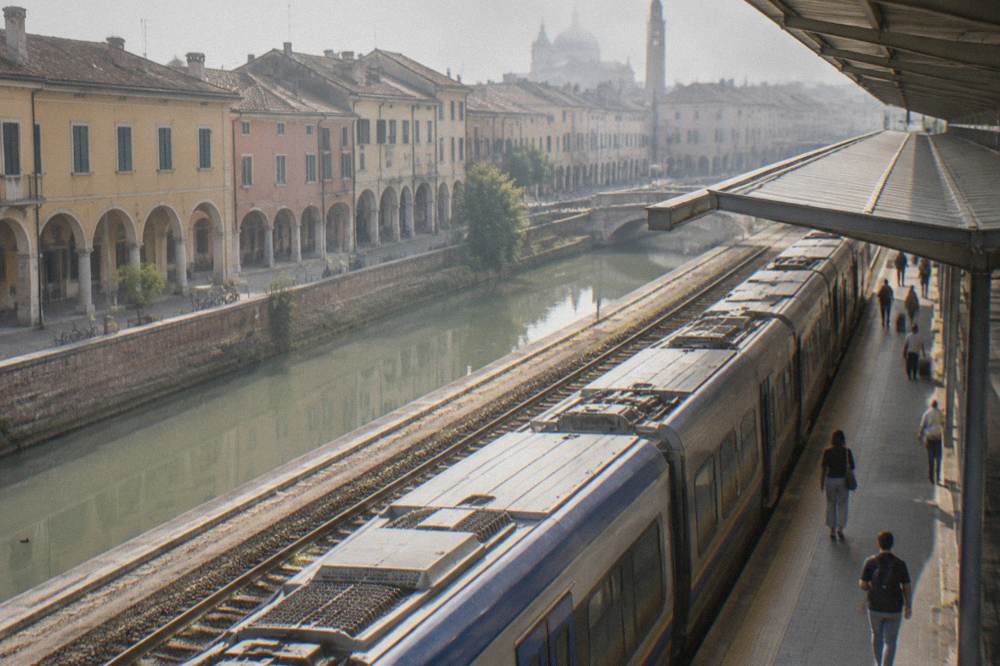
The Arcella side, north of the tracks, is a residential student quarter in everything but an official label; the sources behind this page give no neighbourhood safety score or price level for any area, so the honest framing is positional: it is across the station from the centre, connected by tram and by foot, and the trade is distance from the squares for immediate access to every train. Visitors flying into Venice and out again should read Venice Airport To Padua, and anyone weighing the reverse commute should start with Venice To Padua.
| Journey from Padova station | Typical time | Fare the sources give |
|---|---|---|
| Venezia Santa Lucia (regional) | about 26 to 40 minutes | about EUR 5 |
| Vicenza (regional) | about 16 to 25 minutes | about EUR 6 |
| Verona | about 43 to 60 minutes | not given, confirm on Trenitalia |
| Treviso | about 28 to 60 minutes | not given, confirm on Trenitalia |
| Venice Marco Polo airport (Busitalia) | about 45 minutes | EUR 13 one way, EUR 6.50 child |
One trap to set straight from this side of the city: day-trippers to Venice do not face an access fee today. The 2026 Venice trial ended on 27 July 2026, per Venezia Unica, and no 2027 decision had been announced. A station-based commuter to Venice plans around trains alone, not around a gate charge.
Why Stay In The Santo And Prato Della Valle Quarter?
The Santo quarter, around the Basilica of Saint Anthony and Prato della Valle, is the base for a stay built on the Basilica and the biggest of the city's open spaces: the Basilica is free to enter and holds the Saint's tomb and the Chapel of the Relics, Prato della Valle is a monumental square ringed by a canal and a double ring of numbered statues, and the Saturday market spreads across the Prato from 8:00 to between 19:00 and 20:00 depending on season. Donatello's equestrian Gattamelata stands in the Piazza del Santo outside.
The Basilica's dates come from the history file: construction began in 1232, a year after Saint Anthony died on 13 June 1231, and the Tredicina, the thirteen days of devotion before the feast, ran 31 May to 12 June in 2026 with the procession on 13 June. The feast is annual; no 2027 date is published. A pilgrim-shaped stay in this quarter puts all of that at the door, and the free entry reported by the Basilica's own visitor information means there is no ticket logistics to plan beyond dress suitable for a church. The Saint's story is told at length in Saint Anthony Of Padua.
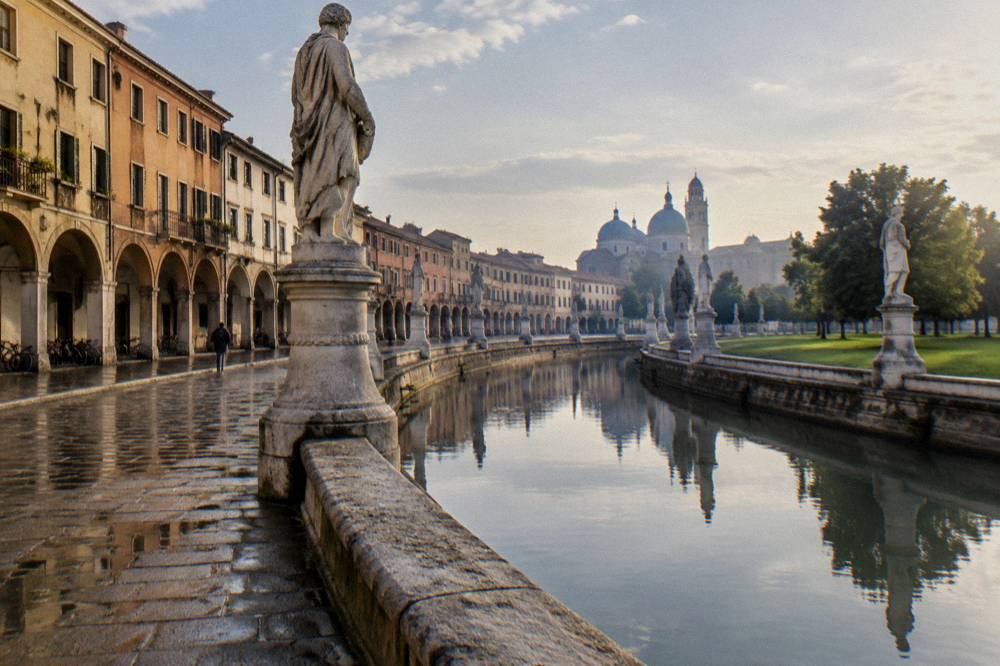
Prato della Valle's own facts are worth repeating because so much online copy invents them. The square is surrounded by a canal with a double ring of statues of famous people; the Venetian Senate declared it communal space in 1767 and it was reclaimed under Andrea Memmo, per the tourism board's page. No area figure and no statue count is given. The antiques market adds a monthly rhythm on the third Sunday of each month, 8:00 to 20:00, across the Prato and via Umberto I. The quarter's walk onward to the centre passes the university quarter; the university, founded 1222, is described by its own pages as among the oldest, and its anatomy-adjacent landmarks, from the anatomical theatre of 1594 to Galileo's years teaching there from 1592 to 1610, are covered in The University Of Padua.
| Santo-quarter anchor | What the sources state |
|---|---|
| Basilica of Saint Anthony | Free entry; tomb and Chapel of the Relics inside; begun 1232 |
| Prato della Valle | Canal with double statue ring; Senate declaration 1767 |
| Saturday market, Prato della Valle | Winter 8:00 to 19:00, summer 8:00 to 20:00 |
| Antiques market | Third Sunday monthly, 8:00 to 20:00, Prato and via Umberto I |
| Tredicina and feast | Latest edition 31 May to 12 June 2026, feast 13 June |
What Is Staying In Portello And The Canal Quarter Like?
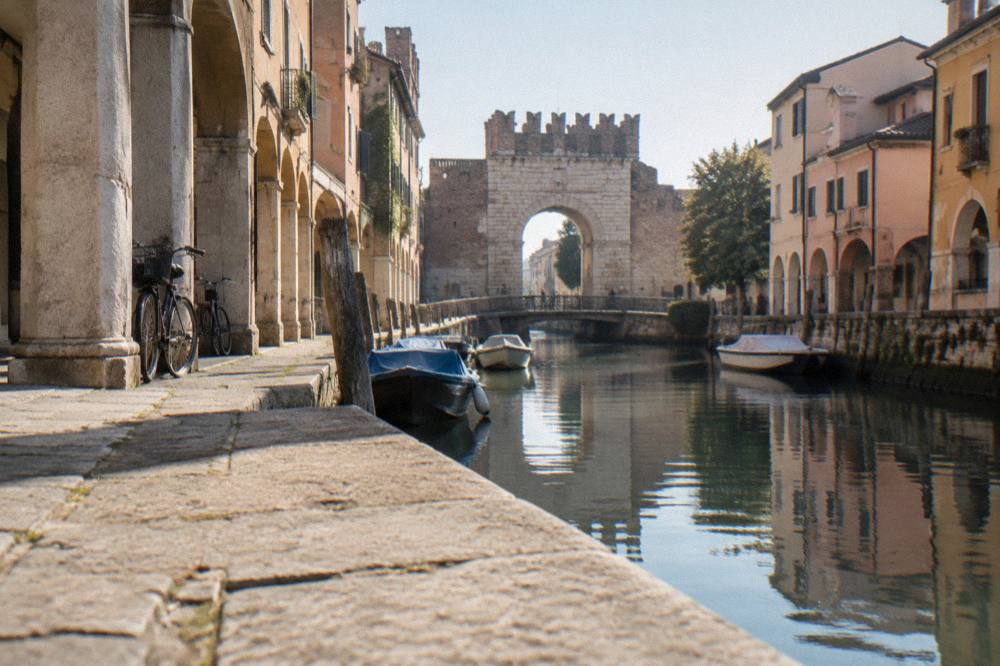
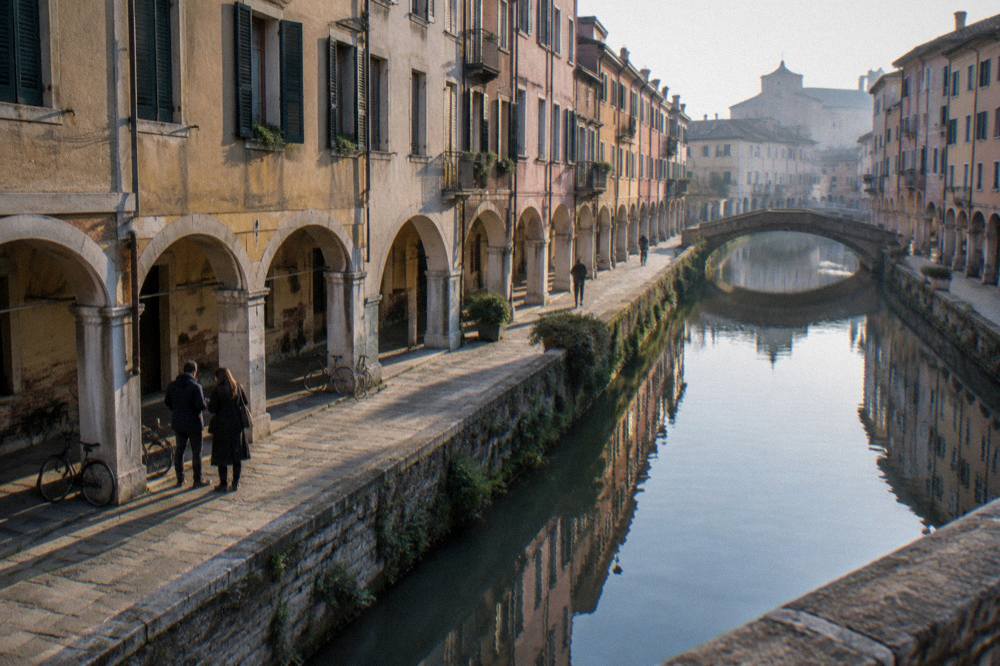
Portello is the quiet edge-of-centre base: the gate there, named Porta Portello on the tourist maps and Porta Ognissanti in the map data behind this site, the same gate, opens onto the canal that runs out of the old city, and the quarter sits between the market centre and Prato della Valle so that neither end of the visit is more than a walk away. It is the one base of the four whose appeal is positional rather than monumental, and the sources support exactly that and nothing more.
The city's historic walls and gates, covered across the site's pages on the Mura di Padua, frame this quarter's character: a river gate on a working waterway rather than a square of museums. The canals of Padua, historically the branches of the Bacchiglione that made the city a river port, are the reason the gate exists at all, and walking the canal path from Portello toward the Prato is one of the free pleasures itemised on Free Things To Do In Padua. Nothing in the sources prices, ranks or characterises this quarter beyond its position, so this page will not invent a vibe for it.
For a traveller weighing Portello against the station side, the decision is between atmosphere and connections. Portello keeps the walk to the Scrovegni Chapel short, roughly the same arc as from Piazza delle Erbe, while the station side keeps the airport bus. The tram does not solve the comparison either way for luggage-heavy arrivals, since SIR1's corridor is the north-south axis and a Portello bed may still mean a walk with bags from the nearest stop. Travellers who prefer to arrive, drop bags and walk out unencumbered can use the station's left-luggage office, EUR 5 per 6 hours daily 6:00 to 20:00, then move to the quarter, confirming the fee on arrival. Other pages covering the same trip are gathered on Padua Travel Guide.
How Much Does It Cost To Stay In Padua?
The one lodging cost every Padua visitor pays and can plan for is the imposta di soggiorno, the tourist tax charged per person per night for up to five consecutive nights, collected by the accommodation itself, with under-16s and hostel guests exempt, per the Comune di Padova's tax page; no nightly hotel or apartment rate for Padua exists in the sources behind this site, so confirm the tax amount and the room price at booking.
What can be budgeted with certainty are the sightseeing and transport figures, which are published and current. The Scrovegni Chapel daytime combination is EUR 15 full, EUR 11 reduced and EUR 5 for residents, plus the EUR 1 chapel booking fee; Palazzo della Ragione is EUR 8 full; the Orto Botanico is EUR 15 full from 1 September 2026 and EUR 12 in November to February; the Palazzo del Bo guided tour is EUR 10 full; the urban transport ticket is EUR 1.70 for 90 minutes. A family note: the Scrovegni family card, EUR 30 plus EUR 1 per person for the chapel, covers up to two adults and two under-18s, which pairs with the five-night tax cap as the two family-relevant numbers the sources actually give.
| Cost item | Figure the sources give |
|---|---|
| Tourist tax | Per person per night, capped at five consecutive nights; under-16s and hostel guests exempt |
| Scrovegni Chapel, museums combined | EUR 15 full, EUR 11 reduced, residents EUR 5, plus EUR 1 booking fee |
| Orto Botanico (from 1 Sept 2026) | EUR 15 full; EUR 12 winter full (Nov to Feb) |
| Palazzo della Ragione | EUR 8 full, EUR 6 concession |
| Palazzo del Bo guided tour | EUR 10 full, about 45 minutes |
| Urban transport | EUR 1.70 for 90 minutes; EUR 4.70 daily |
| Airport bus to Venice Marco Polo | EUR 13 one way |
Seasonality is a fair question and the honest answer is that the sources give climate, not prices. The ERA5 reanalysis for Padua, 1991 to 2020, puts the January mean high at 7.3 C and the July and August mean high at 28.8 C, with November carrying the highest monthly rain total at 114.0 mm and January the lowest at 53.6 mm. Whether rooms cost more in any given month is a question for booking, not for this page; the weather that shapes a visit is covered in Padua Weather And Climate and the timing trade-offs in The Best Time To Visit Padua.
Is Padua A Good Base For Venice And The Veneto?
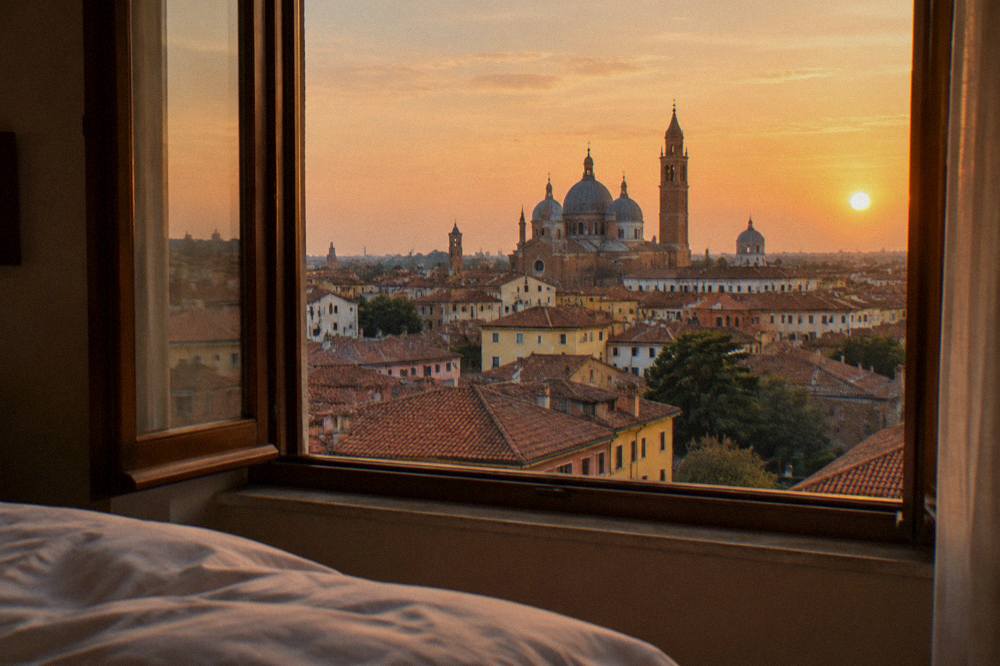
Padua works as a base for the whole region: Venice is about 36 km away in a straight line with regional trains taking about 26 to 40 minutes for about EUR 5, Vicenza 30 km away at 16 to 25 minutes for about EUR 6, Verona 69 km at 43 to 60 minutes, and the Euganean spa towns of Abano Terme and Montegrotto Terme 8 and 11 km away, so a single bed in Padua can carry a week of different day trips without repacking. The airport bus adds Venice Marco Polo at EUR 13 and about 45 minutes.
The Venice relationship deserves its own paragraph because it is the most common pattern. The two cities are separate places, an inland one and a lagoon one, and the commute between them is one of the shortest city-pair hops in northern Italy. The Venice access-fee question is settled for now: the 2026 trial ended 27 July 2026, and no 2027 decision had been announced, so a Padua-based day-tripper books a train and nothing else. The fuller argument, including why sleeping in Padua and visiting Venice daily can suit certain trips, is made in Padua As A Base For Venice, and the general arrival picture in How To Get To Padua.
| Day trip from Padua | Straight-line distance | Train time reported |
|---|---|---|
| Venice | 36 km | about 26 to 40 min |
| Vicenza | 30 km | about 16 to 25 min |
| Verona | 69 km | about 43 to 60 min |
| Treviso | 41 km | about 28 to 60 min |
| Abano Terme | 8 km | local transport, confirm times |
| Montegrotto Terme | 11 km | local transport, confirm times |
| Bologna | 110 km | not given, confirm on Trenitalia |
The same base logic extends to food and evening life, which belong to whichever quarter you sleep in. The tourism board's own gastronomy pages centre the evening on the piazzas with their spritz culture, and Aperol was created in Padua in 1919 by the Barbieri brothers, a fact the drink's histories record; the local dishes the board names are the risotto ricco alla Padovana, cappone alla canevera and torta pazientina. The eating side of the stay is covered in What To Eat In Padua, The Best Restaurants In Padua and Spritz In Padua, and the money-saving angle, including the free sights, in Padua On A Budget.
Practical Questions To Sort Before Booking A Padua Bed
Four practical facts shape any Padua booking: the tourist tax is collected by the accommodation and capped at five consecutive nights per stay, the Scrovegni Chapel requires a timed reservation booked by the day before and closes 16 to 27 November 2026, the airport bus and all regional trains leave from the station side, and the IAT tourist offices at the station and at Piazza delle Erbe 52 in the centre are the two official help points, so a bed near either office simplifies arrival. Everything else, including free municipal Wi-Fi in the piazzas under the PADOVAweb network, is confirmed but secondary.
Booking order matters more here than in larger cities. The chapel slot should be booked first, because slots are capped at 25 people every 15 minutes and the evening visits, chapel only, run 25 March to 1 November from 19:00 to 22:00 every 20 minutes; then the bed can be chosen around the slot. The chapel's own booking page lists slots bookable ahead, and the call centre at +39 049 2010020 handles bookings up to the day before. A fuller arrival-day plan, in which a walking route fills the hours before a chapel slot, is the exact use case for the featured self-guided walk on this site, Check availability alongside the route's own tour page.
The arrival logistics by base, in one place: centre beds are reached on foot or by tram from the station in minutes; station-side beds need no transport at all; the Santo quarter and Portello are tram-and-walk or a single taxi, though no taxi fare is quoted. Travellers arriving by car should read The Padua ZTL And Parking before choosing any central address, since the limited-traffic rules are the one part of central driving the city enforces with specifics this site treats separately. And for the full inventory of what each base gives access to, the root planning page at things to do in Padua is the site's own overview.
Common Questions About Staying In Padua
Where to stay in Padua for a first visit?
The Centro Storico around Piazza delle Erbe is the base the sources support for a first visit: it puts the Scrovegni Chapel, the combined museums, Palazzo della Ragione, the markets and the university quarter within one walking radius, and all eight Padova Urbs Picta fresco complexes lie in or beside it.
Is it better to stay in Padua or Venice?
This site ranks neither city. The sourced facts are that the two are 36 km apart in a straight line, regional trains take about 26 to 40 minutes for about EUR 5, and the Venice access-fee trial ended on 27 July 2026, so a Padua bed with Venice day trips is straightforward; the trade-offs are laid out in the site's Padua-as-a-base-for-Venice guide.
Does Padua charge a tourist tax on hotel stays?
Yes. The imposta di soggiorno is charged per person per night for up to five consecutive nights and is collected by the accommodation; under-16s and hostel guests are exempt. Rates vary by accommodation category, so confirm the amount at booking.
Is the area around Padua station safe to stay in?
The practical reporting describes the station area as scruffier after dark and lists petty theft at the station, in crowds and on public transport as the main risk in the city generally; no neighbourhood safety score exists in the sources. Standard vigilance with bags applies, as in any Italian rail hub.
Can you leave luggage in Padua if you arrive before check-in?
Yes. The official left-luggage office at Padova station, on platform 1, opens daily 6:00 to 20:00 at EUR 5 per 6 hours; the tourism board's page dates from 2024, so confirm the fee on arrival. App-based locker and drop-off services also operate in the city.
Do you need a car to stay in Padua?
No. The urban TU1 ticket is EUR 1.70 for 90 minutes with contactless tap-on available, tram SIR1 runs the north-south corridor, and the centre, the Santo quarter and Portello are all walkable from one another; a car mainly complicates central addresses through the limited-traffic zone covered on the site's ZTL page.