Padua Weather By Month: Fog, Heat And Rain
Padua has a continental northern Italian climate: cold damp winters with fog, hot humid summers, and a rain peak in November. Here is what the ERA5 climate normals say, month by month.
Short answer
Padua's climate, per the ERA5 reanalysis 1991-2020, runs from a January mean high of 7.3 C to July and August mean highs of 28.8 C, with November the month with the highest rain total at 114 mm.
Padua (Padova), in the Veneto in northern Italy, sits inland on the flat Paduan plain about 36 km in a straight line from Venice, and its weather reflects that geography: a continental northern Italian climate with cold, damp winters, hot, humid summers and a fair amount of rain spread across the year. This page reports the numbers the way this site's Padua Travel Guide desk reports everything, from a single stated source: the monthly figures below are ERA5 reanalysis values, 1991-2020, a modelled grid cell at the centre of the city rather than a weather-station record. What follows is the full monthly picture, then the practical reading of it, when rain falls, how hot the summer really gets, what fog and snow do to a winter visit, and what all of it means for packing and planning.
What Kind Of Climate Does Padua Have?
Padua has a humid subtropical-continental climate typical of the Po-Venetian plain: cold, damp winters with mean highs around 7 C in January, hot, humid summers with mean highs of 28.8 C in July and August, and rain in every single month of the year, per the ERA5 reanalysis for 1991-2020. No month is dry in absolute terms; even January, the month with the lowest rain total, averages 53.6 mm.
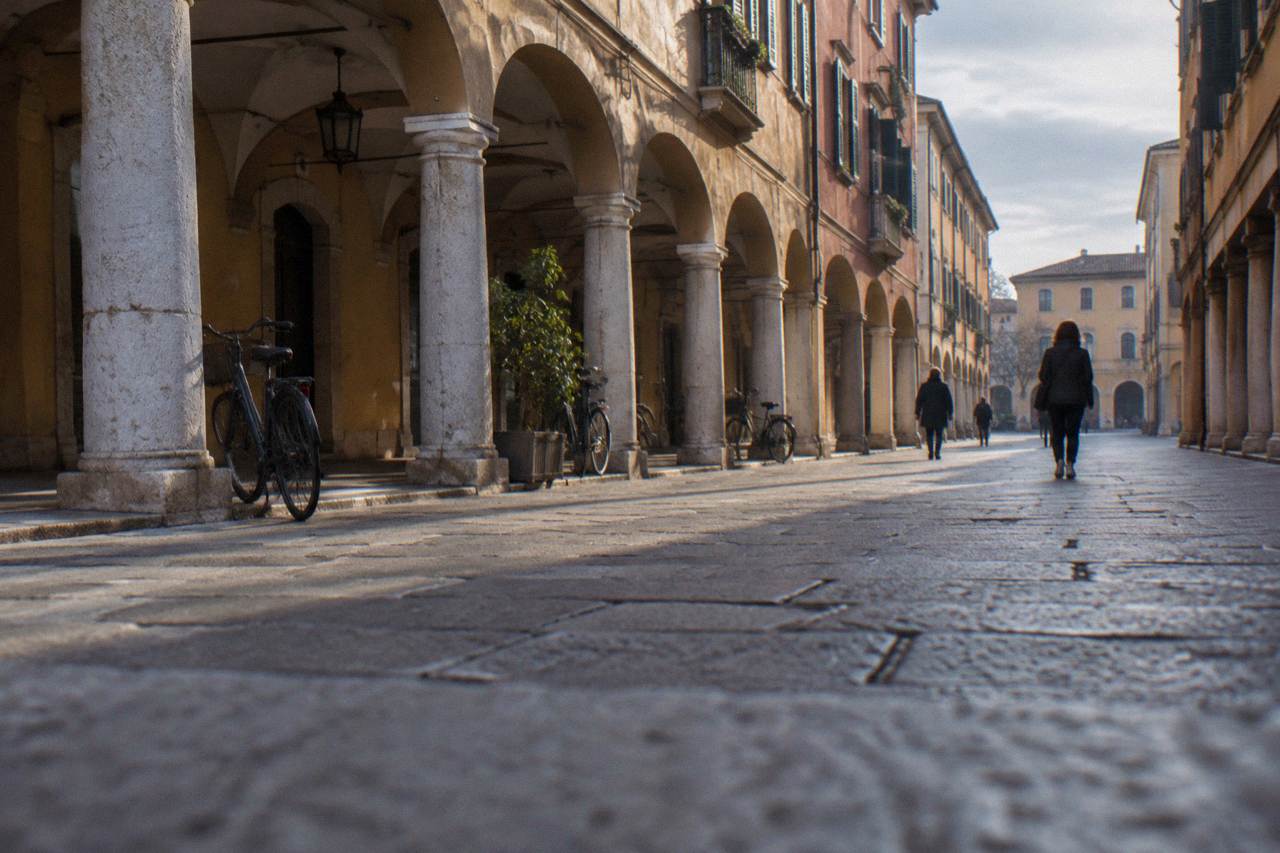
The city's position matters. Padua is inland, on low ground between the Euganean Hills to the west and the Venetian lagoon 36 km to the east, and that plain holds moisture. Winter brings the famous padana fog, the thick radiation fog that settles over the whole Po basin on still nights. Summer brings heat that combines with humidity off the irrigated plain, so a 28.8 C mean high in July can feel heavier than the same number on the coast. Rain is not concentrated in one season: the ERA5 table shows totals above 60 mm in ten of twelve months, with the peak in late autumn rather than in a summer monsoon pattern.
Two things this page will not do. It will not print sunshine hours, because the ERA5 grid does not carry a measured sunshine record for the city, and it will not crown any month with a superlative. The numbers are quoted, and you can compare them yourself.
What Is The Padua Weather By Month, January To June?
The first half of the year warms steadily from a January mean high of 7.3 C and mean low of -0.2 C to a June mean high of 26.2 C and mean low of 16.6 C, while monthly rain climbs from 53.6 mm in January to a first-half peak of 99.7 mm in May, per the ERA5 reanalysis 1991-2020. March, April and May each gain about 4 to 5 C of mean high over the previous month.
| Month | Mean High (C) | Mean Low (C) | Rain (mm) |
|---|---|---|---|
| January | 7.3 | -0.2 | 53.6 |
| February | 9.4 | 0.6 | 57.9 |
| March | 13.7 | 3.9 | 67.2 |
| April | 17.6 | 7.8 | 84.4 |
| May | 22.1 | 12.4 | 99.7 |
| June | 26.2 | 16.6 | 81.0 |
Read the lows as much as the highs. January nights sit just below freezing on average, which is what makes the fog form: clear skies, still air and moisture from the surrounding fields. By April the mean low is 7.8 C and evenings outdoors become plausible again. May is the first half's rain peak at 99.7 mm, but it falls as showers and thunderstorms rather than all-day drizzle, and June actually drops back to 81.0 mm as the warmth builds. For a fuller planning discussion of when to come, the companion page on the best time to visit Padua weighs these numbers against opening hours and events.
What Is The Padua Weather By Month, July To December?
The second half of the year runs from the annual mean-high peak of 28.8 C in both July and August down to 7.8 C in December, while rain builds to the annual peak of 114.0 mm in November, flanked by September and October at about 105 mm each, per the ERA5 reanalysis 1991-2020. Mean lows fall from 19.2 C in August to 0.7 C in December, crossing freezing territory again by the start of winter.
| Month | Mean High (C) | Mean Low (C) | Rain (mm) |
|---|---|---|---|
| July | 28.8 | 18.9 | 62.1 |
| August | 28.8 | 19.2 | 78.7 |
| September | 23.6 | 14.9 | 105.5 |
| October | 18.4 | 10.6 | 105.4 |
| November | 12.6 | 5.5 | 114.0 |
| December | 7.8 | 0.7 | 69.9 |
The shape of autumn is the headline. July and August share the identical 28.8 C mean high, but their rain totals differ: 62.1 mm in July against 78.7 mm in August, August being the month when slow-moving thunderstorms cluster over the plain. Then September and October hold at about 105 mm each and November tops the year at 114.0 mm. November rain in Padua is frontal and persistent, the grey-week kind rather than the summer downpour kind, and it comes with the return of the fog. December eases back to 69.9 mm as the air dries and cools.
When Does It Rain In Padua, And How Much?
Rain in Padua falls in every month of the year, with the highest monthly totals in November (114.0 mm), September (105.5 mm) and October (105.4 mm), and the lowest in January (53.6 mm), February (57.9 mm) and July (62.1 mm), per the ERA5 reanalysis 1991-2020. There is no dry season: the difference between the low and high months is a factor of about two, not ten.
| Rank | Month | Rain (mm) | Character of the rain |
|---|---|---|---|
| 1 | November | 114.0 | Frontal, persistent, often with fog |
| 2 | September | 105.5 | Thunderstorms easing into autumn rain |
| 3 | October | 105.4 | Steady autumn rain, longer dark spells |
| 4 | May | 99.7 | Showers and warm-season thunderstorms |
| 5 | August | 78.7 | Heavy but short thunderstorms |
| 6 | January | 53.6 | Light winter rain, drizzle, occasional snow |
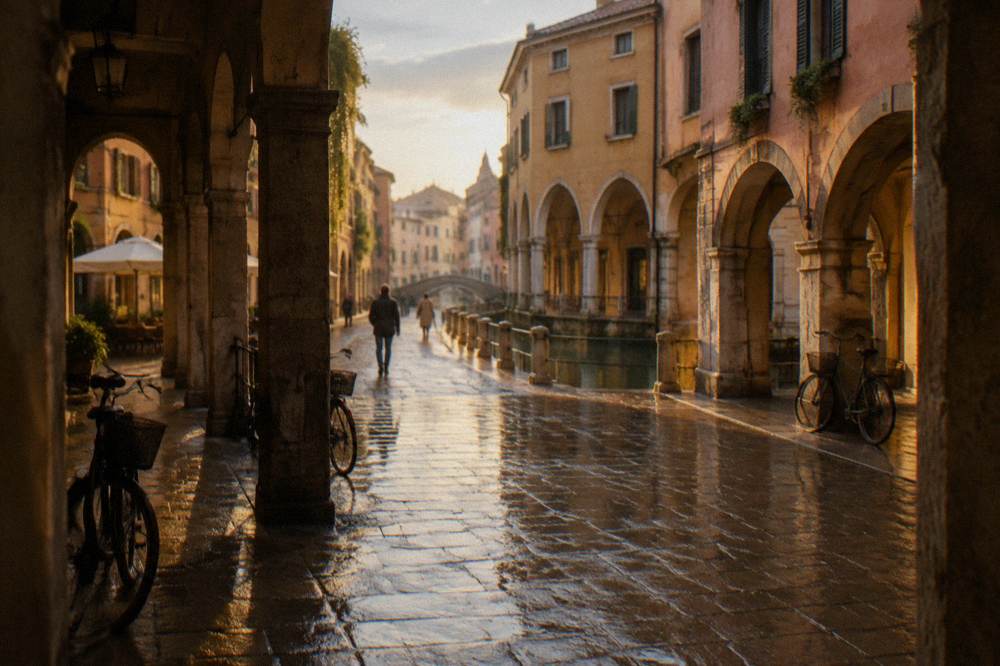
The practical reading is that a rain plan belongs in any Padua trip, whatever the month. The city is unusually well built for it: the historic centre is lined with arcades, the Scrovegni Chapel visit is indoors and timed, and a whole string of museums sits within a short walk of Piazza delle Erbe. The dedicated Padua in the rain itinerary maps a full wet day around exactly those assets, and the Padua museums guide is the natural companion if a grey day swallows your itinerary. For the Scrovegni specifically, remember that entry is timed, with at most 25 people admitted every 15 minutes, and the chapel closes 16 to 27 November 2026 for the annual fresco inspection: booking details are on the Scrovegni Chapel tickets page.
How Hot Does A Padua Summer Get?
July and August share the annual peak mean high of 28.8 C, with mean lows of 18.9 C and 19.2 C, per the ERA5 reanalysis 1991-2020, and the humidity of the Po plain makes the heat feel heavier than the number suggests; rain falls in both months, 62.1 mm in July and 78.7 mm in August, arriving as thunderstorms rather than all-day rain.
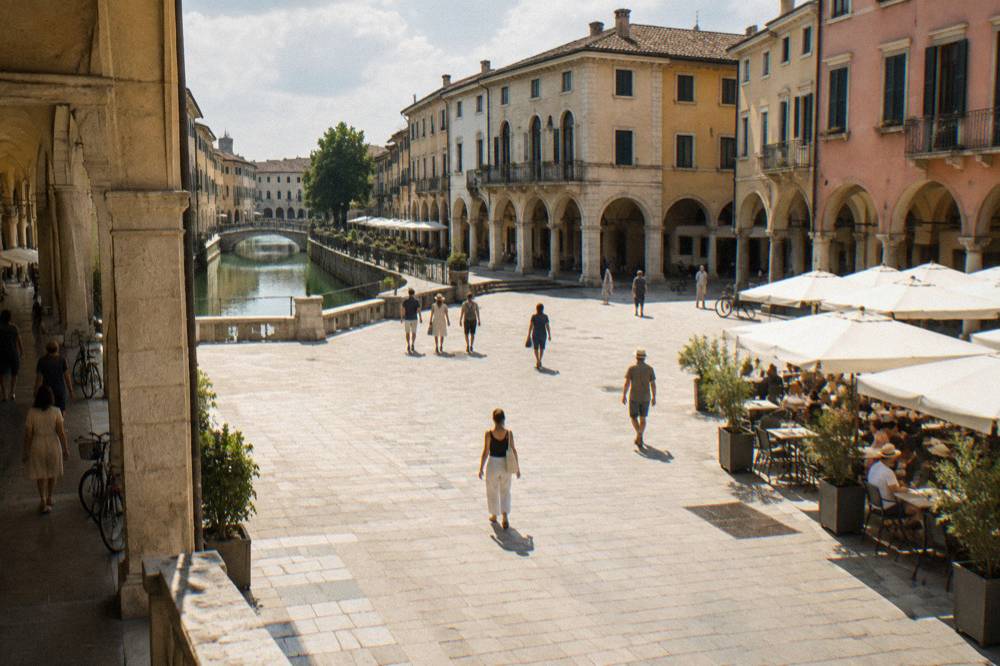
A mean high is an average, and individual summer days in Padua run above it: heat in the low to mid 30s C occurs in a typical July or August spell on the plain. The saving grace is architectural. Padua's centre is a web of narrow streets and continuous arcades that give real shade, and the Basilica of Saint Anthony, the Scrovegni's waiting room and the Musei Civici Eremitani are all cool interiors. The sensible summer shape for a day is early walking, indoor sightseeing across the midday hours, and the evening in the piazzas, where the aperitivo culture takes over once the sun drops. The spritz in Padua page covers that evening ritual, and Aperol itself was created in Padua in 1919 by the Barbieri brothers, a fact the city is entitled to be smug about.
Water matters in this heat more than in a coastal town, because you cannot see the sea from anywhere in Padua. Tap water in the city is safe, and public fountains in the squares and parks are drinkable where marked potable. If the forecast crosses into the mid 30s, shifting the Scrovegni slot to an evening visit is one option: the "Giotto sotto le stelle" evening openings run 25 March to 1 November, 19:00 to 22:00, every 20 minutes, chapel only.
How Cold Is A Padua Winter, And Does It Snow?
Winter in Padua brings a January mean high of 7.3 C and mean low of -0.2 C, December lows of 0.7 C and February lows of 0.6 C, per the ERA5 reanalysis 1991-2020, with fog a regular feature of still nights and mornings; a long-run climate study reports about 4.4 snowy days a year over the 1995 to 2024 period, and seasons with no snow at all are not uncommon.
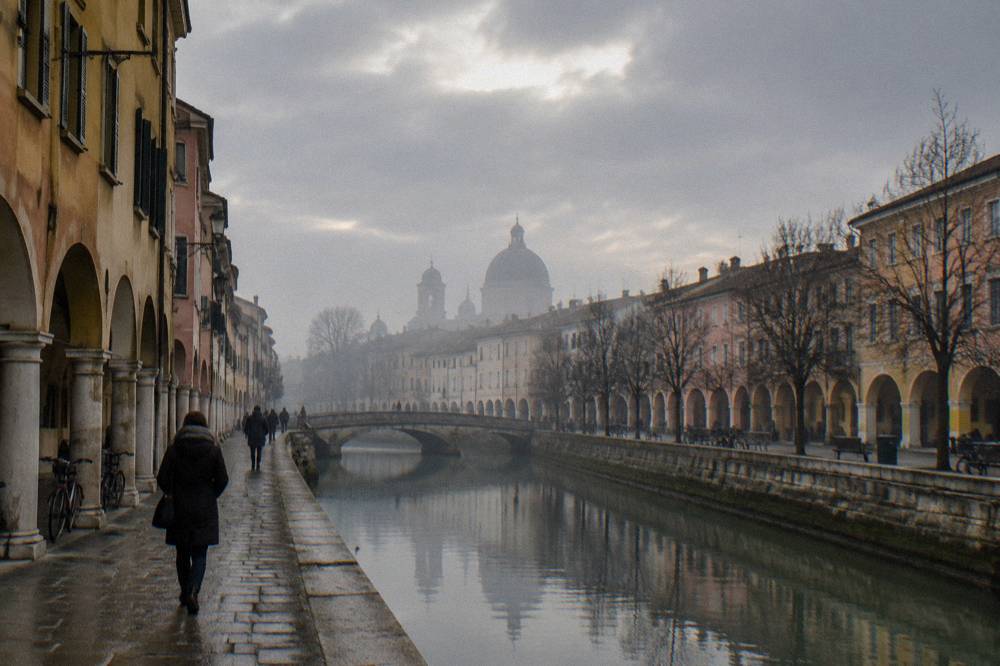
That snow figure deserves its label: it comes from a long-run climate study covering 1725 to 2024, which reports the 1995 to 2024 average at about 4.4 snowy days per year, down from about 10.4 days per year in the 1785 to 1814 period. Snow in Padua today is an event, not a season. When it does fall it rarely stays long, because the mean highs in all three winter months sit above 5 C. The fog is the more reliable winter feature: on clear, windless nights the plain cools and the moisture condenses, and mornings can hold visibility low until midday. Photographically it is a gift, soft grey light over the arcades and the domes; practically it means a warm layer and a little patience with the view from the Mura, the old city walls.
The Padua in winter page takes the cold-season planning further, including what stays open through the short days. One winter closure is already fixed: the Scrovegni Chapel is closed 16 to 27 November 2026 for the annual inspection of the frescoes by the Istituto Centrale per il Restauro, so a late-November trip needs to plan around it.
Which Season Suits A First Visit To Padua Best?
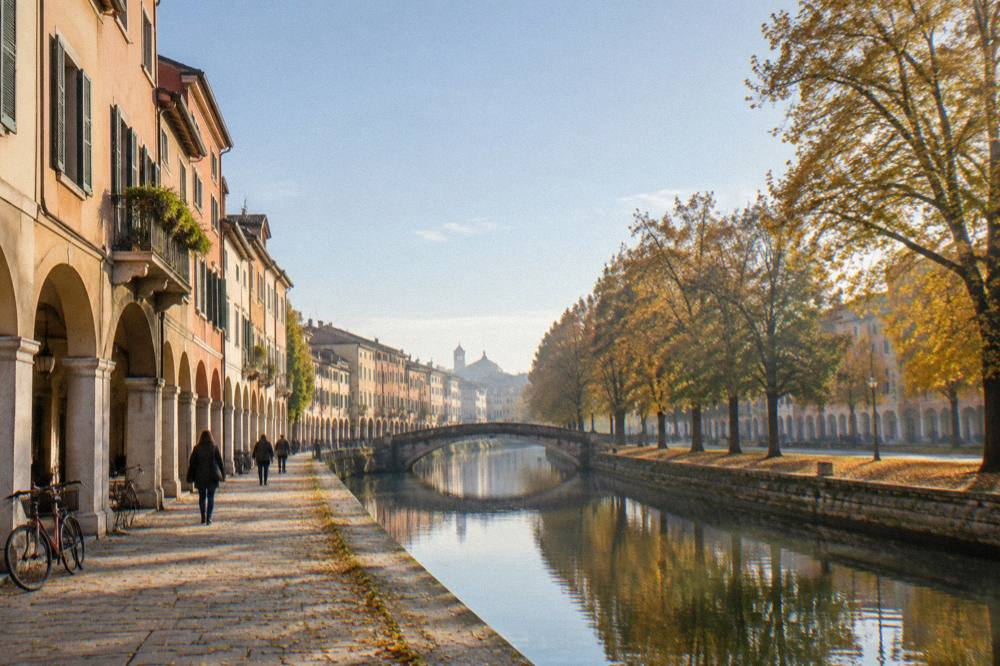
Judged on the numbers alone, late April to June and September to October offer the best balance in the ERA5 reanalysis 1991-2020: mean highs of 17.6 C in April, 22.1 C in May and 26.2 C in June, and 23.6 C in September, though September and October carry the year's second and third highest rain totals at 105.5 mm and 105.4 mm, so a compact umbrella belongs in the bag in any season.
| Season | Months | Mean High Range (C) | Rain Character | Main Planning Notes |
|---|---|---|---|---|
| Winter | Dec to Feb | 7.3 to 9.4 | 53.6 to 69.9 mm/month; fog; rare snow | Short days, foggy mornings, indoor sights |
| Spring | Mar to May | 13.7 to 22.1 | 67.2 to 99.7 mm/month; showers | Warm-up, long evenings by May |
| Summer | Jun to Aug | 26.2 to 28.8 | 62.1 to 81.0 mm/month; thunderstorms | Heat plus humidity; arcades and evening life |
| Autumn | Sep to Nov | 12.6 to 23.6 | 105.4 to 114.0 mm/month; steady rain | Mild September, grey November, fog returns |
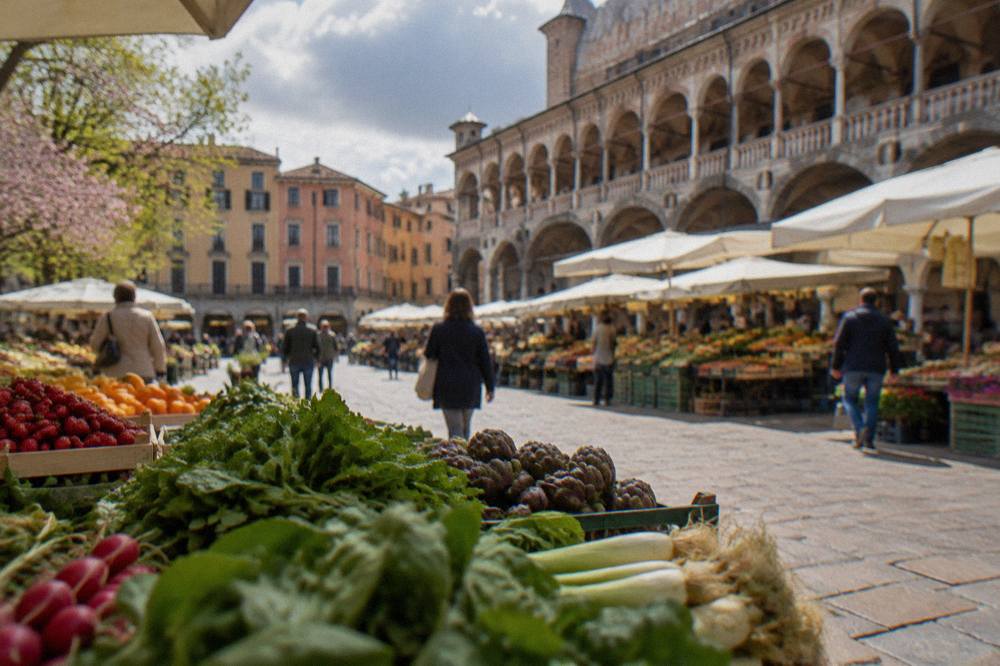
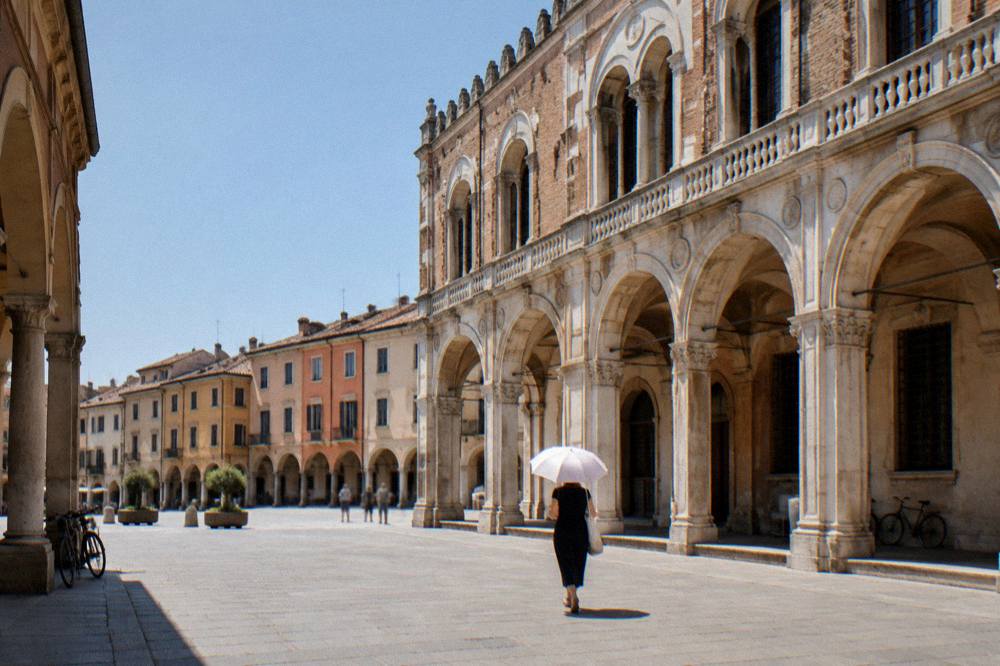
There is no wrong month for the city's core sights, because they are overwhelmingly indoor and close together. What changes is the texture of the day. Winter suits a museum-heavy, café-heavy visit with the fog as atmosphere. Spring and early autumn suit walking, the markets and the day trips into the Euganean Hills. Summer suits a slow rhythm with the evenings in Piazza delle Erbe and Piazza dei Signori. The overview of things to do in Padua can be read against this table to match your interests to a season.
How Does Padua Weather Affect Day Trips And The Venice Run?
Day trips out of Padua sit in the same climate, and the rain peak in November applies equally to Venice, 36 km east in a straight line, the Euganean Hills to the west and Verona about 69 km west: a wet November day in Padua is a wet day everywhere within reach, while summer thunderstorms are short enough that a morning in the hills and an afternoon indoors still works.
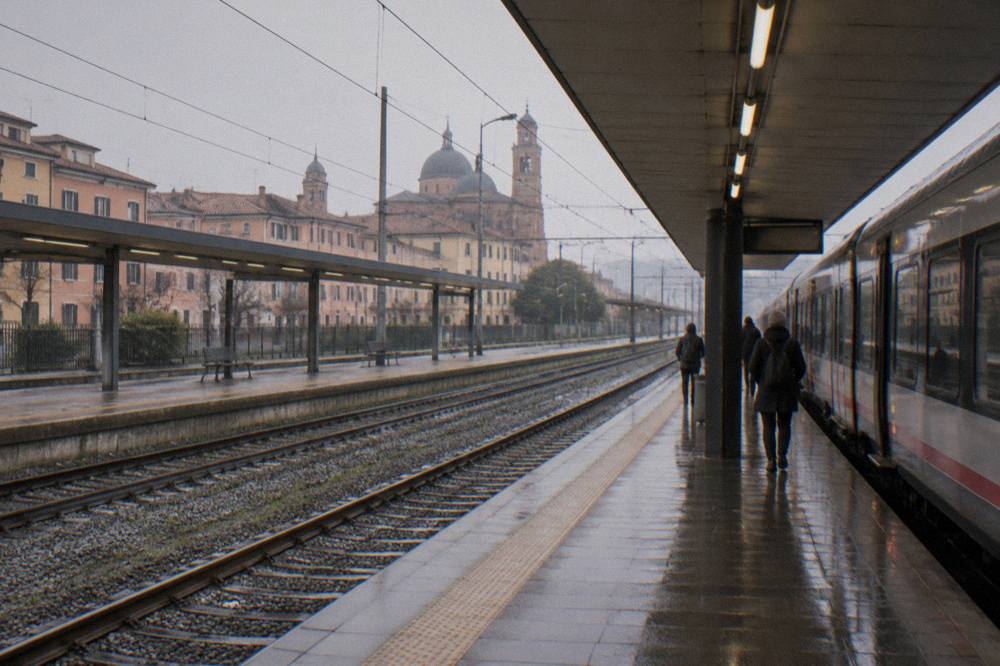
The one weather-adjacent trap to know about involves Venice. The Venice day-tripper access fee trial ended on 27 July 2026, and from that date the fee has not applied; no decision for 2027 had been announced. Weather does not change that, but fog can change the texture of a lagoon day, softening the light across the water. Train times are not weather-dependent: the regional run to Venezia Santa Lucia takes about 26 to 40 minutes, per reported schedules, so a Venice day trip from Padua remains a short-hop decision you can make the evening before with a decent forecast in hand. The Padua as a base for Venice and Venice to Padua pages cover the mechanics.
For the hills, spring and early autumn are the seasons the numbers favour: the Euganean Hills are about 8 to 11 km from the centre as the crow flies at Abano Terme and Montegrotto Terme, and walking terrain there is far more pleasant at a 22 C mean high than at 28.8 C. On a wet day, swap the hills for the city's own covered options: the Sotto il Salone market under Palazzo della Ragione, the museums, or a long lunch. The what to eat in Padua page is the menu-side companion to a rainy afternoon.
What Should You Pack For Padua Weather?
Pack for two climates in one bag: breathable layers and sun protection for summer days with a 28.8 C mean high, a warm midlayer, a real rain jacket and an umbrella for the rest of the year, and for winter a proper coat, hat and gloves for mean lows that sit at or below freezing from December through February, per the ERA5 reanalysis 1991-2020. Comfortable waterproof-capable shoes matter in every month.
| If You Visit In | Daytime Expect (Mean High) | Pack | Weather Watchpoint |
|---|---|---|---|
| Dec to Feb | 7.3 to 9.4 C | Coat, hat, gloves, warm layers | Fog; rare snow; icy mornings |
| Mar to May | 13.7 to 22.1 C | Layers, light jacket, umbrella | April and May showers |
| Jun to Aug | 26.2 to 28.8 C | Breathable clothes, hat, water bottle | Heat plus humidity; thunderstorms |
| Sep to Nov | 12.6 to 23.6 C | Layers, rain jacket, umbrella | 105 to 114 mm/month rain; fog in Nov |
One dress-code note that has nothing to do with temperature: the Basilica of Saint Anthony asks that dress be suitable for a church environment, and that applies in July heat as much as in January cold, so a light scarf or a layer to pull over shoulders belongs in the bag in every season. The urban transport ticket, EUR 1.70 for 90 minutes on the city's buses and tram, is a rainy-day friend when the arcades run out; the getting-around page has the details.
How Do You Read A Padua Forecast Before You Go?
Read a Padua forecast with the ERA5 normals as your baseline and the live forecast as the deviation: a July day forecast at 25 C is a cool one against the 28.8 C mean high, a November forecast of 15 C is well above the 12.6 C mean, and any forecast of rain in September, October or November is the norm rather than the exception, so plan the indoor anchors first and the walking hours around them.
Two local specifics sharpen that reading. First, fog in winter is a morning phenomenon that often burns off by midday, so a grey 8:00 forecast does not necessarily mean a grey day; schedule the panoramic outdoor stops, the walls and Prato della Valle, for the afternoon. Second, summer thunderstorms on the plain build in the afternoon heat, so the early-morning walk is the one worth protecting. The self-guided Padua scavenger hunt and highlights walk fits that rhythm, since it runs on your own timing rather than a fixed departure, and you can start it as early as the light allows; Check availability if that flexibility suits your forecast-reading style.
The final piece of forecast discipline is closure awareness rather than weather awareness: check the fixed dates before you lock an itinerary. The Scrovegni Chapel closes 16 to 27 November 2026, the Orto Botanico closes on non-holiday Mondays in winter and shut for a stretch in January and early February 2026, and the tourist offices at the station and Piazza delle Erbe 52 close 25 and 26 December and 1 January. None of that is weather, but all of it lands on the same itinerary the weather does.
Common Questions About Padua Weather
Does it snow in Padua?
Not much, and not every year. A long-run climate study reports about 4.4 snowy days a year over the 1995 to 2024 period, and notes that seasons with no snow at all are not uncommon. January mean highs of 7.3 C limit how long any snow settles.
What is the rainiest month in Padua?
November, with 114.0 mm in the ERA5 reanalysis 1991-2020. September and October follow at 105.5 mm and 105.4 mm. January has the lowest monthly total at 53.6 mm.
How hot is Padua in summer?
The July and August mean high is 28.8 C, with mean lows near 19 C, per the ERA5 reanalysis 1991-2020, and the plain's humidity makes the heat feel heavier than the number alone suggests. Individual days can run into the 30s.
Is Padua foggy in winter?
Yes, fog is a regular winter feature of the Po-Venetian plain, forming on clear, still nights when January mean lows sit around -0.2 C. It is chiefly a morning phenomenon and often lifts by midday.
Which month has the lowest rainfall in Padua?
January, at 53.6 mm in the ERA5 reanalysis 1991-2020, followed by February at 57.9 mm and July at 62.1 mm. No month in Padua is dry in absolute terms.
When is the best weather for visiting Padua?
On the numbers, late April to June and September offer the best balance of warmth and usable days, with mean highs from 17.6 C to 26.2 C, though September and October carry high rain totals. The best-time-to-visit page weighs these figures against hours and events.
