How Long Does It Take To Visit Scrovegni Chapel?
A visit to the Scrovegni Chapel in Padua takes about 15 minutes inside on a timed slot. Here is how long to budget for the waiting room, the museums and the whole complex.
The Scrovegni Chapel in Padua (Padova), the inland Veneto city about 36 km in a straight line from Venice, gives each visitor about 15 minutes inside, on a timed entry slot booked in advance. That figure comes from the chapel's own visitor information, not from a rule of thumb, and it shapes everything else about the visit: when to arrive, how long the whole stop takes and what else fits into the same ticket. The chapel holds Giotto's fresco cycle, painted between 1303 and 1305, and it is one of the eight buildings that make up Padua's fourteenth-century fresco cycles inscribed by UNESCO in 2021.
How Long Does It Take To Visit Scrovegni Chapel?
A visit to the Scrovegni Chapel in Padua takes about 15 minutes inside the chapel itself, on a timed slot that admits at most 25 people every 15 minutes between 9:00 and 19:00, with the last entry at 18:45. Before the slot there is a mandatory wait in a climate-controlled waiting room, and you should be at the entrance 5 minutes before the time printed on your ticket. Late arrivals must rebook and pay again.
Those three numbers, 25 people, 15 minutes and 5 minutes early, come straight from the chapel's own booking and visitor pages, and they are the fixed frame of a Scrovegni visit. The chapel does not work like a church you drift into: entry is timed, capacity is capped and the clock starts whether you are inside or not. Arriving after your slot means a new paid booking, so the practical answer to "how long" starts with the arrival buffer, not the frescoes.
The 15 minutes inside is a deliberate conservation measure rather than a crowd-control afterthought. Visitors pass through a climate-controlled waiting room, the Corpo Tecnologico Attrezzato, which conditions the air before the chapel itself is entered, so that the internal environment of the frescoed space stays stable. The chapel's own site explains the mechanism plainly, and it is the reason the visit is short, structured and identical for everyone.
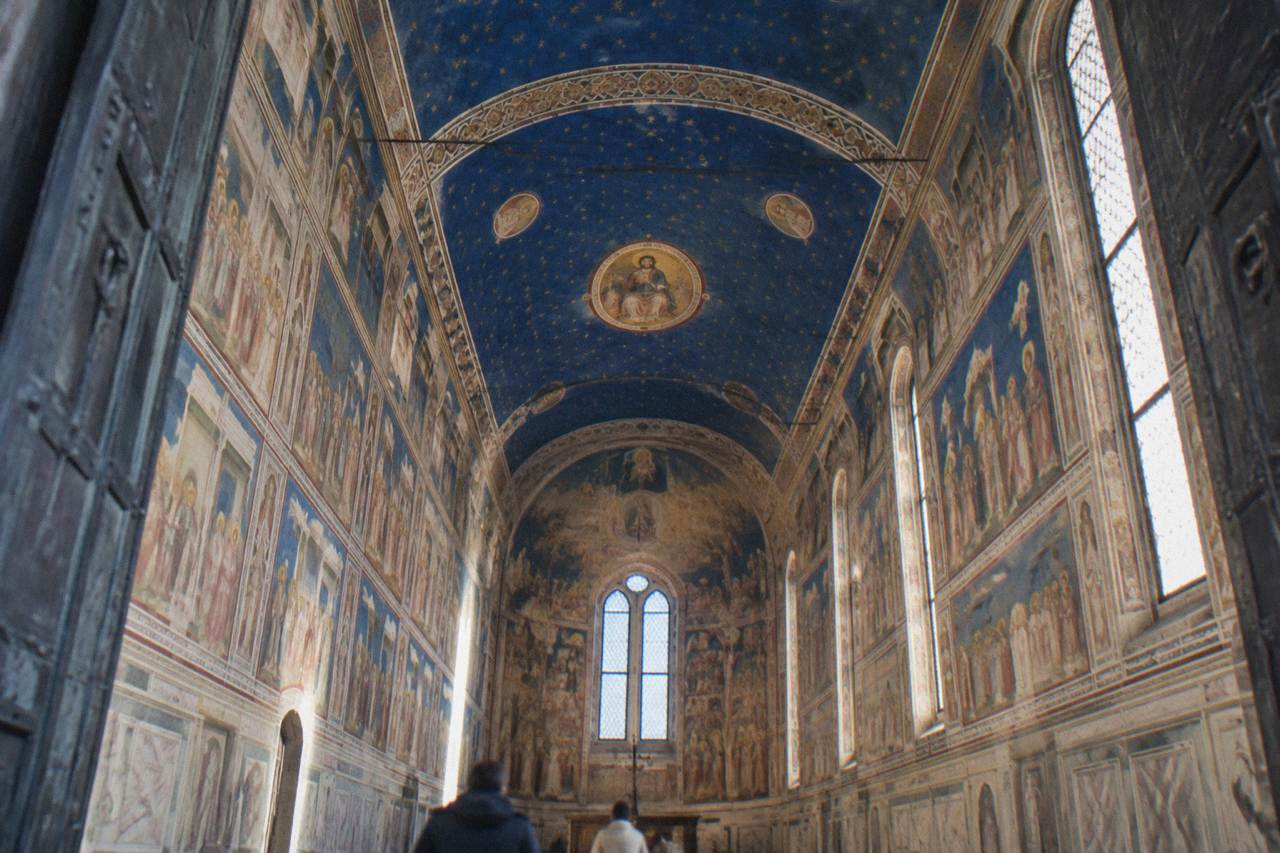
What can you actually see in 15 minutes? The cycle is painted on every interior surface, and the chapel is a single rectangular hall, so the whole thing is in view from the moment you step in. The scenes run across the north and south walls from the Stories of Joachim and Anne through the Life of the Virgin and the Life of Christ, with the Vices and Virtues in panels below and a Last Judgment filling the entrance wall. Fifteen minutes is enough to walk the floor slowly and fix the major scenes, but not enough for detailed study of every panel.
Travellers who want more than a pass through the hall have two honest options: read the cycle carefully before arriving, or join a guided visit that uses the same slot but comes with interpretation. The chapel's own pages carry the history and the scene-by-scene layout, and a companion piece on this site, why the Scrovegni Chapel is famous, covers the cycle in depth.
What The Timed Entry System Means For Your Clock
The timed entry system means your total time at the chapel is your arrival buffer plus the waiting room plus the 15-minute slot, so the chapel itself is roughly a 30 to 40 minute stop, plus whatever you spend at the ticket office. Slots run every 15 minutes in the daytime, and advance slots are bookable through the chapel's own site or by phone. There is no online same-day booking: unbooked visitors should check availability at the Museum ticket office in person.
The waiting-room stage is not optional and not skippable. It is the conservation airlock, and every visitor passes through it before the chapel door opens. The chapel's visitor page advises individuals to be at the entrance 5 minutes before their slot and groups at least 45 minutes early, and it states that latecomers are denied re-entry without a new paid booking. Build the buffer into your day rather than treating it as slack.
The booking mechanics are equally rigid. Advance slots from 9:00 to 18:45 are bookable online up to the day before with a card, or by phone through the call centre. If you arrive in Padua without a booking, the chapel's own guidance is to check availability at the Museum ticket office, which sits about 100 m from the chapel entrance. Nothing in the official guidance promises a walk-up slot, so a booked ticket is the only dependable plan.
| Timing question | Official figure | Source basis |
|---|---|---|
| Time inside the chapel | About 15 minutes | Chapel visitor page |
| Entry slots, daytime | Max 25 people every 15 minutes | Chapel opening-hours page |
| Arrival before slot | 5 minutes (groups 45 minutes) | Chapel visitor page |
| Opening, daytime | 9:00 to 19:00, last entry 18:45 | Chapel opening-hours page |
| Evening slots, 25 March to 1 November | Every 20 minutes, 19:00 to 22:00 | Chapel opening-hours page |
| Booking | Advance online up to day before; no online same-day | Chapel visitor page |
The evening programme deserves a line of its own. From 25 March to 1 November the chapel runs "Giotto sotto le stelle", evening visits from 19:00 to 22:00 every 20 minutes, and these are chapel-only tickets, without the museums that the daytime ticket includes. An evening slot is a real alternative for travellers whose days are already full, and the shorter cadence, 20 minutes rather than 15, means the timed-entry rhythm changes slightly after dark.
How Much Time To Budget For The Whole Scrovegni Complex
Budget at least an hour and a half for the whole Scrovegni complex, because the daytime ticket at EUR 15 full price, EUR 11 reduced, plus a EUR 1 booking fee, also covers the Musei Civici Eremitani and Palazzo Zuckermann, and those two museums add real time on either side of your slot. The chapel alone is a 30 to 40 minute stop including the waiting room. The museums extend the visit into a half-morning or half-afternoon.
The daytime ticket is not a chapel-only ticket, and this is where time planning usually goes wrong. The full "Musei e Cappella" ticket admits the Scrovegni Chapel, the Musei Civici Eremitani directly across the piazza, open 9:00 to 19:00, and Palazzo Zuckermann a short walk away, open Tuesday to Sunday 10:00 to 19:00. A museums-only ticket exists at EUR 11 full and EUR 9 reduced for visitors who cannot get a chapel slot at all.
There is also a family card at EUR 30 for up to two adults and two under-18s, plus the EUR 1 per-person chapel booking fee, and residents of Padua pay EUR 5. The full price conditions for reductions are printed on the museums' own ticket page, and anyone claiming a concession should read them before booking rather than at the desk.
A sensible sequence is museums first, chapel second: book the chapel slot, then spend the time before it in the Eremitani collections, which include archaeological material and paintings, and finish with the airlock and the frescoes. Walking from the museums to the chapel entrance takes minutes, the two stand in the same piazza, so the connection is easy to time.
| Ticket | Full price | What it covers | Extra time to budget |
|---|---|---|---|
| Musei e Cappella | EUR 15 (reduced EUR 11) plus EUR 1 booking fee | Chapel slot, Musei Civici Eremitani, Palazzo Zuckermann | About 90 minutes total |
| Musei only | EUR 11 (reduced EUR 9) | Musei Civici Eremitani and Palazzo Zuckermann | About 60 minutes |
| Residents | EUR 5 | Same as the full ticket | Same as full ticket |
| Evening, chapel only | Separate ticket | Chapel slot only, 19:00 to 22:00, 25 March to 1 November | About 30 minutes |
Visitors comparing a self-planned visit against a guided one can also read the practical overview on Scrovegni Chapel tickets, which collects the booking routes and the price table in one place.
A guided visit does not lengthen the slot itself: the 15 minutes inside are the same 15 minutes. What a guided product adds is the interpretation folded around the entry, so the time is spent with the scenes explained rather than self-directed. Travellers weighing that trade-off can check the operator's live listing directly: Check availability.
When Is The Scrovegni Chapel Closed?
The Scrovegni Chapel is closed from 16 to 27 November 2026 for the annual fresco inspection, and it also closes on 1 May, 25 and 26 December and 1 January, so a visit planned around those dates needs a different day. Daytime opening is 9:00 to 19:00 with the last entry at 18:45 on every other day of the year. The chapel is not open every day without exception, and November is the month to check first.
The November closure is a standing feature of the chapel's calendar, tied to the conservation programme for the frescoes, and the chapel's own homepage announces the 2026 dates plainly. Anyone building a Padua itinerary around the chapel should anchor the chapel day first and arrange everything else after it, precisely because the chapel is the one sight in the city that cannot absorb a schedule slip: no ticket, no entry, and no same-day online booking to rescue a plan. The full index of guides sits on Padua Travel Guide.
The 2026 closure window happens to sit inside the month that the ERA5 reanalysis, 1991-2020, gives as the month with the highest rain total in Padua, November at 114 mm on average, against 53.6 mm in January. Weather does not change the chapel, which is indoors, but it changes the rest of a November day, when the museums on the same ticket become the natural filler before and after the slot.
For travellers connecting the chapel to the rest of the city, a workable day pairs the Scrovegni and its museums with Piazza delle Erbe and the Basilica of Saint Anthony, and the planning sequence on one day in Padua shows how the chapel's fixed slot anchors the rest.
Guided Tours Versus Independent Visits: Which Takes Longer?
A guided visit and an independent visit take the same 15 minutes inside the chapel, because the timed slot is identical for both; a guided product simply wraps the entry in a walking route or commentary before and after, which extends the total commitment. An independent visit is the shortest version, roughly 30 to 40 minutes on site, while a tour-built visit lasts as long as the walk around it. The clock inside the chapel never changes.
This is the detail worth fixing before booking anything. The 15-minute slot is set by the chapel's conservation rules, not by the seller of the ticket, so no product on earth extends it. What varies is everything outside: a private city walk that ends at the chapel, a small-group tour that includes the entry, or a standalone guided chapel visit each arrange the same 15 minutes differently. Travellers short on time should book the chapel entry alone; travellers who want the cycle read to them should book the version that comes with a guide.
The booking route for the independent visit is the chapel's own site or its call centre, with advance slots open up to the day before. The booking route for a guided product is the operator's live listing, where the current price and availability render directly. The two are different things, and a guided booking should not be described as the chapel's own site.
There is one more time factor that the chapel's own pages flag: the ticket office sits about 100 m from the chapel, so collecting or checking a ticket adds a short walk each way. Groups are told to arrive 45 minutes early partly for that reason. Individuals who already hold a mobile booking need less margin, but the 5-minute rule at the entrance still stands.
Fitting The Chapel Into A Day In Padua
Fitting the Scrovegni Chapel into a day in Padua means anchoring the day to a pre-booked slot and building outward: the chapel and the two museums on its ticket take about 90 minutes, and the rest of the historic centre, Piazza delle Erbe, Palazzo della Ragione and the Basilica of Saint Anthony, is walkable around it. Padua is compact and inland, and the chapel sits at the edge of the old centre near the Eremitani church, so nothing in the core is far.
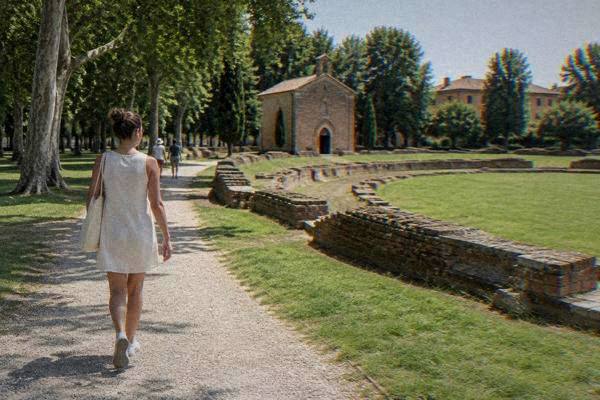
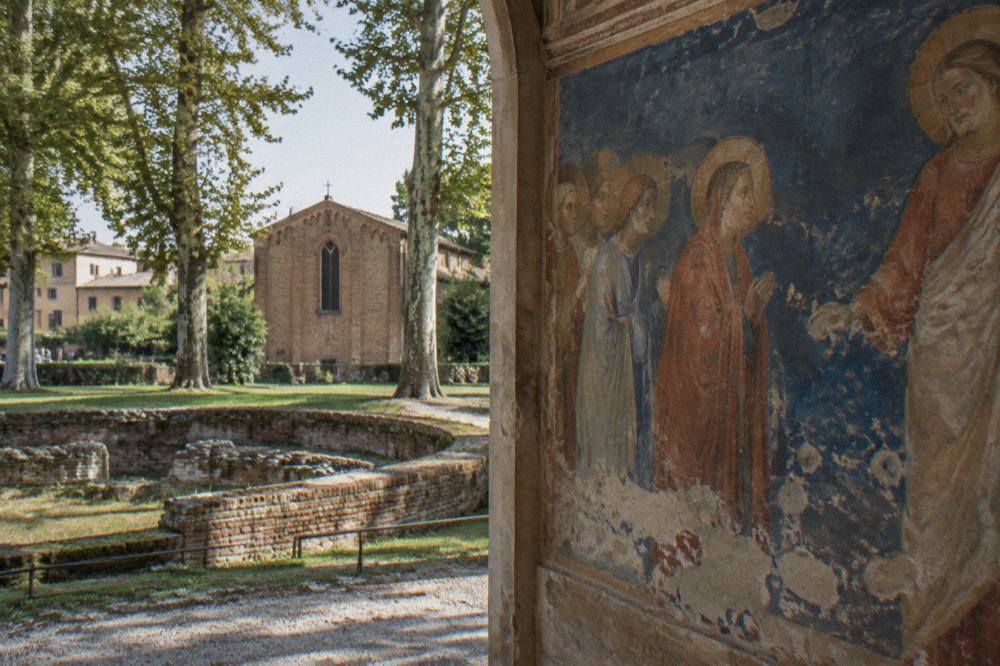
The geography helps. The chapel stands on the site of Padua's Roman amphitheatre, which is why it is also called the Arena Chapel, and that ground places it at the north-western edge of the historic centre, a few minutes on foot from the Eremitani church and then from the sequence of squares that runs down to the Bo and the Basilica. A morning slot frees the afternoon; a late-afternoon slot frees the morning. The chapel's rhythm, one entry every 15 minutes, is the fixed point and everything else flexes.
For visitors arriving from Venice, the train from Venezia Santa Lucia to Padova takes about 26 to 40 minutes, so a day trip with a booked chapel slot is workable with margin, provided the slot is booked before the train is. The companion page on whether Padua is worth visiting from Venice works through that decision. For longer stays, the fresco theme extends across the whole city: the eight buildings of the UNESCO inscription, listed on Padova Urbs Picta, include Palazzo della Ragione and the Baptistery, both within the same walkable core.
Common Questions About Visiting The Scrovegni Chapel
How long does it take to visit Scrovegni Chapel?
About 15 minutes inside the chapel, on a timed slot admitting at most 25 people every 15 minutes. With the waiting-room stage and the 5-minute arrival buffer, the chapel itself is a 30 to 40 minute stop, and the full ticket with its two museums takes about 90 minutes.
Can you stay longer than 15 minutes in the Scrovegni Chapel?
No. Entry is by timed slot, and the slot admits at most 25 people for about 15 minutes inside. The system is part of the chapel's conservation regime, which routes every visitor through a climate-controlled waiting room first.
How far in advance should you arrive at the Scrovegni Chapel?
The chapel's own visitor page says to be at the entrance 5 minutes before the slot time on your ticket, and groups at least 45 minutes early. Late arrivals must rebook and pay again. The ticket office is about 100 m from the chapel.
Is the Scrovegni Chapel open every day?
No. It opens 9:00 to 19:00 with last entry at 18:45, but it closes on 1 May, 25 and 26 December and 1 January, and it is closed 16 to 27 November 2026 for the annual fresco inspection.
Do the museums on the Scrovegni ticket add much time?
Yes. The daytime ticket covers the Musei Civici Eremitani, open 9:00 to 19:00, and Palazzo Zuckermann, open Tuesday to Sunday 10:00 to 19:00, so the complex is roughly a 90-minute visit rather than a 15-minute one.
Is there an evening visit to the Scrovegni Chapel?
Yes. From 25 March to 1 November the chapel runs evening visits, 19:00 to 22:00, every 20 minutes, and these tickets are chapel only, without the museums included in the daytime ticket.
The short version: book ahead, arrive 5 minutes early, give the chapel and its museums about 90 minutes, and keep mid-to-late November 2026 off your calendar. The frescoes stay on the wall; the slot does not wait.