Which City Is Better To Visit, Verona Or Padua?
An honest comparison of Verona and Padua from a Padua-based guide: frescoes, trains, ticket prices and which traveller each Veneto city suits.
Verona and Padua are both Veneto cities, and the question of which one to visit is really a question about what kind of trip you are planning. Padua (Italian: Padova) is an inland city about 36 km in a straight line from Venice, known for Giotto's frescoes in the Scrovegni Chapel, the Basilica of Saint Anthony and a university founded in 1222. Verona lies about 69 km west of Padua in a straight line, and the two are linked by trains that take about 43 to 60 minutes. This page is written by a Padua travel guide, so everything sourced below is about Padua's own sights, prices and transport, with Verona treated honestly as the neighbouring city this site does not cover in detail.
Which City Is Better To Visit, Verona Or Padua?
Neither city is objectively better, and the honest deciding factors are your days, your interests and your base. Padua suits a traveller built around Giotto's timed-entry Scrovegni Chapel, the Basilica of Saint Anthony, two UNESCO listings and one of Italy's oldest universities, while Verona works as a short-stay city reached from Padua by a train of about 43 to 60 minutes, so a two-centre plan needs no difficult choice at all.
That framing is not a dodge. The two cities serve different itineraries. Padua's core sights are concentrated and walkable, its Scrovegni Chapel is the single most tightly managed visitor experience in the Veneto after Venice itself, and its position on the Venice to Milan rail line makes it a practical base for Verona, Vicenza, Venice and the Euganean Hills. Verona, for its part, is a destination in its own right that this site does not detail; what can be said with sources is the distance and the train time, both of which make a day trip straightforward.
The practical reality for a traveller with three or more days is that the comparison dissolves. Base in Padua, take a day trip to Verona, and you see both. Travellers deciding between the two for a single day should weigh what follows: Padua's fresco cycles, the fourteenth-century UNESCO inscription of 2021, and the ticket prices and timed-entry rules of its civic museums.
What Makes Padua Different From Verona?
Padua's distinction is twofold: a fourteenth-century fresco heritage spread across eight UNESCO-listed complexes (Padova Urbs Picta, inscribed 2021) and a working university city founded in 1222, with about 76,000 students reported for the 2026/27 academic year. No other city in the comparison carries both, and the Scrovegni Chapel, Giotto's cycle painted between 1303 and 1305, anchors the fresco claim.
The fresco story is bigger than one chapel. UNESCO's 2021 inscription, Padova Urbs Picta, covers eight complexes in the old centre: the Cappella degli Scrovegni, the Chiesa dei Santi Filippo e Giacomo agli Eremitani, Palazzo della Ragione, the Cappella della Reggia Carrarese, the Battistero della Cattedrale, the Basilica e Convento di Sant'Antonio, the Oratorio di San Giorgio and the Oratorio di San Michele. A fresco-focused visit can therefore span a full day inside a compact historic centre, as laid out in the guide to the Urbs Picta inscription.
The university layer is equally concrete. The Palazzo del Bo's guided historical tour costs EUR 10 full price and includes the anatomical theatre, inaugurated in 1594, and Galileo's chair in the Sala dei Quaranta; Galileo held the chair of mathematics at Padua from 1592 to 1610. The Orto Botanico, founded 1545 and inscribed by UNESCO in 1997 as the world's first university botanical garden, completes the set. That trio, chapel plus Bo plus garden, is a Padua-specific itinerary with no Verona equivalent in this site's sources.
How Do You Get Between Padua And Verona?
Trains run from Padova to Verona in about 43 to 60 minutes, according to schedule aggregators, and the straight-line distance is about 69 km, so Verona is a realistic day trip from a Padua base in either direction, with regional fares varying by date and operator and best checked on the operator's own booking system.
That train time is reported by aggregator listings rather than the operator's own published timetable, so treat it as approximate and confirm when booking. What the sources do establish firmly is the geometry of the region: from Padua's centre, Venice is about 36 km in a straight line, Vicenza about 30 km, and Verona about 69 km, all connected by the same rail corridor. The train from Verona to Padua question has its own detailed answer on this site, as does the wider Verona day trip guide.
For travellers staying in Padua, the practical detail that matters more than the intercity leg is urban transport inside Padua: a 90-minute TU1 ticket costs EUR 1.70, valid on bus and tram, and can be bought in the operator's app or by tapping a contactless card on board. The tram line SIR1 runs north to south through the city; a second line, SIR3, is in pre-service testing and no opening date should be assumed.
For a Verona day planned from Padua, an alternative to the train is a guided product that bundles the day: the operator's listing for a Check availability full-day Verona and Garda trip is one option. Lake Garda should not be described as near Padua: Sirmione, on the lake, is about 99 km away in a straight line, so it belongs to a day trip, not a half-day excursion.
Which Sights Can You Only See In Padua?
The sights unique to Padua in this comparison are the Scrovegni Chapel (Giotto, 1303 to 1305, timed entry, EUR 15 full ticket plus EUR 1 booking fee, closed 16 to 27 November 2026), the Basilica of Saint Anthony with the Saint's tomb and free entry, the Orto Botanico (EUR 15 full from 1 September 2026), and the Palazzo del Bo's 1594 anatomical theatre (EUR 10).
The Scrovegni Chapel is the headline, and its rules shape any Padua plan. Entry is timed, with groups of at most 25 people admitted every 15 minutes during daytime hours, and the visit inside lasts about 15 minutes after a stop in a climate-controlled waiting room; arrivals must be at the entrance 5 minutes before their slot, and latecomers must rebook and pay again. Same-day online booking does not exist: the chapel's own booking page directs unbooked visitors to check availability at the museum ticket office on the day. The full daytime ticket, EUR 15 plus the EUR 1 chapel booking fee, also covers the Musei Civici Eremitani and Palazzo Zuckermann. The chapel is closed 16 to 27 November 2026 for the annual fresco inspection.
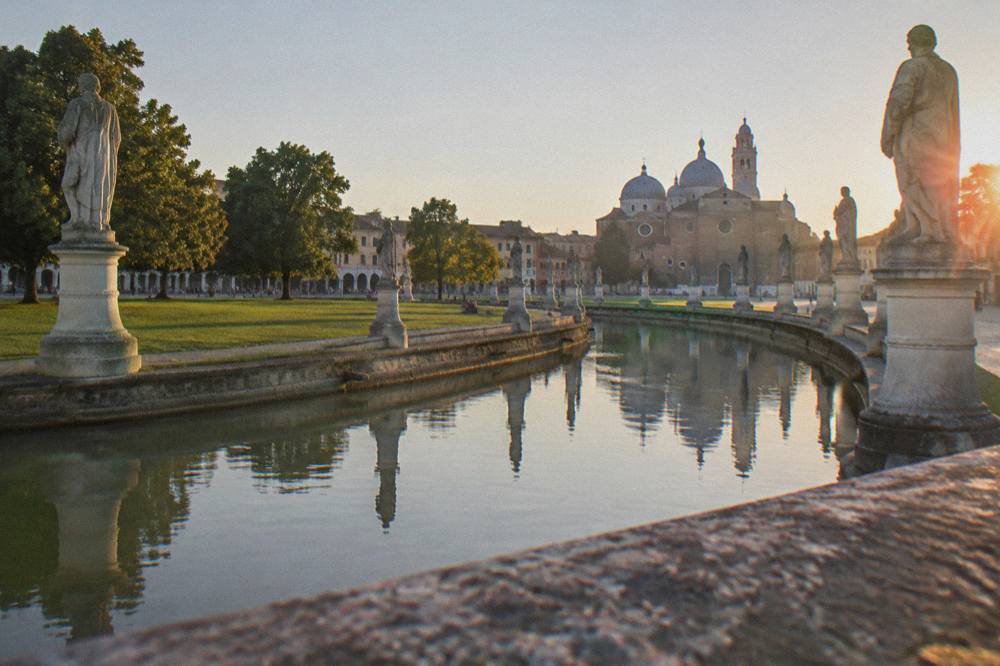
The rest of the civic network carries its own price list. Palazzo della Ragione is EUR 8 full. The Orto Botanico's tariffs rose to EUR 15 full from 1 September 2026 (EUR 12 in winter, November to February). The Basilica of Saint Anthony is free to enter, reported by the Urbs Picta visitor page, with the Saint's tomb and the Chapel of the Relics accessible, so check the basilica's own site for opening hours before a visit. Prato della Valle, the canal-ringed square the Venetian Senate declared communal space in 1767, costs nothing to walk.
| Sight in Padua | Ticket | What the ticket includes |
|---|---|---|
| Scrovegni Chapel (daytime) | EUR 15 full, EUR 11 reduced, plus EUR 1 booking fee | Musei Civici Eremitani and Palazzo Zuckermann; about 15 minutes inside, timed slot |
| Orto Botanico | EUR 15 full from 1 Sept 2026; EUR 12 winter (Nov to Feb) | Audioguide included, per the garden's ticket page |
| Palazzo del Bo guided tour | EUR 10 full | About 45 minutes, anatomical theatre and Galileo's chair |
| Palazzo della Ragione | EUR 8 full | Tue to Sun entry |
| Basilica of Saint Anthony | Free entry | Tomb and Chapel of the Relics; hours on the basilica's own site |
Can You Combine Both Cities On One Trip?
Yes, and combining them is the plan the geography rewards: Padua and Verona are about 69 km apart by straight line with trains taking about 43 to 60 minutes, so a three or four day stay in Padua can carry a Verona day trip and still leave full days for the Scrovegni Chapel, the Orto Botanico and the Basilica of Saint Anthony without repacking a bag.
The sequencing question is how many days to give Padua itself, which this site answers in detail on the page about how many days you need in Padua. The Scrovegni Chapel's timed-entry system is the main constraint: slots are booked ahead, the chapel closes for its annual inspection (16 to 27 November 2026), and the evening "Giotto sotto le stelle" visits run only from 25 March to 1 November, 19:00 to 22:00, chapel only. Building the Padua days around a confirmed chapel slot, then slotting Verona into a free day, is the low-friction order of operations.
A combined trip also opens the rest of the Veneto from the same base. Vicenza is about 30 km away by straight line with trains of 16 to 25 minutes, and Venice about 36 km with trains of about 26 to 40 minutes, so Padua functions as a rail hub in a way a single-city Verona stay does not duplicate in this site's sources. Travellers weighing the Venice side of the equation can read whether Padua is worth visiting from Venice.
What Does A Day In Padua Cost Compared With A Day In Verona?
A full sightseeing day in Padua can be costed from the published list: Scrovegni Chapel EUR 15 plus EUR 1 booking, Palazzo del Bo EUR 10, Orto Botanico EUR 15, Palazzo della Ragione EUR 8, Basilica free and a 90-minute urban ticket at EUR 1.70, while this site's sources carry no comparable Verona price list, so no honest side-by-side total for Verona can be given here.
What can be compared is structure, not sums. Padua's prices are published, timed and mostly bookable ahead; the chapel's own site is the booking channel, and the padovamusei network prints one table covering the civic museums. Verona's sight prices do not appear in this site's research, and inventing a comparison would be exactly the kind of unsourced claim this site exists to avoid. A traveller budgeting a combined trip should cost the Padua days from the table above and check Verona's own attraction pages directly before the Verona day.
Two Padua-specific cost notes matter. First, the tourist tax (imposta di soggiorno) exists in Padua, is collected by the accommodation, applies per person per night for up to five consecutive nights, and its per-category rates should be confirmed with the booking accommodation. Second, the Scrovegni evening ticket is chapel only and separate from the daytime museums ticket, so an evening visit is not automatically a cheaper substitute for the full daytime entry.
When Is The Better Month To Visit Padua Rather Than Verona?
The climate record for Padua, ERA5 reanalysis 1991-2020, shows a July and August mean daily high of 28.8 C, a January mean high of 7.3 C with a mean low of minus 0.2 C, and November as the month with the highest rain total at 114.0 mm, so shoulder months fit outdoor walking best, with one hard date override: the Scrovegni Chapel closes 16 to 27 November 2026.
| Month group (ERA5 reanalysis, 1991-2020) | Mean daily high | Rain |
|---|---|---|
| January | 7.3 C | 53.6 mm |
| April | 17.6 C | 84.4 mm |
| July | 28.8 C | 62.1 mm |
| November | 12.6 C | 114.0 mm |
These are modelled normals for Padua's grid cell, not a weather-station record, and this site has no equivalent Verona series, so no city-versus-city weather verdict is offered. The seasonal point that is specific and sourced is the chapel calendar: evening visits run 25 March to 1 November, and the November inspection closure removes the city's headline sight for twelve days, which matters more to a Padua plan than two degrees of temperature.
The comparison, then, lands where it started. A traveller with one day chooses by interest: Giotto and the university quarter point to Padua. A traveller with three or more days should not choose at all: base in Padua, book the chapel slot, and give Verona one of the middle days on a train of about 43 to 60 minutes. This site's own fuller case for the city is on whether Padua is worth visiting, and the root planning page at Padua Travel Guide pulls the practical pages together.
Common Questions About Choosing Between Verona And Padua
Which City Is Better To Visit, Verona Or Padua?
There is no sourced ranking either way. Padua's case rests on the Scrovegni Chapel, the eight-site Padova Urbs Picta UNESCO inscription of 2021, a university founded in 1222 and a rail-hub position about 69 km from Verona by straight line; Verona's sights are outside this site's sources. Decide on your interests and days, or combine both.
How far is Verona from Padua?
About 69 km in a straight line, with trains taking about 43 to 60 minutes according to schedule aggregators.
Can you do Verona as a day trip from Padua?
Yes. The train time of about 43 to 60 minutes makes a day trip workable, and guided full-day products to Verona, some pairing Lake Garda, run from Padua; Sirmione on the lake is about 99 km away in a straight line.
What is the single thing to book ahead in Padua?
The Scrovegni Chapel. Entry is timed, at most 25 people every 15 minutes, the daytime ticket is EUR 15 full plus a EUR 1 booking fee, and same-day online booking does not exist. The chapel is closed 16 to 27 November 2026.
Is Padua cheaper than Verona?
No sourced Verona price list exists here, so no verdict. Padua's own published prices are EUR 15 for the Scrovegni daytime ticket, EUR 15 for the Orto Botanico from 1 September 2026, EUR 10 for the Palazzo del Bo tour and free entry at the Basilica of Saint Anthony.
Do you need a car to combine the two cities?
No. Both sit on the same rail corridor, and inside Padua a EUR 1.70 ticket covers 90 minutes of bus and tram travel. This site prints no drive times and none are needed for this itinerary.