What Language Is Spoken In Padua?
Italian is the language of Padua (Padova), in the Veneto, with a local Veneto dialect alongside it. A clear answer for visitors, plus names, phrases and practical context.
Italian is the language spoken in Padua (Padova), a city in the Veneto in northern Italy, about 36 km in a straight line from Venice and firmly inland. Italian is the official language of the country, used in government, schools, signage and daily commerce throughout the city. Alongside it, a Veneto dialect is also used locally, and the presence of one of Italy's largest universities, with about 76,000 students reported for the 2026/27 academic year, means other languages are heard around the historic centre too. This page sets out what that means for a visitor: how the dialect relates to standard Italian, what the city's two names tell you about its language, and which words are worth having ready.
What Language Is Spoken In Padua?
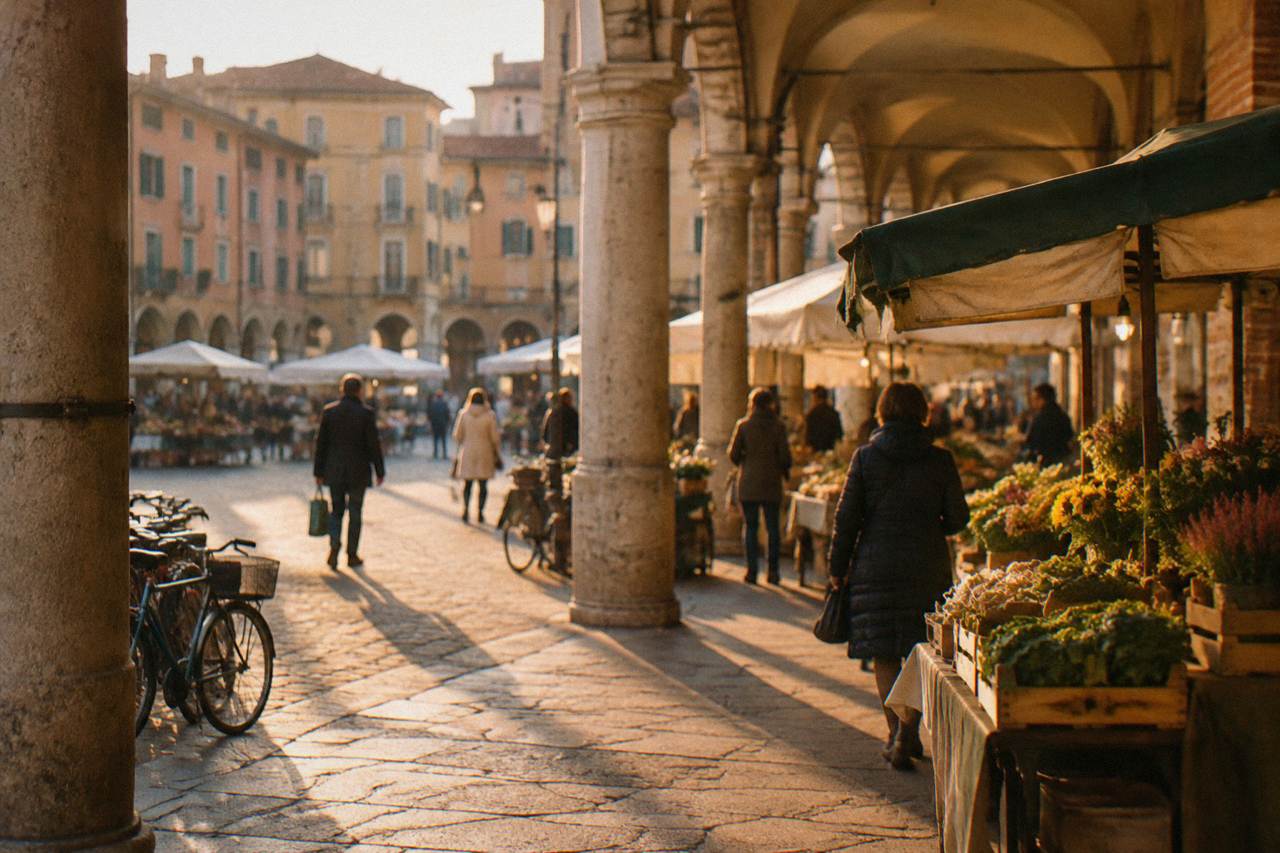
The language spoken in Padua is Italian, the official language of Italy, and it is what you will hear and read everywhere in the city: on street signs, in shops, at the market stalls of Piazza delle Erbe and on every ticket counter. Padua is in the Veneto, an inland region of northern Italy, and like the rest of the country it runs on Italian in public life. A local Veneto dialect is also in use, which this page covers below.
That single answer covers the practical case. Menus are in Italian, museum panels are in Italian, the Scrovegni Chapel's booking flow is in Italian with English options, and the tram announcements are in Italian. The city's own institutions, from the Comune di Padova to the University of Padua, publish in Italian first. Nothing about a visit to Padua requires any other language to read a sign or buy a ticket, and a handful of Italian words, covered further down this page, carry a visitor through nearly every routine transaction.
The regional context matters less than visitors expect. The Veneto has its own dialect traditions, and Padua sits inside that, but the public language of the region is the same standard Italian taught worldwide. A person who learned Italian anywhere will read the same words on a Paduan street as in Rome or Milan. What changes locally is accent, some vocabulary heard in casual speech, and food words that the city's tourism board itself promotes, such as risotto ricco alla Padovana and gallina padovana, the names of dishes rather than a separate tongue.
For orientation beyond the language question, the Padua Travel Guide covers the city's sights, transport and day trips in depth, and a good starting point for the wider picture is what Padua is famous for.
Is There A Dialect Spoken In Padua?
Yes, a Veneto dialect is spoken in Padua alongside standard Italian. Veneto is one of Italy's regional dialect groups, and in Padua it appears mainly in informal speech, older generations, local expressions and certain food words, while Italian remains the language of work, school, signage and public life. The dialect is a living local tradition rather than a language a visitor needs: standard Italian is understood throughout the city.
The distinction between a dialect and a language is worth a sentence, because it shapes what a visitor actually hears. Italy's regional dialects descend in large part from Vulgar Latin along their own lines, and Veneto varieties were carried widely by Venetian trade and emigration. In Padua today, the dialect shows up in casual conversation and in the character of local pronunciation rather than in any official channel. A visitor who knows Italian will recognise the framework of a dialect sentence and often lose the detail, which is normal and expected even for Italians from other regions.
Practically, this means two things. First, nothing in Padua's tourist infrastructure operates in the dialect: it is not on tickets, museum walls or menus. Second, the dialect is part of the city's texture, and hearing it around the market squares or in the evening on Piazza delle Erbe is one of the marks of a city with a long local life behind its tourist surface. The city's name itself carries that double identity, English "Padua" and Italian "Padova", which is covered in its own section below.
A guided walk is one way to have the city explained while the language hums around you: the Private Padua Top City Sights Guided Tour covers the main monuments with a guide, and Check availability on the operator's live listing if that suits your plans.
Is "Padua" Or "Padova" The Right Name?
Both names are correct and refer to exactly the same city: "Padua" is the English name and "Padova" is the Italian one. You will see and hear "Padova" on Italian signs, train tickets and announcements, including at the railway station, while "Padua" is the standard English form used in guidebooks and English-language writing. Saying either one will be understood; locals say "Padova" because that is the Italian name of their city.
This is a name question rather than a dialect question, and it has practical edges. A train ticket search works with either spelling on most booking interfaces, but the station itself is signposted Padova, and the city's official web domains use the Italian form. Street level is Italian-form territory: addresses, bus destination boards and the local tram all say Padova. The tourism board operates in both, since it serves Italian and international visitors alike.
The same pattern, an English exonym and an Italian endonym, runs across the Veneto and Italy generally, and it is a useful habit for any travel in the country. If the two-name question interests you, the site covers it directly in are Padua and Padova the same place and in how Italians say Padua.
Which Italian Words Help Most In Padua?
A short list of everyday Italian words covers nearly every routine moment in Padua: greetings such as buongiorno and buonasera, grazie for thank you, prego as the standard reply, per favore to make a request polite, quanto costa to ask a price, and il conto to ask for the bill. These are standard Italian, not dialect, and they work in shops, cafes, museums and taxis across the city. Ticketing and museum signage use the same vocabulary nationwide.
| Italian | What it means | Where you will use it in Padua |
|---|---|---|
| Buongiorno | Good day | Greeting until early evening, shops and market stalls |
| Buonasera | Good evening | Restaurants, cafes after dark on the piazzas |
| Per favore | Please | Any request, from a bar order to directions |
| Grazie / prego | Thank you / you're welcome | Every transaction; prego is also "please, go ahead" |
| Quanto costa? | How much does it cost? | Market stalls on Piazza delle Erbe, souvenirs |
| Il conto, per favore | The bill, please | Cafes, osterias, Caffè Pedrocchi and elsewhere |
| Biglietto | Ticket | Museum counters, the Scrovegni Chapel ticket office |
| Aperto / chiuso | Open / closed | Shop and museum doors |
| Dov'è...? | Where is...? | Asking for the Basilica, the Duomo, a platform |
| Scusi | Excuse me | Getting attention politely, passing through crowds |
Two Paduan specifics deserve their place beside the generic list. At the Scrovegni Chapel, booked visitors wait in a climate-controlled waiting room before their timed slot, so the words "orario" (time, as in the time on your ticket) and "ritardo" (delay, the thing to avoid) are the operative ones at the door. At the covered Sotto il Salone market under Palazzo della Ragione, the food vocabulary of the Veneto does the work: the tourism board's own named local dishes are worth reading before a market or restaurant visit, and they are covered in what food Padua is known for.
Number words repay some practice more than any other group, because prices in Padua are in euro and spoken quickly at counters. Un, due, tre, quattro, cinque covers one through five, and trenta, quaranta, cinquanta covers the tens a market shopper meets daily. Written prices are no obstacle either: Italy uses the comma where English uses the decimal point, so a price displayed with a comma is read in euro exactly as the tag intends.
Does The University Change The Languages You Hear In Padua?
The University of Padua, founded in 1222, brings a large student population into the city, reported at about 76,000 for the 2026/27 academic year, including an international share reported at about 11 percent. That concentration means the streets around the historic centre and Palazzo del Bo carry a wider mix of languages than a city of about 208,000 residents otherwise would, alongside the everyday Italian of the city itself.
The university is not a linguistic curiosity only in the present tense. Its history carries language facts that surface on plaques and guided visits: Galileo held the chair of mathematics from 1592 to 1610, and Elena Lucrezia Cornaro Piscopia was awarded her doctorate in philosophy on 25 June 1678, recorded as the first woman university graduate. The university's own heritage pages preserve these dates, and the Palazzo del Bo's guided "Giro storico" route takes in the anatomical theatre of 1594 and the Sala dei Quaranta with alternating Italian and English tour slots, a small built-in example of the city's two-language tourist reality.
For a visitor, the university's presence shows up as signage and announcements in more than one language around campus buildings, and as student speech in the cafes between Piazza delle Erbe and the Bo. The deeper point for this page is that Padua is a working Italian university city first, and the additional languages orbit its institutions rather than replacing Italian anywhere in public life.
Do You Need Italian To Enjoy Padua?
You do not need Italian to enjoy Padua, but a small amount of it improves nearly every interaction: the city's official language is Italian, its major sights are bookable online in advance, and its museum and transport systems are straightforward to navigate with a ticket in hand. Learning a greeting and a thank-you costs minutes and changes the tone of every counter, market stall and cafe visit in the city.
Booking ahead is the single biggest language leveller in Padua. The Scrovegni Chapel, the city's most constrained sight, runs timed entry for up to 25 people every 15 minutes, with slots booked in advance, and its booking flow and the museums' pages carry English options. Once the ticket exists, the visit itself asks little of a visitor's vocabulary: be at the entrance five minutes before the printed slot, wait in the climate-controlled room, and spend the roughly fifteen minutes inside looking at Giotto's frescoes, painted between 1303 and 1305.
The rest of the city follows the same pattern. A regional train to Venice takes about 26 to 40 minutes from Padova station, with a regional fare of about 5 euro, and the urban bus and tram system runs on a 1.70 euro 90-minute ticket that can be tapped contactless on board without a word exchanged. The emergency number, 112, is the single European number and needs no Italian to dial. Where language does matter, in markets, trattorias and evening aperitivo on the piazzas, the short table of words above carries a visitor across the line. The spritz itself has a Paduan thread: Aperol is reported to have been created and presented in Padua in 1919 by the Barbieri brothers, so ordering one is a local-history act even in a borrowed accent.
For travellers weighing the city against longer plans, whether Padua is worth visiting and how many days you need in Padua are covered elsewhere on the site.
Common Questions About Language In Padua
What Language Is Spoken In Padua?
Italian is the language spoken in Padua, a city in the Veneto in northern Italy. Italian is the country's official language and is used in all public life in the city, from signage to schools to ticket counters. A Veneto dialect is also used locally in informal speech.
Is English An Official Language In Padua?
No. Italy has one official language, Italian, and Padua follows that. Booking systems for the major museums, including the Scrovegni Chapel, offer English options online, but the working language of the city is Italian.
Is The Veneto Dialect The Same As Italian?
No. The Veneto dialect is a regional variety with its own vocabulary and pronunciation, used in informal and family speech, while standard Italian is the language of government, education and signage in Padua and across Italy. A visitor needs only standard Italian.
Should I Say Padua Or Padova?
Both are correct names for the same city. "Padua" is the English name and "Padova" is the Italian one, and you will see the Italian form on signs, trains and official pages in the city itself.
Do I Need To Speak Italian To Visit The Scrovegni Chapel?
No. The chapel runs timed entry booked in advance, with about fifteen minutes inside, and the booking flow has English options. Arrive five minutes before the slot printed on your ticket and follow the flow through the climate-controlled waiting room.
What Currency And Emergency Number Apply In Padua?
Padua is in Italy, which uses the euro and is a Schengen member state. The single European emergency number is 112, reachable without any Italian to dial it.
