What Is The Cathedral Baptistery In Padua?
The Baptistery of Padua's Cathedral, frescoed by Giusto de' Menabuoi in the fourteenth century and part of the UNESCO Padova Urbs Picta listing, explained in plain terms.
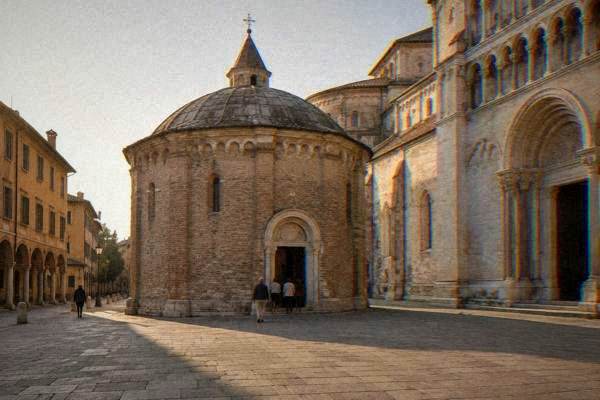
The Cathedral Baptistery in Padua (Battistero del Duomo) is the small round baptismal church that stands beside the city's Cathedral in the heart of the old centre: a building whose walls and dome are covered with fourteenth-century frescoes by Giusto de' Menabuoi, and one of the eight sites inscribed on the UNESCO World Heritage list in 2021 under the name Padova Urbs Picta. Padua itself is an inland city in the Veneto, northern Italy, about 36 km in a straight line from Venice, and its fourteenth-century fresco cycles, spread across those eight buildings, are what the UNESCO entry recognises. The Baptistery is the piece of that listing dedicated to the Cathedral complex, and this page explains what the building is, what is inside it and how a visit fits into a stay in the city. More on the whole complex sits in the site's Duomo and Baptistery guide.
What Is The Cathedral Baptistery In Padua?
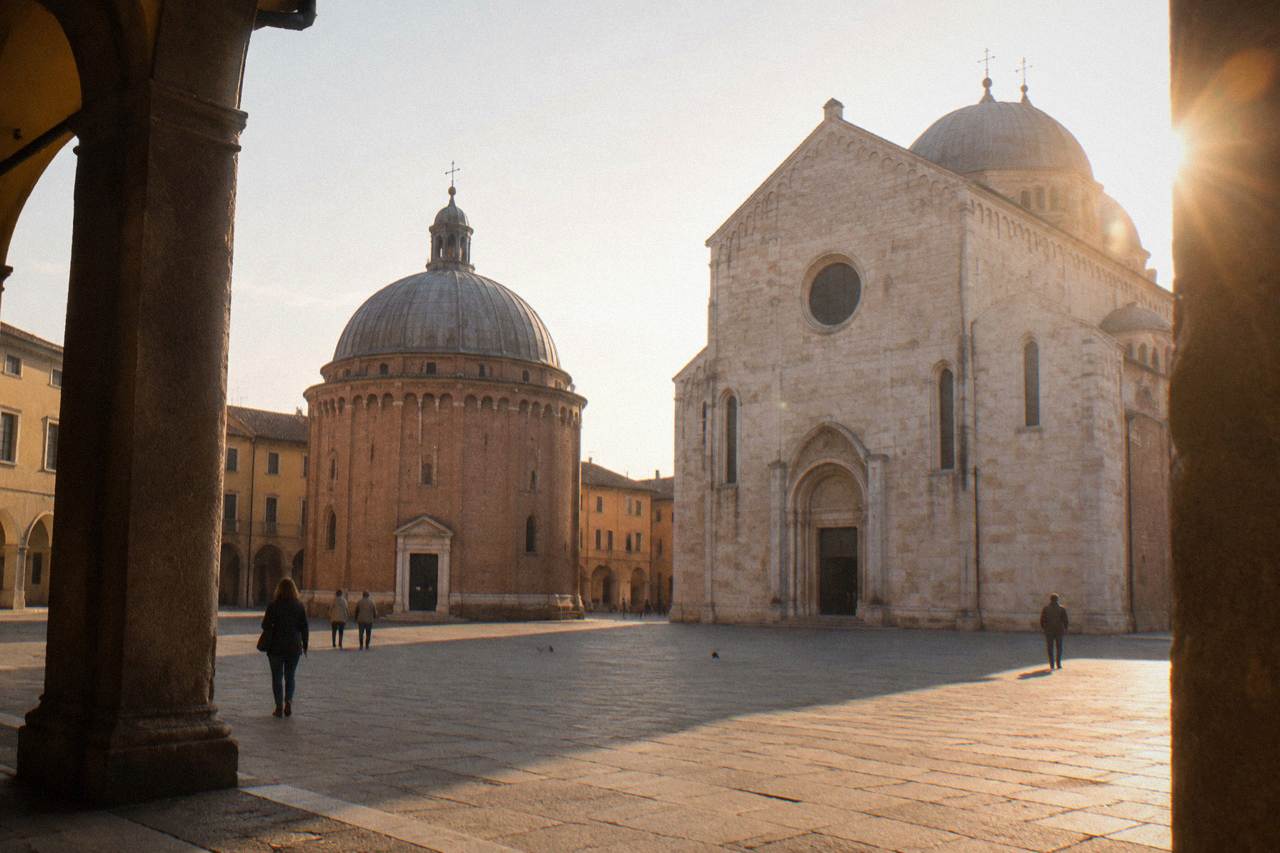
The Cathedral Baptistery in Padua is a separate baptismal church standing next to Padua's Cathedral, the Duomo, in the historic centre: a compact domed building whose interior is covered with a fourteenth-century fresco cycle painted by Giusto de' Menabuoi, dedicated to the Virgin, and listed by UNESCO in 2021 as one of the eight monuments of Padova Urbs Picta, the city's fresco-cycles World Heritage entry.
A baptistery, as a building type, is exactly what the name says: the church where baptisms were performed, traditionally constructed apart from the main cathedral and often round or octagonal in plan. Padua's follows that pattern. It sits on the piazza shared with the Cathedral, close to the Bishop's palace, and it is visited as a distinct monument rather than as a side chapel of the Duomo. The two buildings are neighbours, not one space.
What makes this small building carry the same UNESCO badge as Giotto's Scrovegni Chapel is the fresco work inside. The decoration is by Giusto de' Menabuoi, a painter who worked in Padua in the fourteenth century, and it runs across the walls, the dome and the apse in a single coordinated scheme. The Padova Urbs Picta inscription of 2021 covers eight buildings in the old centre: the Scrovegni Chapel, the Church of the Santi Filippo e Giacomo agli Eremitani, Palazzo della Ragione, the Chapel of the Reggia Carrarese, the Baptistery of the Cathedral, the Basilica and Convent of Sant'Antonio, the Oratory of San Giorgio and the Oratory of San Michele. Each holds fourteenth-century fresco cycles, and the Baptistery's Menabuoi cycle is the Cathedral complex's contribution.
If the question behind the search is whether the Baptistery is worth the stop on a Padua itinerary, the frescoes are the answer: this is one of the most complete painted interiors in a city that UNESCO lists precisely for its painted interiors. The site's overview of what Padua is famous for puts the fresco cycles at the centre of the city's identity, and the Baptistery belongs to that story as much as the better-known chapel does.
Who Painted The Baptistery And What Is Inside?
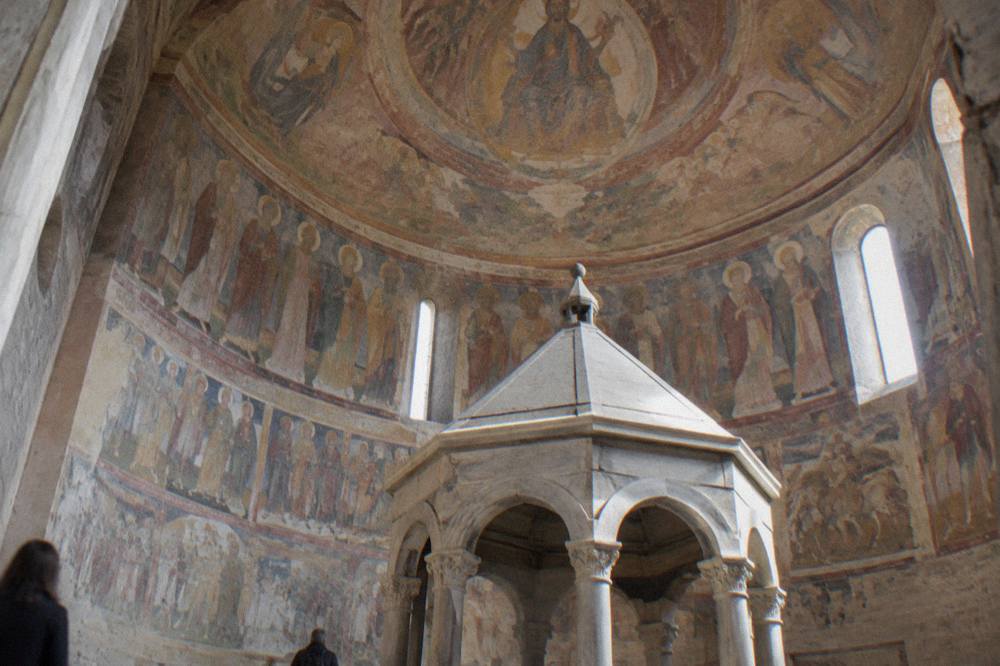
The interior of the Padua Cathedral Baptistery was frescoed by Giusto de' Menabuoi in the fourteenth century, with a programme centred on the life of the Virgin and the life of Christ, culminating in a dome showing Paradise: the whole cycle is the reason the building belongs to the UNESCO Padova Urbs Picta inscription of 2021, alongside Giotto's Scrovegni Chapel and six other painted buildings in the old centre.
Menabuoi was one of the painters working in fourteenth-century Padua in the period UNESCO recognises. Where Giotto's Scrovegni cycle, painted between 1303 and 1305, is the most famous of the city's fresco ensembles, the Urbs Picta listing exists because that work did not stand alone: several buildings across the centre received coordinated fresco schemes in the same century, and the Cathedral Baptistery holds Menabuoi's. The dome carries a representation of Paradise, and the walls carry the narrative scenes, arranged so that a visitor standing on the floor reads upward from the stories to the celestial order above.
The building is small, which is part of why the painted surface reads so densely. A round or polygonal room lined with fresco leaves no wall untouched: the scheme wraps around the viewer rather than hanging on one side of a long nave. That is the common thread across the Urbs Picta sites, and it is why the listing covers eight separate buildings rather than a single museum: the frescoes are inseparable from the rooms they were made for.
A practical point for planning: the frescoes are the content. A stop at the Baptistery is shorter than a museum visit and closer in spirit to the Scrovegni Chapel, where the visit is the painting. Readers deciding how long the whole city needs can weigh it with the site's answer on how many days you need in Padua, and those coming from the lagoon can read whether Padua is worth visiting from Venice.
How Does The Baptistery Relate To Padua's UNESCO Listing?
Padua's fourteenth-century fresco cycles were inscribed on the UNESCO World Heritage list in 2021 under the name Padova Urbs Picta, and the Cathedral Baptistery with its Menabuoi frescoes is one of the eight buildings in that entry: the listing recognises a whole painted city rather than one chapel, so the Baptistery shares the same inscription as the Scrovegni Chapel, and it is the second of Padua's two UNESCO listings alongside the Orto Botanico, inscribed in 1997.
The eight buildings named in the inscription are spread within walking distance of one another in the old centre, and the Baptistery is the one attached to the Cathedral. The inscription was made under criterion (ii), which the World Heritage Centre publishes on its listing page for the site. For a visitor, the practical meaning is simple: the frescoes in these rooms are considered of outstanding value to humanity as a group, and the Baptistery is a full member of that group, not a footnote to it.
The table below shows where the Baptistery sits inside the eight-site listing:
| Padova Urbs Picta Site | Inscription Year | What The Listing Covers |
|---|---|---|
| Scrovegni Chapel | 2021 | Fourteenth-century fresco cycle |
| Church of the Santi Filippo e Giacomo agli Eremitani | 2021 | Fourteenth-century fresco cycle |
| Palazzo della Ragione | 2021 | Fourteenth-century fresco cycle |
| Chapel of the Reggia Carrarese | 2021 | Fourteenth-century fresco cycle |
| Baptistery of the Cathedral | 2021 | Fourteenth-century fresco cycle by Giusto de' Menabuoi |
| Basilica and Convent of Sant'Antonio | 2021 | Fourteenth-century fresco cycle |
| Oratory of San Giorgio | 2021 | Fourteenth-century fresco cycle |
| Oratory of San Michele | 2021 | Fourteenth-century fresco cycle |
The second UNESCO point matters for anyone tallying the city's listings. Padua has two: the Orto Botanico, the university botanical garden founded in 1545 and inscribed in 1997, and Padova Urbs Picta, inscribed in 2021. A traveller can cover a UNESCO botanical garden and a UNESCO ensemble of painted rooms in the same day, on foot, in a compact city centre.
How Do You Visit The Baptistery Of The Cathedral?
The Baptistery is visited as a separate monument from the Cathedral beside it, and it is included in ticketed sightseeing options that pair it with the Museum of the Diocese: entry prices and hours are not fixed in this site's research, so check the current price and times on the official ticket page before booking, or book a ticketed product that covers both the Baptistery and the museum, and allow a short visit, since the building is one painted room rather than a museum.
One practical way in is a combined ticketed product that covers the Baptistery together with the Museum of the Diocese, which sits in the same Cathedral complex. The site's featured option is the Padova: Baptistery of the Cathedral & Museum of the Diocese tour, a tickets-and-passes product for exactly this pair; Check availability on the operator's live listing for current dates. A product like this suits a traveller who wants the entry handled and the museum alongside, rather than working out two doorways separately.
For readers building the visit themselves, the same rule that applies across this site applies here: confirm prices and opening times on the official ticket page before relying on them. The fresco is the attraction, so a visit is measured in the time it takes to read the walls and the dome, with the Paradise image at the top as the payoff. Visitors pairing the Baptistery with the Scrovegni Chapel should remember the chapel's own regime: timed entry only, groups of at most 25 people every 15 minutes, booking ahead, and a closure from 16 to 27 November 2026 for the annual fresco inspection. The site's page on how long it takes to visit the Scrovegni Chapel covers that regime in detail.
Where Does The Baptistery Sit In A Day In Padua?
The Baptistery stands in the dense monumental core of Padua, within a short walk of the Scrovegni Chapel and the Eremitani museums to the north, Piazza delle Erbe and Palazzo della Ragione in the centre, and the Basilica of Saint Anthony to the south, so a walking day in Padua can move from the Cathedral complex through the market squares to the Basilica without transport: the whole old centre is compact and flat, and the city is known for being walkable.
That geography is the quiet advantage of Padua as a sightseeing city. The Duomo and Baptistery sit roughly between the two poles of a day's walk: the Scrovegni Chapel near the station end and the Basilica of Saint Anthony at the other. A reasonable sequence runs chapel in a morning slot, Eremitani museums, then the Cathedral complex and the market squares, then Prato della Valle and the Basilica. The city's squares and markets, including Piazza delle Erbe with its stalls, are covered in the main things to do in Padua roundup, and the question of whether Padua is walkable has its own answer page.
A rough spacing table for planning:
| Sight Pairing In The Old Centre | Relationship |
|---|---|
| Cathedral Baptistery and Scrovegni Chapel | Both Urbs Picta fresco sites on the same walking axis |
| Cathedral Baptistery and Palazzo della Ragione | Market-hall centre a few streets south of the Duomo |
| Cathedral Baptistery and Basilica of Saint Anthony | Basilica, with the Saint's tomb, further south near Prato della Valle |
| Cathedral Baptistery and Eremitani complex | Museums and church at the chapel end of the walk |
For visitors basing themselves in the city, the Padua Travel Guide covers the practical layer as well: the urban bus and tram ticket is EUR 1.70 for 90 minutes, the station's left-luggage office at platform 1 runs daily from 6:00 to 20:00 at EUR 5 per 6 hours, and the tourist tax charged by accommodation is capped at five consecutive nights. None of that is needed for the walk between the Duomo and the squares, but it answers the questions that usually follow a first afternoon in the centre.
Common Questions About The Cathedral Baptistery In Padua
What Is The Cathedral Baptistery In Padua?
The Cathedral Baptistery in Padua is a freestanding baptismal church beside the city's Cathedral, decorated with a fourteenth-century fresco cycle by Giusto de' Menabuoi and listed since 2021 as one of the eight sites of the UNESCO Padova Urbs Picta inscription.
Who painted the frescoes in the Padua Baptistery?
The frescoes are by Giusto de' Menabuoi, a fourteenth-century painter whose cycle in the Baptistery covers the walls and the dome, with a Paradise scene in the dome, and forms part of the UNESCO-listed fresco ensemble of Padua.
Is the Baptistery part of the Duomo?
The Baptistery stands beside Padua's Cathedral as a separate building with its own identity and its own ticketed visit; it is visited as a distinct monument within the Cathedral complex, not as a chapel inside the Duomo.
Is the Baptistery a UNESCO site?
Yes, in the sense that the building is one of the eight monuments included in the Padova Urbs Picta UNESCO World Heritage inscription of 2021, which recognises Padua's fourteenth-century fresco cycles as a group; the city's other UNESCO listing is the Orto Botanico, inscribed in 1997.
How long does a visit to the Baptistery take?
The Baptistery is one painted room, so a visit is short compared with a museum: the time goes into reading the Menabuoi fresco programme on the walls and the dome. Confirm current hours and ticket arrangements on the official ticket page before going.
Can you buy a ticket that includes the Baptistery?
Yes, ticketed products pair the Baptistery with the Museum of the Diocese in the same complex; the site's featured option covers both, and current dates and prices are on the operator's live listing.