What Food Is Padua Known For?
The dishes Padua is known for, from risotto ricco alla padovana and gallina padovana to the mint coffee at Caffè Pedrocchi and the Aperol spritz, with the markets where locals shop.
Padua (Italian: Padova) is an inland city in the Veneto, northern Italy, about 36 km in a straight line from Venice, and its food reputation rests on a handful of named dishes rather than on a long restaurant scene. The Padua tourism board itself lists the signature plates: risotto ricco alla padovana, capon alla canevera made with the local gallina padovana chicken, and the torta pazientina cake. Around them sit bigoli pasta, baccalà, a covered market that the tourism board describes as trading under Palazzo della Ragione for eight centuries, a famous cafe that poured coffee without closing its doors until 1916, and an aperitivo culture that produced Aperol in 1919. This page sets out what the sources actually say about each of those, and where the food is bought and eaten. The site's own food coverage starts at the Padua food tour page, and the desk behind it is introduced at Padua Travel Guide.
What Food Is Padua Known For?
Padua is known for risotto ricco alla padovana, capon alla canevera made with the gallina padovana chicken, and the torta pazientina, three dishes the Padua tourism board names as the city's own, alongside bigoli pasta and baccalà as standard local mentions, a mint-layered coffee born at Caffè Pedrocchi in 1831, and Aperol, created in Padua in 1919 by the Barbieri brothers and still poured as a spritz across the city's squares.
Those three named plates are the core of the answer because they are the ones the tourism board puts its own name to, on its page of patented Paduan recipes. Risotto ricco alla padovana is a rich rice dish in the northern Italian tradition. Capon alla canevera is a cooked chicken dish that uses the gallina padovana, a local breed the same tourism pages treat as part of the city's agricultural identity. The torta pazientina is the dessert that completes the set, a layered cake with a name that plays on patience.
Beyond the board's list, bigoli and baccalà appear again and again as standard local mentions for the city and the wider Veneto. Bigoli is a thick, rough-surfaced pasta that holds heavy sauces; baccalà is salt cod, cooked in the region's various ways. Neither is exclusive to Padua, but both belong squarely to the Paduan table.
| Dish or drink | What it is | Status on the record |
|---|---|---|
| Risotto ricco alla padovana | Rich local risotto | Named by the Padua tourism board |
| Capon alla canevera | Cooked chicken dish made with the gallina padovana breed | Named by the Padua tourism board |
| Torta pazientina | Layered local cake | Named by the Padua tourism board |
| Bigoli | Thick, rough pasta for heavy sauces | Standard local mention |
| Baccalà | Salt cod, Venetian-region preparation | Standard local mention |
| Caffè Pedrocchi | Coffee layered with mint, the cafe's signature | Signature drink of Caffè Pedrocchi, opened 1831 |
| Aperol spritz | Bitter aperitivo created in Padua in 1919 by the Barbieri brothers | Press record and encyclopaedia sources |
Where Does Padua Shop For Its Food?
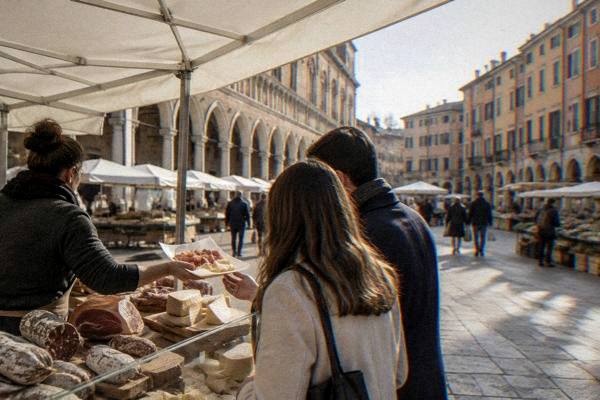
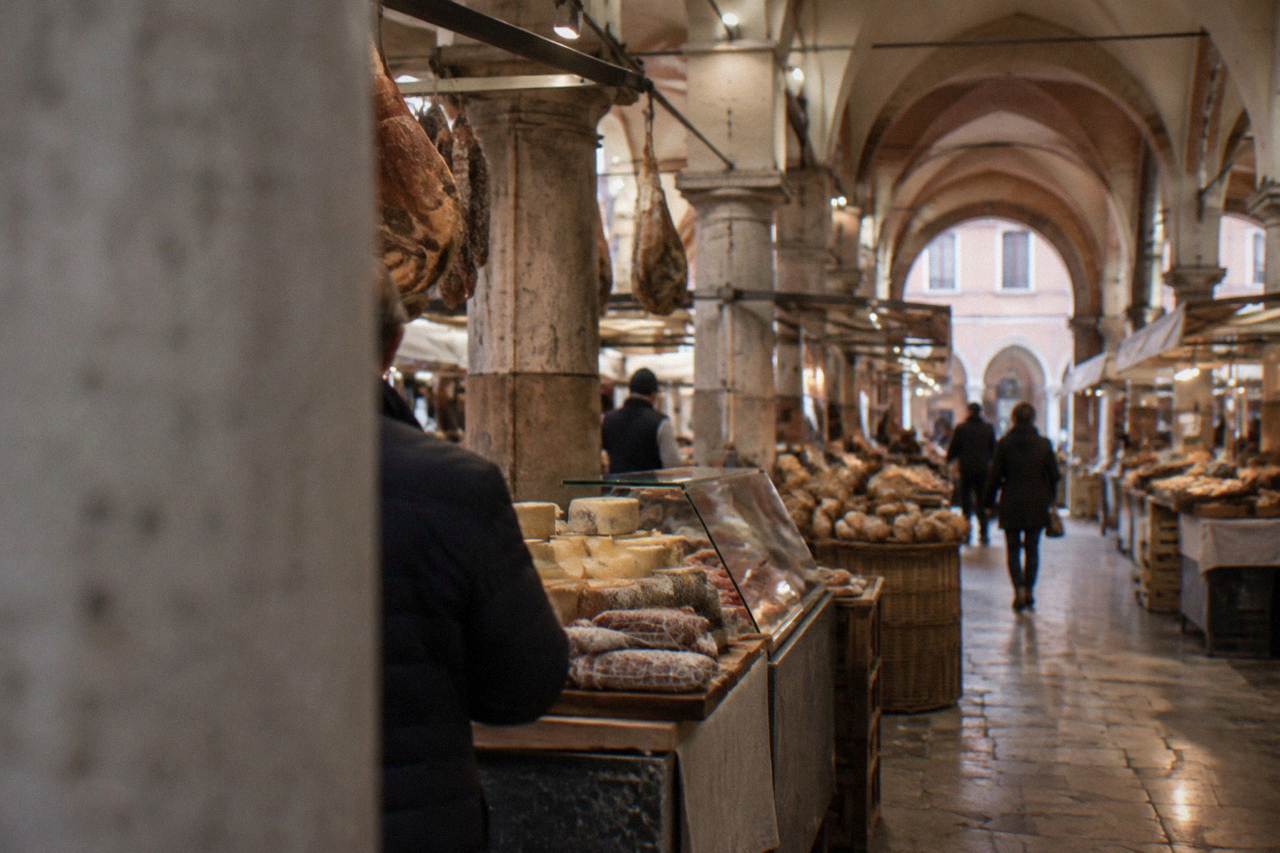
Padua shops for food in a chain of historic markets centred on Sotto il Salone, the permanent market the tourism board describes as having traded under Palazzo della Ragione for eight centuries, plus the daily stalls of Piazza delle Erbe and Piazza dei Frutti and the Saturday market at Prato della Valle, all with published hours on the Comune di Padova's own market page.
Sotto il Salone is the anchor. It sits beneath Palazzo della Ragione, the great hall between the two market squares, and the tourism board presents it as a covered market of local products with eight centuries of trading behind it. The Comune's market page gives the hours that matter for a visit: Piazza delle Erbe, with its 52 stalls of mostly fruit, vegetables and flowers, runs Monday to Friday 7:30 to 13:30 and Saturday 7:30 to 20:00. Piazza dei Frutti runs its food stalls Monday to Wednesday 8:00 to 14:00 and Thursday to Saturday 8:00 to 19:00. Prato della Valle hosts the Saturday market, 8:00 to 19:00 in winter and 8:00 to 20:00 in summer, and the antiques market moves in on every third Sunday of the month.
| Market | Days | Hours | What the Comune lists |
|---|---|---|---|
| Piazza delle Erbe | Mon to Fri, Sat | 7:30 to 13:30, Sat to 20:00 | 52 stalls, mostly fruit, vegetables, flowers |
| Piazza dei Frutti (food) | Mon to Wed, Thu to Sat | 8:00 to 14:00, Thu to Sat to 19:00 | Food stalls |
| Prato della Valle | Saturday | 8:00 to 19:00 winter, to 20:00 summer | Non-food, plants, flowers, fruit and vegetables |
| Antiques market | Third Sunday monthly | 8:00 to 20:00 | Prato della Valle and via Umberto I |
The October calendar adds a food event on top of the permanent market: the Salone dei Sapori ran 11 to 18 October 2026, a week of food and wine specialities tied to Sotto il Salone. For a fuller walk through the shopping side of the city, see the guide to Padua shopping and markets.
A guided walk that moves from market stalls to tastings with a local guide is one structured way to meet this food culture, and the operator's listing says what each option covers. A market tour paired with a hands-on cooking class goes further, shopping the stalls first and cooking afterwards, which suits travellers who want to take a recipe home rather than only eat it.
Why Is Caffè Pedrocchi Part Of Padua's Food Story?
Caffè Pedrocchi belongs to Padua's food story because it opened in 1831 in a neoclassical building by Giuseppe Jappelli, stayed open around the clock as the cafe without doors until 1916, and created a signature drink that is still on the table: the caffè Pedrocchi, a coffee layered with mint that the tourism board lists as the house speciality.
The building is a monument in its own right, and the tourism board's history makes the food connection explicit: this was a cafe that never shut, a gathering place for the city's students and political life after it opened in 1831. The mint coffee is the reason it appears on a food page rather than only an architecture one. The name of the drink and the name of the cafe are the same, and the tourism board treats the pairing as one of the city's edible signatures, in the same breath as its patented recipes. The cafe sits at the edge of the historic centre, a short walk from the market squares that supply the rest of this page.
The food and culture walking tour with tastings is the site's featured way to eat through this list with a guide, and the operator's live listing carries the current price and dates. Check availability before locking a food day into an itinerary, since tasting walks tie themselves to market days and opening hours.
Was The Spritz Invented In Padua?
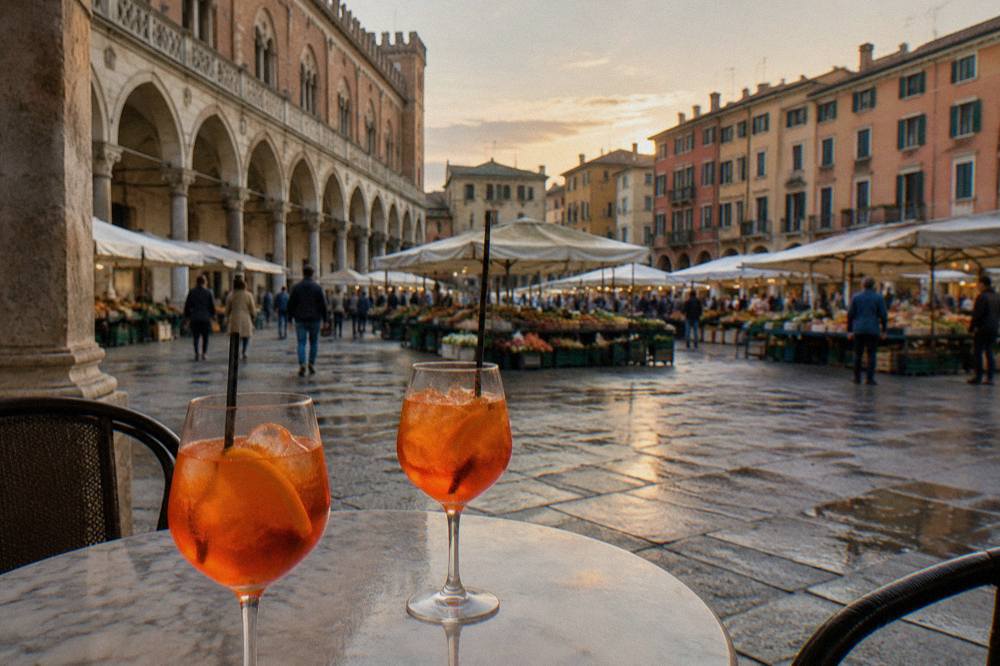
The spritz as a concept was not invented in Padua, but its most famous ingredient was: Aperol was created and first presented in Padua in 1919 by the Barbieri brothers, Luigi and Silvio, at the city's fair, and the drink built on it spread from the Veneto's aperitivo hour to become the region's standard pour, a line the press record and encyclopaedia sources both support.
That is the whole claim, and it is worth keeping precise. The earlier spritz idea, wine cut with something sparkling, predates Aperol and belongs to a broader story; this page prints no origin story beyond the 1919 line. What the sources do establish is that the bright orange bitter itself is a Paduan product, born at the fair in 1919, and that the aperitivo scene around Piazza delle Erbe and Piazza dei Signori is where the city drinks it now. The tourism board's own enogastronomy pages name those two squares as the centre of Padua's evening drinking culture, with spritz and the small snacks that come with it. Name the squares, not the venues: which bar pours what is a matter of taste the sources do not settle.
How Many Days Does A Food-Focused Visit To Padua Need?
A food-focused visit to Padua needs the same one to two days that a general visit needs, because the food sits on top of the sights rather than apart from them: the markets open early, the Scrovegni Chapel and the Basilica of Saint Anthony fill the middle of the day, and the aperitivo squares fill the evening, so a traveller eating well and a traveller sightseeing well are largely the same person on largely the same schedule.
The practical layer supports this. Padua is compact and walkable, the station connects to Venice in about 26 to 40 minutes by train, and the market squares, Palazzo della Ragione, Caffè Pedrocchi and the Santo all sit within an easy walk of one another. The Scrovegni Chapel needs a timed booking made in advance, up to the day before, which anchors the day around a fixed slot. Readers working out the broader arithmetic can start with how many days you need in Padua, and those weighing the city against its neighbours can read what Padua is famous for beyond the table.
What Should A Visitor Actually Order In Padua?
A visitor should order the dishes the tourism board patents, the risotto ricco alla padovana, the capon alla canevera and the torta pazientina, then the standard local mentions, bigoli and baccalà, a caffè Pedrocchi with its mint layer at the cafe that created it, and a spritz built on the Aperol the city produced in 1919, shopping the Erbe and Frutti markets in between and finishing, if the calendar allows, at the Salone dei Sapori food week in October.
That list is deliberately short and entirely sourced. Every item on it traces to the Padua tourism board, the Comune di Padova's market page or the press record for Aperol, and nothing on it depends on a restaurant recommendation, a price or a quality judgement, none of which the sources for this page provide. What a kitchen does with the gallina padovana, or how a pastry shop layers the torta pazientina, varies by cook, and the honest instruction is to order the named dish and let the kitchen answer.
The one date worth flagging for a food-motivated trip is autumn. The Salone dei Sapori ran 11 to 18 October 2026 as its latest edition, an annual event rather than a permanent fixture, and it concentrates the region's producers around the historic market. A traveller whose whole trip is built around eating should check the event calendar against the chosen dates before booking anything else.
Common Questions About Food In Padua
What Food Is Padua Known For?
Padua is known for risotto ricco alla padovana, capon alla canevera made with the gallina padovana, and the torta pazientina, all three named by the Padua tourism board, plus bigoli, baccalà, the mint-layered caffè Pedrocchi and the Aperol spritz, Aperol having been created in Padua in 1919 by the Barbieri brothers.
Where do locals buy food in Padua?
At Sotto il Salone, the permanent covered market under Palazzo della Ragione, and at the daily stalls of Piazza delle Erbe and Piazza dei Frutti, with the Saturday market at Prato della Valle. The Comune di Padova publishes the hours for all of them.
What is the famous drink from Padua?
Aperol, created and first presented in Padua in 1919 by the Barbieri brothers, is the city's famous contribution to the bar, poured as a spritz in the aperitivo squares. Caffè Pedrocchi's signature coffee with mint is the famous non-alcoholic one.
Is Padua good for a food trip?
Yes, as a compact food city: the markets, the historic cafe, the named dishes and the aperitivo squares all sit within walking distance of each other and of the Scrovegni Chapel and the Basilica of Saint Anthony, so food and sightseeing share one itinerary.
When is the food event in Padua?
The Salone dei Sapori, tied to the Sotto il Salone market, ran 11 to 18 October 2026 as its latest edition. It is an annual event, so check the current year's calendar before planning around it.