Does It Snow In Padova, Italy?
Yes, Padua (Padova) gets snow, but not much: about 4.4 snowy days a year on recent averages. What the climate data says and what it means for a winter trip.
Snow does fall in Padua (Italian: Padova), the inland Veneto city about 36 km in a straight line from Venice, but it is a modest event, not a fixture of the season. A long-run climate study covering the Padua area counts about 4.4 snowy days per year over the period 1995 to 2024, down from about 10.4 days a year in the 1785 to 1814 window of the same series. The study also notes that seasons with no snow at all are not uncommon. In short: yes, it can snow in Padua, but a visitor should not plan around it, and should not be surprised by a grey, damp, snowless January either.
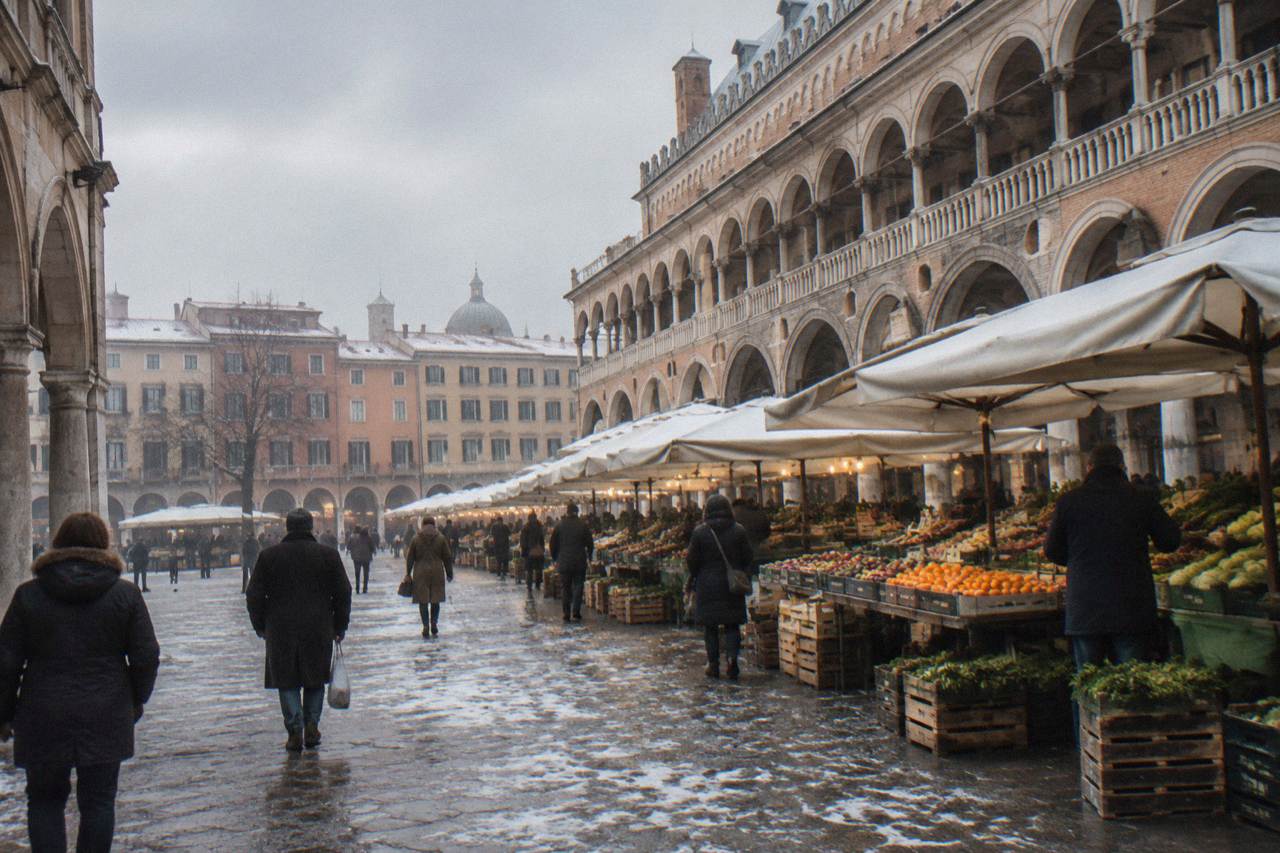
Padua sits on the flat Veneto plain, which shapes its winters more than its latitude does. The ERA5 reanalysis, 1991-2020, for the grid cell at the city centre puts the January mean daily high at 7.3 C and the January mean daily low at -0.2 C: cold enough for frost overnight, rarely cold enough to hold snow on the ground for long. December and February sit in the same band. When snow does fall, the same plain that lets damp fog settle in winter usually means it melts within a day or two. Readers weighing Padua against other northern Italian cities can start with is Padua worth visiting before letting the weather decide.
Does It Snow In Padova, Italy?
Yes, it snows in Padova, but lightly and infrequently: the long-run climate series for Padua reports about 4.4 snowy days per year over 1995 to 2024. Snow here is an interruption to a grey, damp, cold season rather than the season itself, and what falls rarely stays on the ground for long.
The figure comes from a climate study of the Padua area published at mdpi.com, which reconstructs snow days far back into the record using documentary and instrumental sources. The comparison its authors draw is stark: about 10.4 snowy days a year in the 1785 to 1814 window, against about 4.4 across 1995 to 2024. Padua's snow has been thinning for a long time, and the study explicitly flags that winters with zero snow days now happen. So the honest framing for a traveller is probabilistic. A January or February visit might coincide with a dusting on Piazza delle Erbe or the statues ringing Prato della Valle's canal. Statistically it more likely will not.
What kind of snow, when it comes? The city's position matters. Padua is inland on the Veneto plain, about 36 km in a straight line from Piazza San Marco in Venice, and it is not on the lagoon, the coast or a lake. Plain cities in this region get their winter precipitation mostly as rain and fog, with snow arriving when a cold outbreak from the north coincides with moisture. The result, when it works, is a light cover rather than a Alpine-style dump. When it does not, you get the other Paduan winter: 7 C, damp air, and the arcaded streets doing exactly the job they were built for.
How Cold Does Padua Get In Winter?
Mean daily highs run 7.3 C in January, 9.4 C in February and 7.8 C in December, with mean daily lows of -0.2 C, 0.6 C and 0.7 C in the same months, per the ERA5 reanalysis, 1991-2020, a modelled grid cell at the city centre rather than a weather station. That is frost-overnight, coat-in-the-day cold, not deep-freeze cold.
| Month | Mean daily high | Mean daily low | Rain |
|---|---|---|---|
| December | 7.8 C | 0.7 C | 69.9 mm |
| January | 7.3 C | -0.2 C | 53.6 mm |
| February | 9.4 C | 0.6 C | 57.9 mm |
Two readings of that table matter for packing. First, the overnight lows hover at freezing, which is where frost and the occasional snowflake come from, but the daytime highs climb above it every month of winter. Second, winter is not the rainy season here: December through February carries the three lowest rain totals of the year, with January at 53.6 mm the lowest of all twelve months. The heavy precipitation months are November (114.0 mm), September (105.5 mm) and October (105.4 mm). A winter day in Padua is more likely dry than a November one, whatever the thermometer says.
The practical translation: layers, a real coat for the evening, and shoes that can handle damp paving. The city's famous arcades, the covered Sotto il Salone market under Palazzo della Ragione and the café culture around Caffè Pedrocchi (opened 1831, per the tourism board's history of it) are the reason cold here is more bearable than the raw numbers suggest. For orientation before a first trip, what is Padua famous for covers the ground.
Does Snow Ever Disrupt Travel In Padua?
Serious snow disruption is rare in Padua, given about 4.4 snowy days a year in the recent record and falls that usually melt within a day or two, but even light snow can briefly gum up a flat plain city where trams, bikes and scooters do much of the daily work, so it pays to keep schedules loose on snow-warning days.
The transport backbone takes ordinary cold in its stride. Trains run from Padova to Venice in about 26 to 40 minutes and to Vicenza in about 16 to 25 minutes on the Venice-Milan line, and high-speed services call at the same station. The urban network centres on tram line SIR1 and city buses, with a 90-minute ticket at EUR 1.70 or a contactless card tap on board. None of that depends on mountain passes or exposed coastal routes. The realistic winter risk is the ordinary one of any northern Italian plain city: a morning dusting, cold rails or roads, and short delays while everything is gritted, rather than closures. More of these guides are collected on Padua Travel Guide.
The day-trip picture is similar. Venice is about 36 km away in a straight line; Verona about 69 km; Vicenza about 30 km. All are plain-and-hill destinations reached by frequent regional trains, not alpine routes. The one structural winter note worth carrying is about Venice itself: the 2026 day-tripper access fee trial ended on 27 July 2026, and no decision for 2027 had been announced, so a winter day trip from Padua should be planned against the current official information, not last year's headlines. And within Padua, the Scrovegni Chapel runs timed entry only, at most 25 people every 15 minutes, and it is closed 16 to 27 November 2026 for the annual fresco inspection, so a late-autumn visit needs that date circled.
Is Winter A Good Time To Visit Padua?
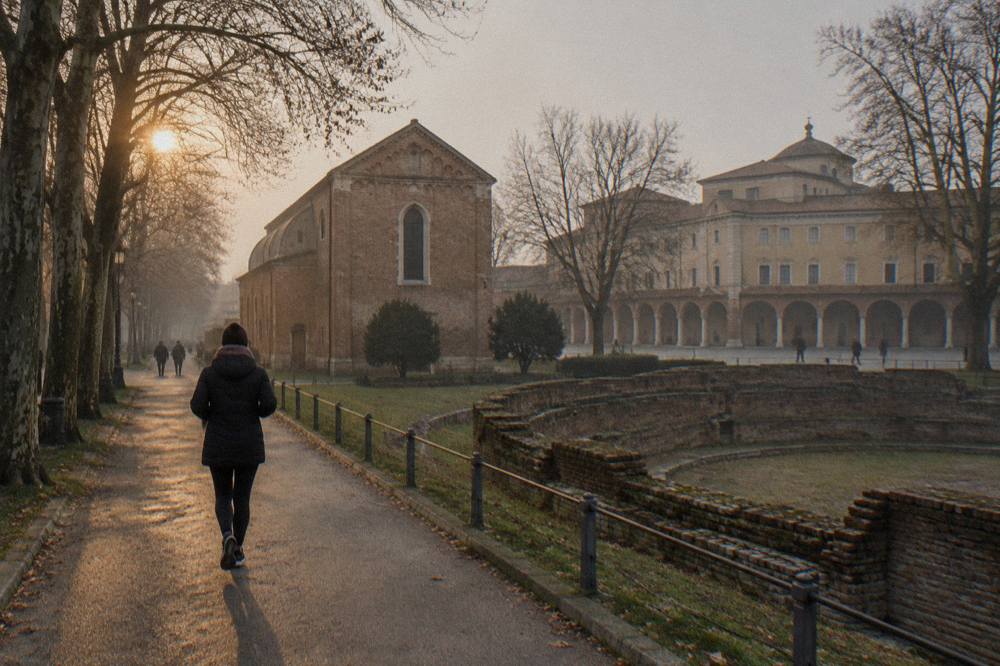
Winter suits Padua well, because the city's core attractions are interiors: Giotto's frescoed Scrovegni Chapel, the Basilica of Saint Anthony with the Saint's tomb, the anatomical theatre of 1594 at Palazzo del Bo and the covered markets are all indoor or arcaded, so a cold day costs a visitor very little of the itinerary, and the frescoes are the same in January as in July.
The Scrovegni Chapel deserves the headline slot on any cold-day plan. Giotto painted the cycle between 1303 and 1305, and the chapel's own booking system manages visits in 15-minute slots with advance reservation; there is no same-day online booking, so a winter trip should be built around a booked slot. The daytime ticket (EUR 15 full, EUR 11 reduced, plus a EUR 1 booking fee) also covers the Musei Civici Eremitani and Palazzo Zuckermann. The Basilica of Saint Anthony is free to enter and holds the Saint's tomb; a dress code suitable for a church applies. The Orto Botanico, one of Padua's two UNESCO listings alongside the fourteenth-century fresco cycles of Padova Urbs Picta, stays open through winter at reduced hours, with a winter ticket at EUR 12 from November to February.
One December date is printed in the calendar: the city's marathon aside (18 April 2027, if you are planning far ahead), winter's fixed point is that the Scrovegni Chapel closes for its fresco inspection, in 2026 from 16 to 27 November. Beyond that, the season belongs to the covered market, the museums and the spritz culture the city claims through Aperol, created in Padua in 1919 by the Barbieri brothers. For a fuller seasonal weighing, how many days do you need in Padua does the arithmetic.
What Should You Pack For A Padua Winter?
Pack for damp cold just above freezing rather than for snow: a proper insulated coat, warm layers, a hat and gloves for evenings that average between -0.2 C and 0.7 C overnight in the core winter months, and waterproof shoes for paved streets that stay wet through much of the season, with snow gear unnecessary beyond perhaps a warm pair of boots you would wear anyway.
| Condition | What the data says | What to bring |
|---|---|---|
| Daytime cold | Mean highs 7.3 to 9.4 C, December to February | Insulated coat, sweater layers |
| Overnight frost | Mean lows -0.2 to 0.7 C | Hat, gloves, scarf |
| Rain | 53.6 to 69.9 mm across the winter months, lowest totals of the year | Compact umbrella, waterproof shoes |
| Snow | About 4.4 snowy days a year, 1995 to 2024 | No special gear needed |
The one packing item the data actually argues for is good footwear. Padua is a walking city of arcades, cobbles and market squares, and a winter visitor will log the kilometres regardless of the weather, because the frescoes, the basilica and the university halls are spread across a compact but not tiny centre. The January question, specifically whether the cold rules out walking, is answered in detail at is Padua walkable.
The indoor anchors are strong enough that even a wet or cool day fills quickly. A guided walk themed on Saint Anthony's life, with an option to extend to Camposampiero, leans on the basilica and its stories, and the colder months are when a slower, church-centred pace makes sense; Check availability on the operator's live listing. The same logic covers the Scrovegni ticket with audio guide and, for the early evening, a spritz tour, since Padua's claim to the aperitif predates its winter weather problems by a century.
Common Questions About Snow In Padua
Does It Snow In Padova, Italy?
What falls usually melts within a day or two.
How cold does Padua get in January?
The ERA5 reanalysis, 1991-2020, gives a January mean daily high of 7.3 C and a mean daily low of -0.2 C for the city-centre grid cell: frost overnight, coat weather by day.
Is winter the rainiest season in Padua?
No. January has the lowest rain total of the year at 53.6 mm, and December and February are nearly as dry. The heaviest rain months are November (114.0 mm), September (105.5 mm) and October (105.4 mm).
Do I need snow boots for Padua?
No. With about 4.4 snowy days a year and daytime winter highs above freezing, waterproof shoes for damp streets are the practical choice; snow boots are unnecessary.
Does snow close the Scrovegni Chapel?
No, weather is not the issue there. The chapel's fixed closure is the annual fresco inspection, which in 2026 runs 16 to 27 November, and entry is always by timed booking, at most 25 people every 15 minutes.
Snow in Padua is a bonus, not a plan. The city's winter identity is damp cold just above freezing, covered arcades, interiors full of fourteenth-century frescoes, and the occasional white morning on Prato della Valle that is gone by lunchtime. Pack for the damp, book the chapel, and let any snowfall be a pleasant surprise rather than the reason you came.
