Is Padua Walkable?
Is Padua walkable? A plain answer from the map and the transport data: how compact the historic centre is, when to hop on a tram, and which sights sit within an easy stroll.
Padua, Italian Padova, is an inland city in the Veneto, northern Italy, about 36 km in a straight line from Venice, and it answers the walkability question better than nearly any city of its size in the region. The computed map data is unambiguous: every city-tier landmark in Padua lies within 3 km of the centre, and the principal sights, the Scrovegni Chapel, the Basilica of Saint Anthony, Prato della Valle, Piazza delle Erbe, Palazzo della Ragione and the Orto Botanico, all stand in or on the edge of a dense medieval street plan wrapped in porticoes. A visitor who books the Scrovegni slot, steps off the train and never opens a transit app will still reach everything the city is famous for. This page lays out what the sources say about walking Padua: how the centre is shaped, where the arcades run, when the tram helps, and which corners reward the shoe leather most, with the practical fares the transport operators publish.
Is Padua Walkable?
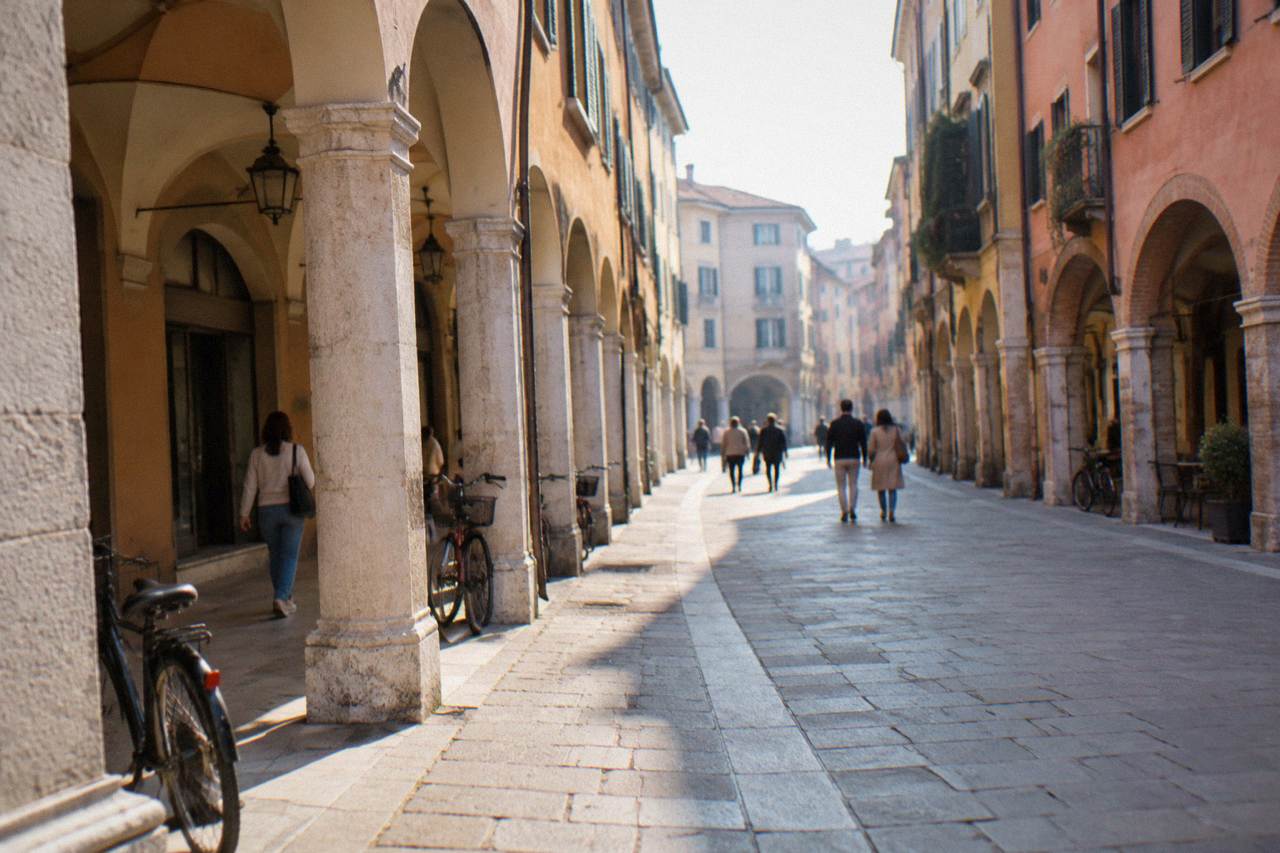
Yes, Padua is walkable to a degree that surprises visitors expecting a car or a full transit day: the computed map data puts every city-tier landmark within 3 km of the centre, the medieval street plan is compact and pedestrian in scale, and the six headline sights, from the Scrovegni Chapel to the Basilica of Saint Anthony, all sit inside or on the rim of that walkable core. Rain, summer heat and the November closure of the Scrovegni Chapel shape when you walk, not whether you can.
That answer rests on geography rather than opinion. Padua's centre grew around its market squares, Piazza delle Erbe and Piazza della Frutta, which the Comune di Padova's own market page shows still trading on medieval patterns: stalls from 7:30 in the morning on weekdays, until 20:00 on Saturdays. The civic museums, the university's Palazzo del Bo, the Caffè Pedrocchi and the Santo all radiate out from those squares in a tight web of arcaded streets. The porticoes matter more than they sound: they are continuous covered walkways, so a shower in a month like November, which the ERA5 reanalysis for 1991-2020 shows as the month with the highest rain total at 114.0 mm, interrupts a walk far less than it would in an open-built city.
The same flatness that makes the city walkable made it a cycling and tram city too. The SIR1 tram line runs north to south through the centre for about 10.5 km with 26 stops, reported by the city's own project documents, and a second line, SIR3 from the station to Voltabarozzo, was in pre-service testing toward the end of 2026, with no opening date to be promised. For a visitor, the walking question is really a question of pacing, which the guide how many days do you need in Padua covers in detail.
How Compact Is The Historic Centre Of Padua?
The historic centre of Padua is compact enough that the walk between the two poles of most itineraries, the Scrovegni Chapel by the station side and the Basilica of Saint Anthony on the south-east side, crosses the entire sightseeing core, and the computed straight-line data still keeps every city landmark within 3 km of the centre point. Prato della Valle, the outermost of the headline sights, sits on the ring of canals and walls that bounds the old town.
Put differently: the shape of a Padua visit is a loop, not a network. You leave the Scrovegni area, pass the Eremitani church, enter the market squares under Palazzo della Ragione, continue to the Caffè Pedrocchi and the university, and finish at the Santo and Prato della Valle, all along streets built before cars. The walls that once enclosed this core still exist as the Mura di Padua, a walking and cycling circuit, and the Porta Portello, the same gate OSM names Porta Ognissanti, marks where the riverfront barge trade once met the city.
The one walk that leaves the core is the one to the Orto Botanico, and even that stays inside the old boundaries. The garden, founded in 1545 and inscribed by UNESCO in 1997, closes on non-holiday Mondays and charges EUR 15 full from the tariffs that took effect on 1 September 2026, EUR 12 in the November to February window. Its own pages publish the seasonal hours, so check them before setting out.
| Journey in Padua | What the sources give | Notes |
|---|---|---|
| Station to historic centre (IAT Stazione exit, platform 1) | Adjoins the core | Tourist office Mon to Sat 9:00 to 19:00, per turismopadova.it |
| Scrovegni Chapel to Piazza delle Erbe | Inside the 3 km landmark radius | Computed straight-line data, places.json |
| Piazza delle Erbe to the Basilica of Saint Anthony | Inside the 3 km landmark radius | Same computed data |
| Centre to Prato della Valle | Outer rim of the old town | Canal ring with a double ring of numbered statues |
| Padua to Venice | 36 km straight line | Day trip by train, not on foot |
That table is the whole argument for walking Padua in one view: nothing on the list requires a vehicle inside the city, and the only distance that does, Venice at 36 km, is a train ride of about 26 to 40 minutes, reported by rail aggregators for the regional service.
Do You Need A Car Or Transit Inside Padua?
No, a car is a liability inside Padua's centre and transit is a supplement rather than a necessity: the urban TU1 90-minute ticket costs EUR 1.70, bought digitally or by tapping a contactless card on board tram or bus, per the operator's own fares page, and the daily ticket is reported at EUR 4.70.
The limited-traffic rules of the historic centre are enforced, and no hours or fine amounts are published, so the working answer is simply: arrive, park outside or not at all, and walk.
The tram exists for the longer hops. SIR1 crosses the city north to south, and its stops include the station end, which helps with luggage on arrival day. The station's left-luggage office at platform 1, open daily 6:00 to 20:00 at EUR 5 per 6 hours, per the tourism board's own page, solves the same problem for EUR 5 if you would rather drop bags and start walking immediately.
Bicycles are the third leg of the system, and the student population rides them hard; the University of Padua counts about 76,000 students, reported by the university itself for the 2026/27 academic year, which is why bike traffic and graduation parties fill the centre. The bike-share picture is in flux, with operator and tariff details unclear, so no operator or price can be named here: check what is running when you arrive.
For the arrival itself, the airport picture is simple. The Busitalia airport bus from Venice Marco Polo costs EUR 13 one-way, runs every 40 minutes through the day and takes about 45 minutes, all per the operator's own service page. Treviso airport has no confirmed direct link in these sources. If flying in and out is your question, is there a train from Venice airport to Padua covers the rail alternatives.
Which Sights In Padua Reward Walking Most?
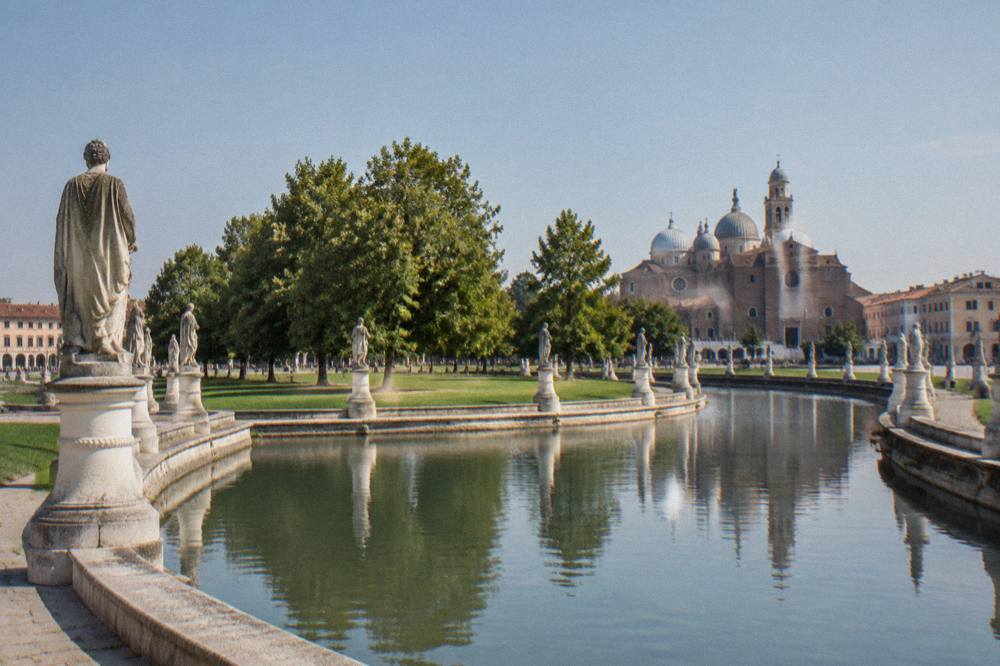
The sights that reward walking most are the ones whose settings are the experience: Piazza delle Erbe and Piazza della Frutta with their daily markets and the vaulted Sotto il Salone food hall beneath Palazzo della Ragione, the porticoed streets around the university's Palazzo del Bo, and the long canal-lined expanse of Prato della Valle, whose double ring of numbered statues was declared communal space by the Venetian Senate in 1767 and rewards a slow circuit rather than a transit pass.
The market squares are the natural anchor. The Comune di Padova publishes the stall hours: Piazza delle Erbe runs Monday to Friday 7:30 to 13:30 and Saturday 7:30 to 20:00, while Piazza della Frutta's food stalls run 8:00 to 14:00 early in the week and to 19:00 from Thursday to Saturday. Saturday adds the Prato della Valle market itself, and every third Sunday of the month the antiques market spreads across Prato della Valle and via Umberto I. None of this is drivable, and none of it needs to be: it is stall-to-stall walking by design. The wider set of guides lives on Padua Travel Guide.
The university quarter adds a different texture. The Palazzo del Bo's guided historical tour, booked through the university's own centre, takes in the Sala dei Quaranta with Galileo's chair, the anatomical theatre inaugurated in 1594 and the statue of Elena Lucrezia Cornaro Piscopia, who graduated in philosophy on 25 June 1678 as the first woman to take a university degree. Galileo held the chair of mathematics here from 1592 to 1610, years he later called the best eighteen of his life, per the university's own history pages. The building is a walk-in stop on any central loop.
The Scrovegni Chapel deserves its own note because walking there is not the constraint, timing is. Entry is strictly by reservation, at most 25 people every 15 minutes, with about 15 minutes inside after a wait in the climate-controlled waiting room, and visitors are told to arrive 5 minutes before the slot at the entrance about 100 m from the chapel. Same-day online booking does not exist. The chapel is closed 16 to 27 November 2026 for the annual fresco inspection. The details live on the Scrovegni Chapel guide, and the history of why the building is also called the Arena Chapel is on why is the Scrovegni Chapel also called the Arena Chapel.
Does Weather In Padua Change The Walking Answer?
Weather changes how a walking day in Padua feels but not whether it works: the ERA5 reanalysis for 1991-2020 gives January a mean daily high of 7.3 C and a mean low of -0.2 C, July and August a mean high of 28.8 C, and November the highest monthly rain total at 114.0 mm against January's 53.6 mm, so the porticoes, which cover long stretches of the central streets, do real work in the wet and hot months alike.
Summer walking rewards an early start, not because of any crowd data but because a 28.8 C mean high means midday walking is simply warm work. Winter is milder than the mountains but damp: long-run climate studies for Padua report an average of about 4.4 snowy days per year in the 1995 to 2024 period, so snow disruption to a walking plan is rare rather than routine. Whatever the season, the two World Heritage listings anchor the indoor options: the Orto Botanico, inscribed in 1997, and the eight frescoed complexes of Padova Urbs Picta, inscribed in 2021, several of which, Palazzo della Ragione, the Baptistery, the Oratorio di San Giorgio among them, sit within a few covered minutes of the squares.
Common Questions About Walking In Padua
Is Padua Walkable?
Yes. The computed map data places every city-tier landmark within 3 km of the centre, the historic core is a compact medieval grid of arcaded streets, and the six headline sights from the Scrovegni Chapel to the Basilica of Saint Anthony all fall inside that walkable radius.
How walkable is central Padua for someone with heavy luggage?
The station adjoins the core, and the left-luggage office at platform 1, open daily 6:00 to 20:00 at EUR 5 per 6 hours per the tourism board's page, lets you drop bags before you start. The SIR1 tram links the station end with the centre if you would rather ride with suitcases.
Do I need public transport to see the main sights of Padua?
No. All the headline sights sit inside the 3 km landmark radius. The TU1 90-minute ticket at EUR 1.70, or the reported EUR 4.70 daily ticket, covers the tram and bus for the longer hops such as returning to the station.
Is Padua flat enough for easy walking?
Yes, Padua is an inland plain city in the Veneto with no hills inside the built-up core. The only climbing in the standard sightseeing day is stairways inside towers and upper floors of museums.
Can you walk to the Scrovegni Chapel from the station?
The chapel's own visitor information puts the ticket office about 100 m from the chapel itself, near the Eremitani museum complex at the station end of the centre, well within the walkable core. The constraint is the timed reservation, at most 25 people every 15 minutes, not the distance.
One Last Look At The Map
Padua's walkability is not a marketing claim, it is a measurement: a 3 km radius that contains every landmark worth the name, porticoes that keep the walk covered, and a tram for the moments feet give out. The visitor who plans around the Scrovegni reservation and then improvises the rest on foot will not go wrong, and the guide to things to do in Padua plus the wider question is Padua worth visiting fill in what to aim those feet at. A guided option exists for travellers who want the loop narrated: the private personalized walking tour of Padua's top sights, with live dates and pricing on the operator's listing, Check availability. For everything else, the city itself is the map, and it fits under a shoe.
